As Westminster voting intention stabilises, have the Greens seen the end of their Polanski surge?
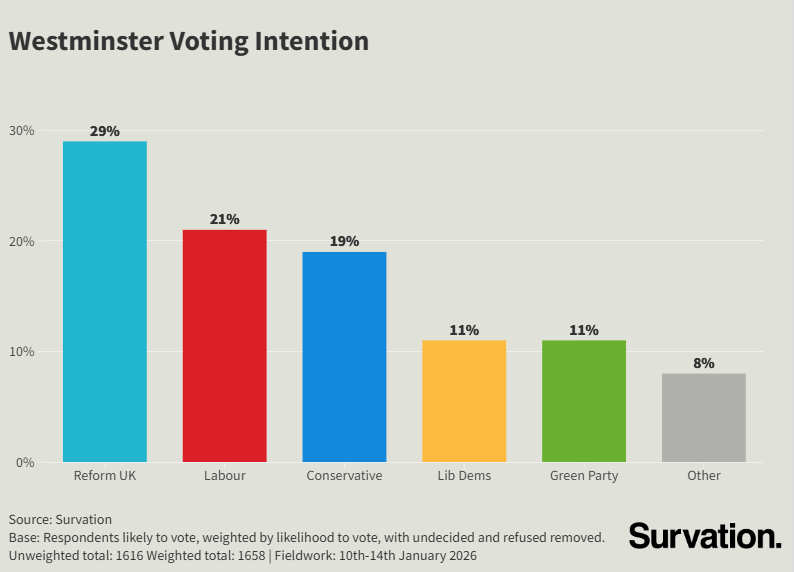
In our first Westminster voting intention polling of 2026, all five parties remain in a similar position to 2025, having seen their prospective vote share remain the same or move by a single point in either direction. Reform UK may have now found their ceiling since taking the lead in the polls several months ago, garnering the support of around 3 in 10 (29%, no change since 29th November). At the other end of the spectrum, the Green Party – who entered double digits for the first time in our November poll – have seen no change on 11%.
With Reform seemingly having achieved their peak, and now settled, have the Greens also reached the limits of their support following a Polanski-boom?
Two-fifths don’t know if Polanski is doing well or not as party leader
Despite achieving prominence since becoming Leader of the Green Party – boosted by the vacuum on the left following the Your Party chaos – just over two-fifths of the general public (44%) do not know if Polanski is doing well or not as party leader. This compares to 32% for Kemi Badenoch as Conservative leader, 22% for Nigel Farage at the head of Reform, and under a fifth (18%) for Keir Starmer as Labour leader.
Additionally, even though he has overseen a rise in the polls and achieved milestones such as being able to boast over 100,000 members – a reportedly 80% increase since his election in September 2025 – only about 3 in 10 (31%) thought he was doing well as Green leader, compared to exactly a quarter who did not. Overall, more think that Badenoch (37%) and Farage (44%) are doing well as leaders of their respective parties, with only Starmer faring worse on 21%.
Whilst such findings will not be music to their ears, what this perhaps suggests is that the modest rise in the polls for the Greens is not necessarily the end of the story. With the data seemingly implying that Polanski is achieving greater cut through with the party’s natural supporter base (72% of 2024 Green voters said he was doing well) there is clearly scope for his leadership to resonate with wider audiences, particularly amongst those with lower levels of education and annual income.
If Polanski can reach this section of the public and sell them a convincing political narrative, then getting the Greens over their current period of stasis is not beyond the realms of possibility.
Likelihood to vote Green on the lower end amongst the general public, but high growth potential remains
When asked how likely it is they would ever vote for a given party, the Greens, at first, appear wanting. Just 33% said it was likely they would ever do so (joint last with Labour), and 56% said it was unlikely (second to Labour on 58%). Whilst it may be reassuring to be ahead of Labour in this respect, when your party has yet to have a track record of national government and has, so to speak, almost entirely been able to campaign in poetry rather than govern in prose, these numbers don’t suggest the groundswell of optimism that is required to bring about hefty electoral impact.
Polanski’s New Year resolution
With the data suggesting that large swathes of the population remain untouched by the recent enthusiasm for the Greens and Polanski’s leadership, they seemingly have a greater potential to grow than most of the other major parties. Gaining salience amongst those groups is of course not the only answer – but it is the essential starting point for a party looking to move beyond its grassroots and wield real influence. If Polanski can translate his success amongst would-be Green members to success amongst would-be Green voters, then 2026 could see real gains for the party.
—
GET THE DATA.
Survation conducted an online poll of 2,006 adults aged 18+ in the UK on their voting intentions. Fieldwork was conducted between 10th–14th January 2026. Tables are available here.
________________________________________
Survation. is an MRS company partner, a member of the British Polling Council and abides by their rules. To find out more about Survation’s services, and how you can conduct a telephone or online poll for your research needs, please visit our services page.
If you are interested in commissioning research or to learn more about Survation’s research capabilities, please contact John Gibb on 020 3818 9661, email researchteam@survation.com, or visit our services page.
For press enquiries, please call 0203 818 9661 or email media@survation.com
< Back