Buyer’s Remorse? Where public opinion stands 10 years after Brexit
A decade on since the country voted to Leave the European Union on the 23rd of June 2016, public opinion has shifted decisively away from the choice made ten years ago. In the run up to the anniversary of the referendum, Survation conducted a poll of 10,024 respondents between 19th May and 1st June to examine people’s attitudes and beliefs about Brexit 10 years after the referendum, followed by a qualitative panel to explore these views more in depth.
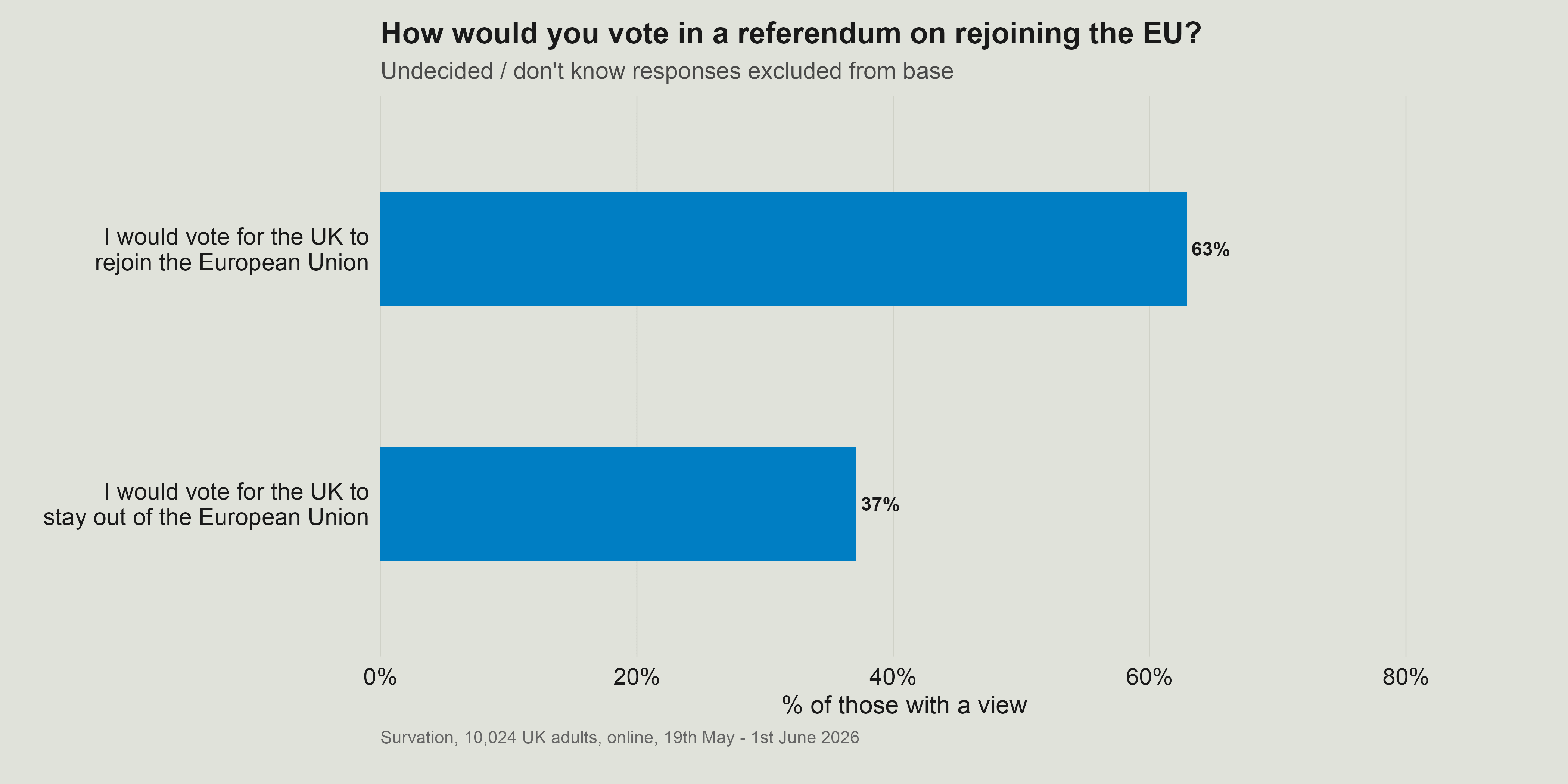
If a referendum on EU membership were held tomorrow, 55% of those who would vote in a new referendum would vote to rejoin the EU against 32% who’d vote to stay out, with 13% still undecided. If we focus only on those who have decided one way or another, the picture sharpens further to 63% who would vote to Rejoin vs 37% who would stay out of the EU.
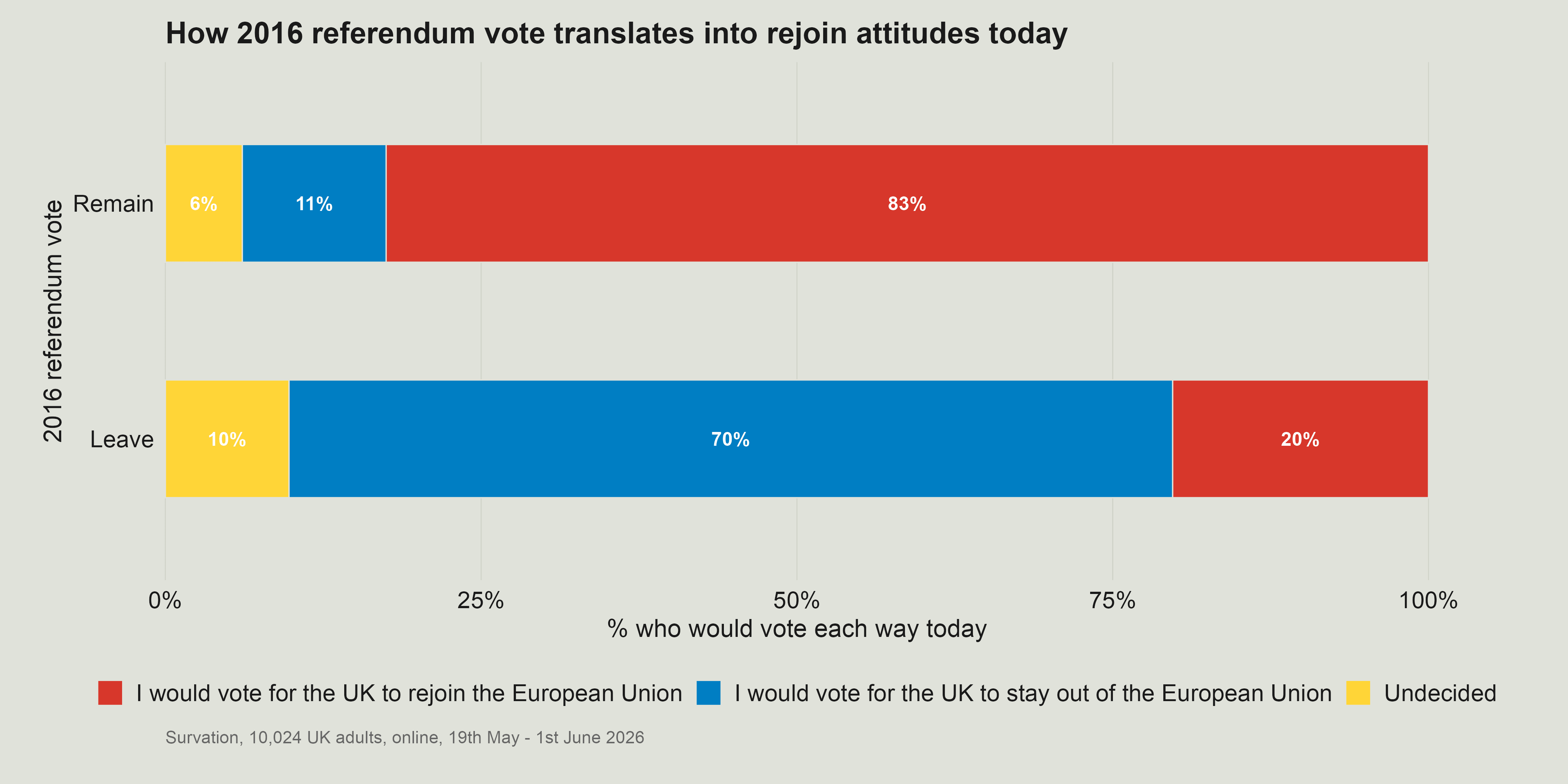
Ten years on, those who voted for Remain in 2016 have barely shifted. Eight in ten (83%) would vote to Rejoin if a referendum were held tomorrow, while only one in ten would now back staying out of the EU. Leave voters are a different story. 70% would still vote to stay out, but one in five (20%) have swung the other way and would now vote to rejoin, meaning the winning coalition of 2016 is less unified today than the Remain one.
Yet a hypothetical vote only captures part of the picture. Ten years on, Brexit continues to shape people’s identities and their hopes for what comes next.
Brexit 10 years on: attitudes and identities
Most people who want Britain back in the EU don’t expect it to happen. Among all respondents, 39% would prefer the UK to have rejoined the EU as a full member within the next five years, but only 16% actually expect it to happen. The same pattern shows up in reverse for the more cautious options: just 29% want the UK to stay outside the EU with a much closer relationship than today, yet 35% expect that’s how things will end up, and only 20% want a relationship broadly similar to today’s against 33% who expect it.
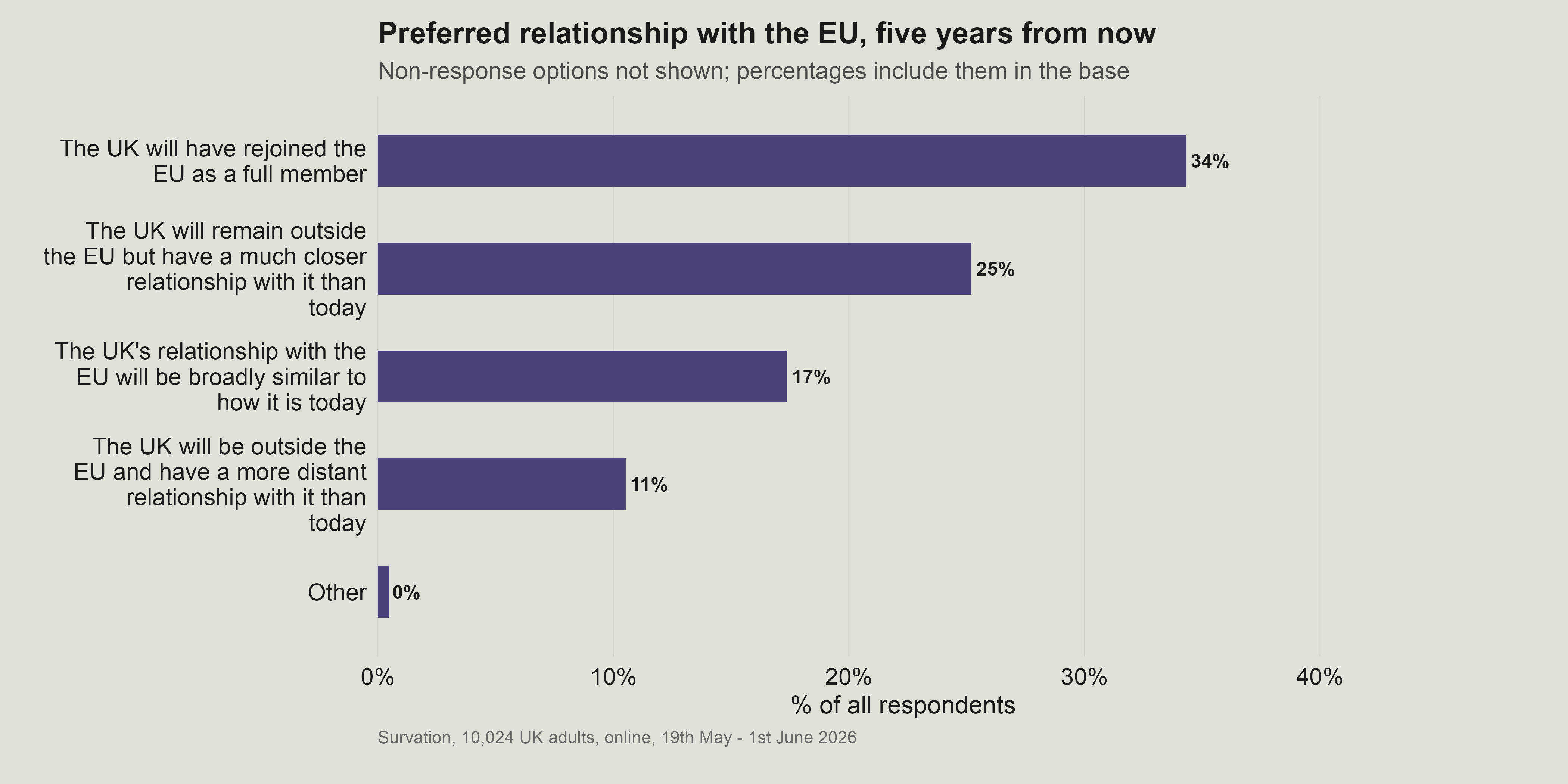
Hope and expectation pull in opposite directions when considering the 2016 vote, and the gap is widest among those who voted Remain in 2016. Remainers do want to rejoin the EU but they have largely made peace with the idea that this will not happen in the near future. One participant in our qualitative panel who voted Leave in 2016 and would now vote to rejoin captured that exact split when asked what Britain’s relationship with Europe will look like in ten years’ time:
“Hopefully: We are allowed to rejoin the EU and regain some credibility, our MPs etc get themselves into gear and try to work for us for once, we become influential within the EU. Realistically: We are likely to be still debating and negotiating deals.”
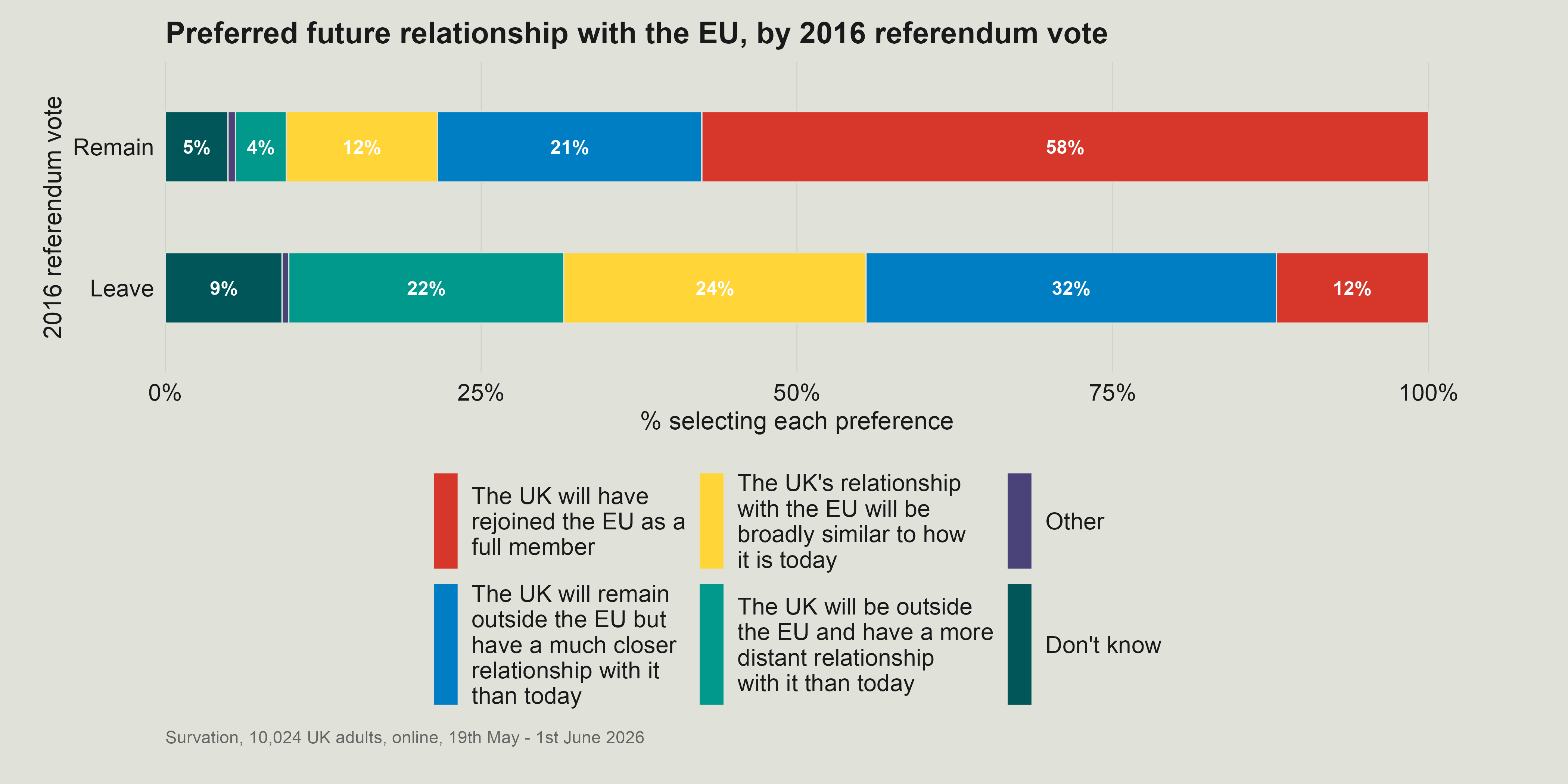
The Leave-Remain divide runs just as deep when it comes to what people actually want five years from now. The majority (58%) of 2016 Remainers want to see the UK back in the EU by then, compared with just 12% of Leavers. Leavers aren’t united behind a single alternative, though, as one in three (33%) still want to stay outside the EU but build a much closer relationship than exists now (a position only 21% of Remainers share). Smaller shares on both sides (24% of Leavers and 12% of Remainers) are happy with something close to the current status quo, while 22% of Leavers would rather see the UK drift even further from Brussels.
How Durable are Brexit Identities?
The 2016 Referendum did something relatively unusual for British politics by producing not just a polarised result, but an identity that people held onto for years to come. Political scientists have documented how “Remainer” and “Leaver” became social labels that people adopted far beyond the vote itself, and shaped how people viewed and interacted with each other. It also resulted in political realignments which left their mark on British politics in the 2017 and 2019 General Elections. Ten years on, the question remains how durable those identities still are.
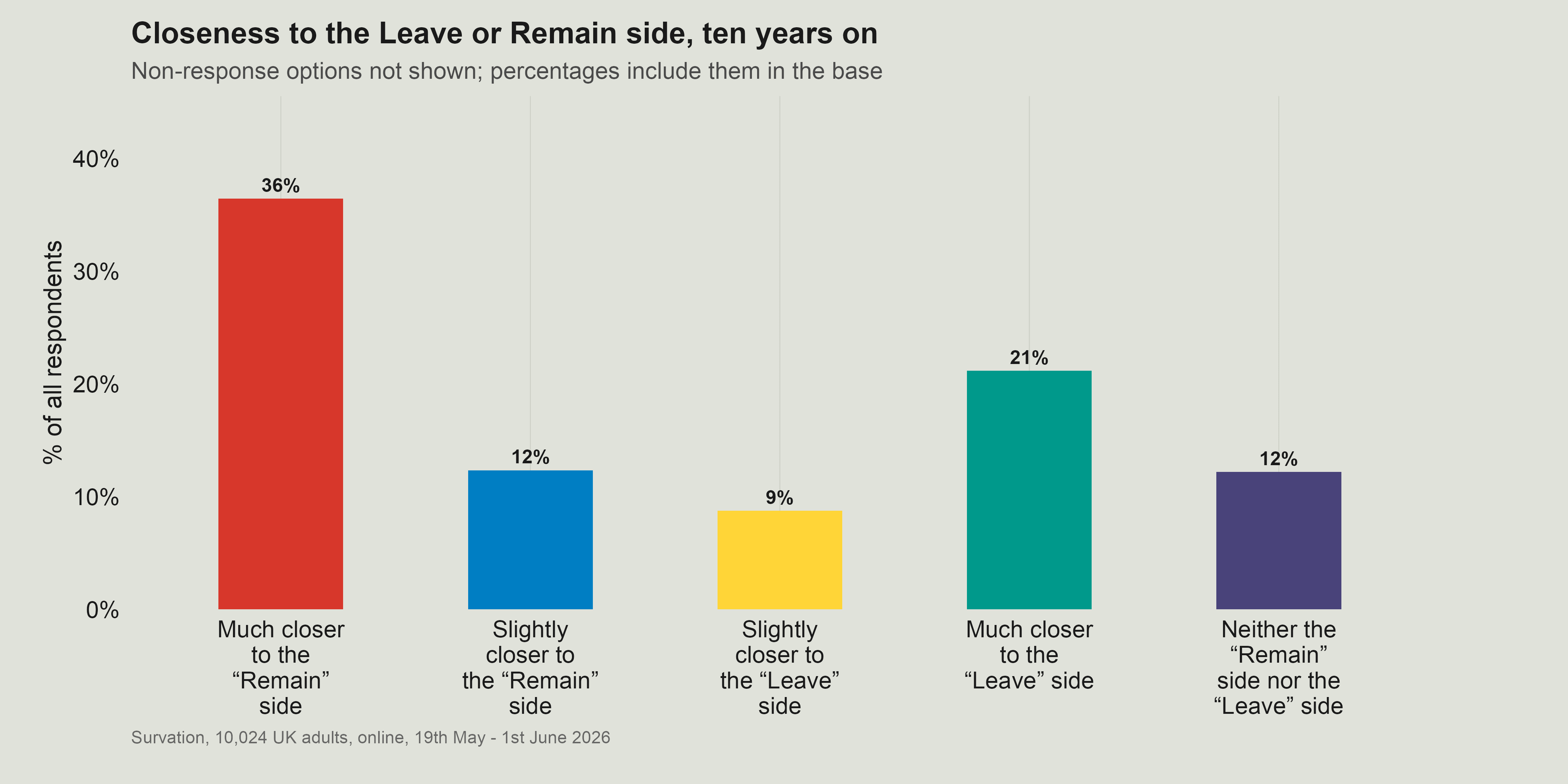
Overall, 36% of the public feel much closer to the Remain side and another 12% feel slightly closer to it, against 12% who feel much closer to Leave and 21% who lean towards it more mildly.
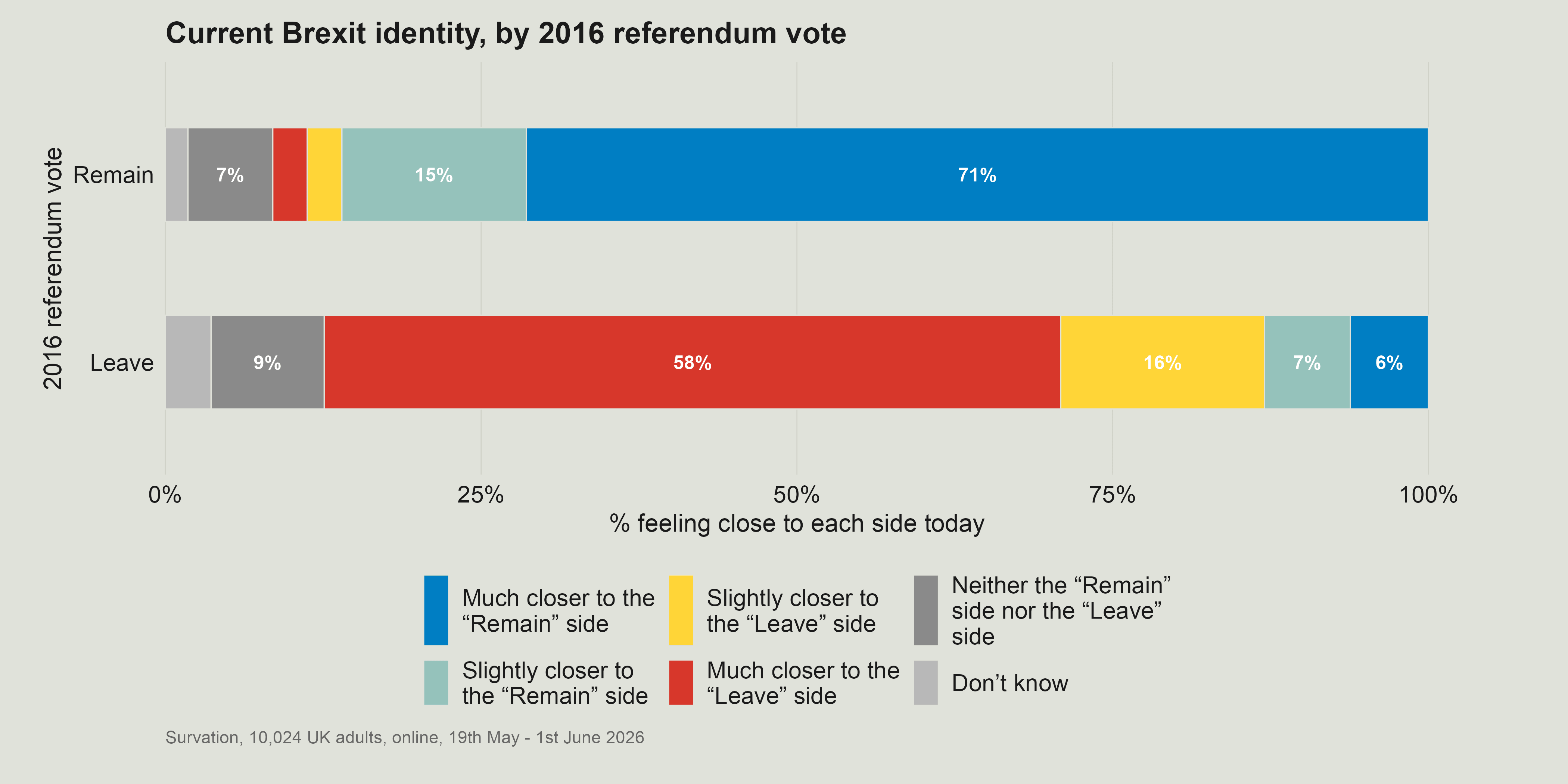
That gap becomes even clearer once we connect current identity back to how people voted in 2016. Seven in ten (71%) of 2016 Remainers still feel much closer to Remain today, but only 58% of 2016 Leavers feel as strongly attached to Leave now – a sizeable erosion of conviction on one side that hasn’t happened on the other, at least to the same extent. There has also been some asymmetrical movement across the old divide, with 13% of 2016 Leavers now feeling slightly or much closer to Remain, compared with 9% of Remainers who have drifted towards Leave.
In our qualitative panel, one account helps explain where some of that drift comes from: this respondent voted Leave in 2016, but their reasoning was narrow and practical rather than tied to a wider sense of identity, and a decade of mismanagement has been enough to push her away from the side she once voted for:
“I voted leave as I wanted rid of another layer of MPs, the fewer of the overpaid bureaucrats the better. However, our negotiators have totally messed up the leaving process and the EU have been punitive… I would vote remain now as better the devil you know.”
The 2016 vote had an age gradient – the youngest groups broke heavily for Remain, while the majority of those aged over 65 voted to Leave. That divide hardened into one of the sharpest dividing lines in British politics, and it carried an uncomfortable implication: young voters felt misrepresented by an outcome that older generations had voted for on their behalf, and those not yet old enough to vote in 2016 would have to live with the consequences the longest.
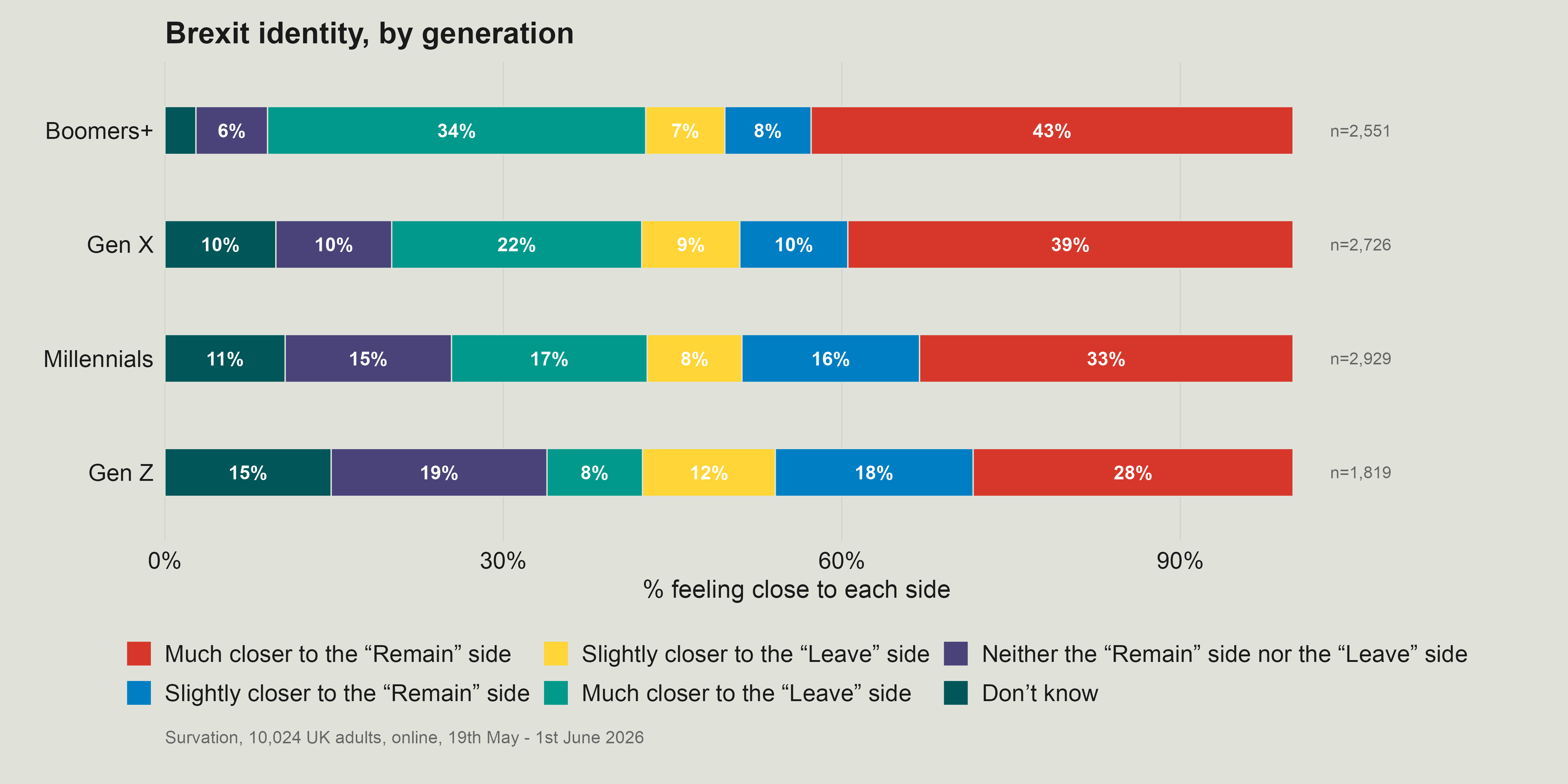
A decade on, a new cohort of voters has come of age. Those too young to vote in 2016 are now in their twenties and most of them have already had an opportunity to vote in a General Election.Yet their attachment to either side of the Brexit divide is markedly weaker than the rest of the population. Rather than inheriting the Leave and Remain labels that were so prevalent in 2016, many still feel little pull towards either side. Gen Z adults have the highest proportion of undecided responses (15% don’t know and 19% feeling closer to neither the “Remain” nor the “Leave” side), while 46% feel much closer or somewhat closer to the Remain side and 20% to the Leave side. The intensity of these identities rises from generation to generation, with Boomers and older people registering 51% closer to the Remain side and 41% closer to the Leave side. It suggests that Brexit, once the defining fault line in British politics, may be loosening its grip on those who grew up in its shadow.
The mood, ten years on
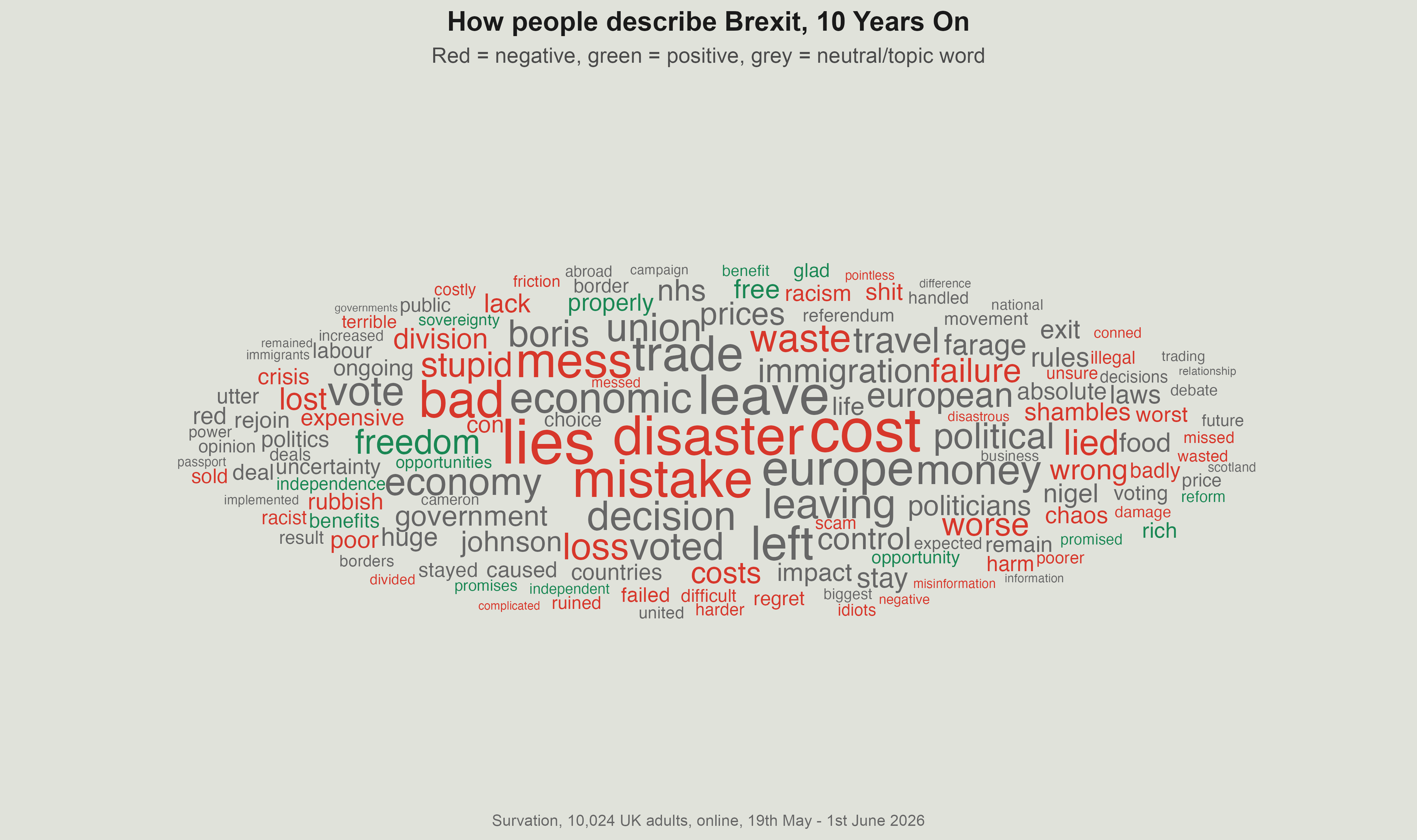
Beyond identity lies mood, and the overall mood around Brexit ten years on is unmistakably sour on both sides of the divide. When asked to describe how they feel about Brexit in their own words, people responded with strong negativity. Of 5,541 sentiment-bearing words, roughly 4,528 were negative (82%) against just 1,013 positive ones (18%), with disaster, mistake, cost and mess among the most common.
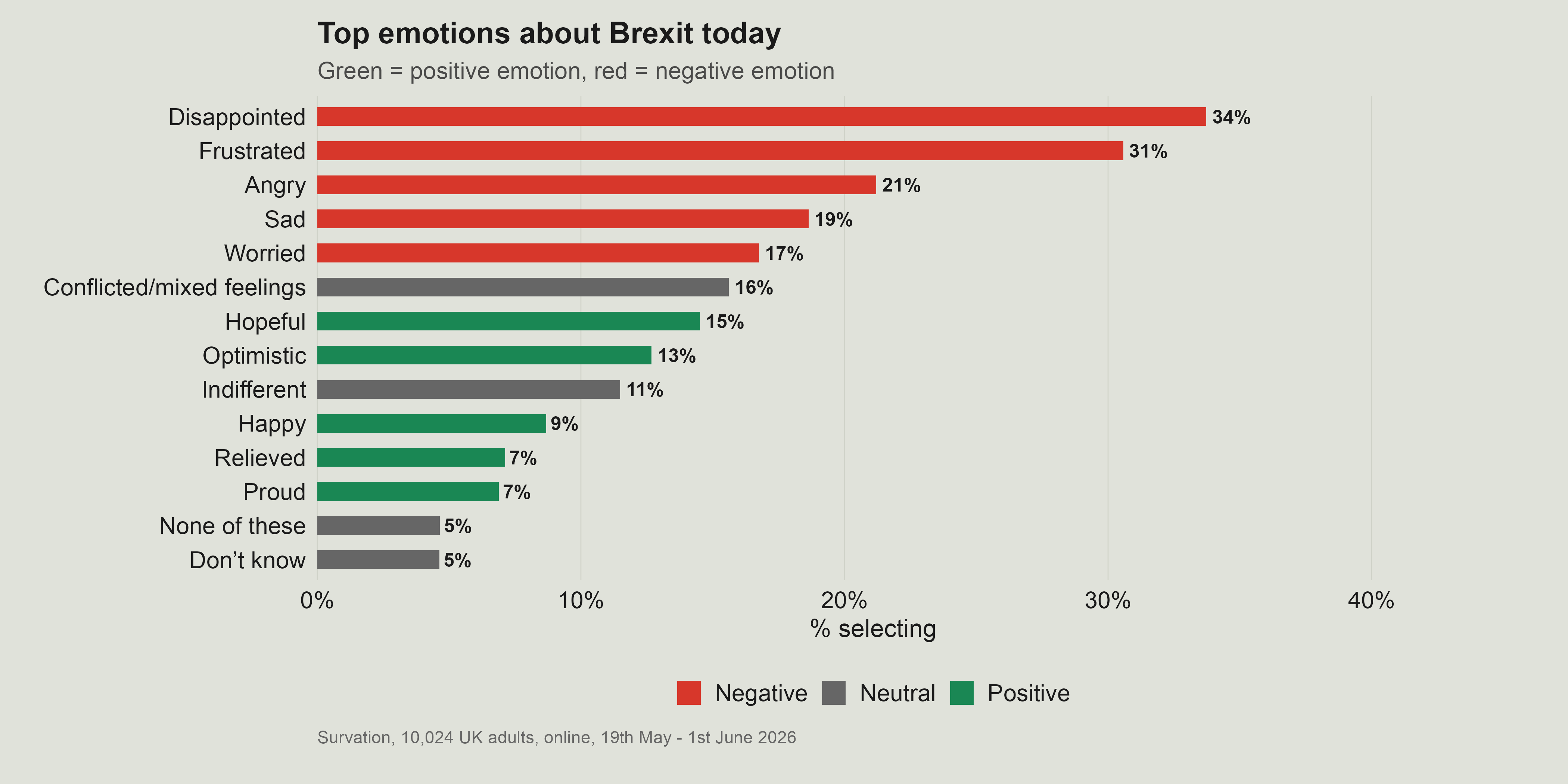
The emotional language tells the same story, with an interesting wrinkle. Disappointment (34% of selections) and frustration (31%) top the list for both Leavers and Remainers alike which marks a rare point of agreement. Where the two camps part ways is in what sits just beneath that shared disappointment: 22% of Leavers are still “hopeful”, while 36% of Remainers indicate that they are “angry” with the result.
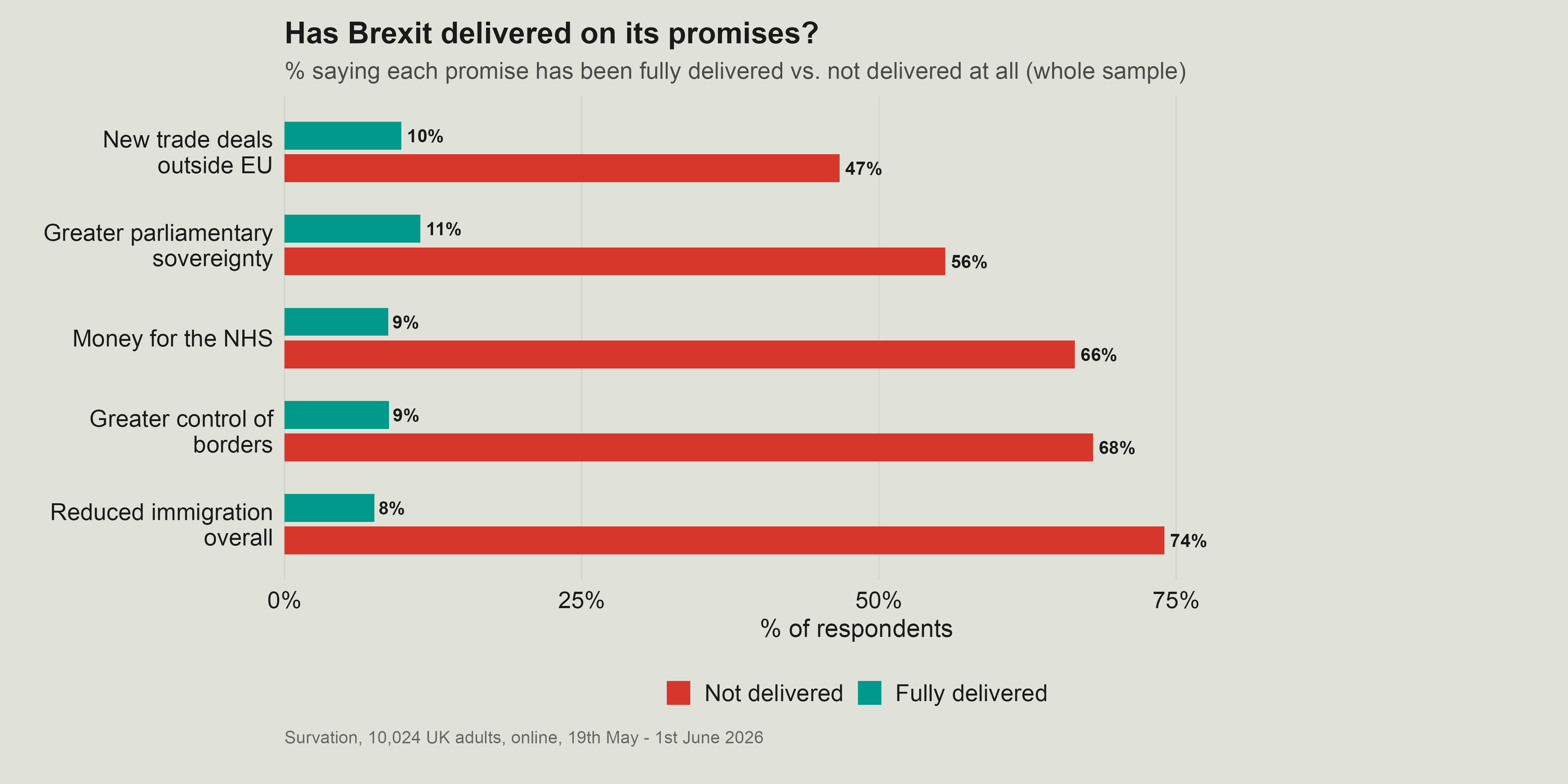
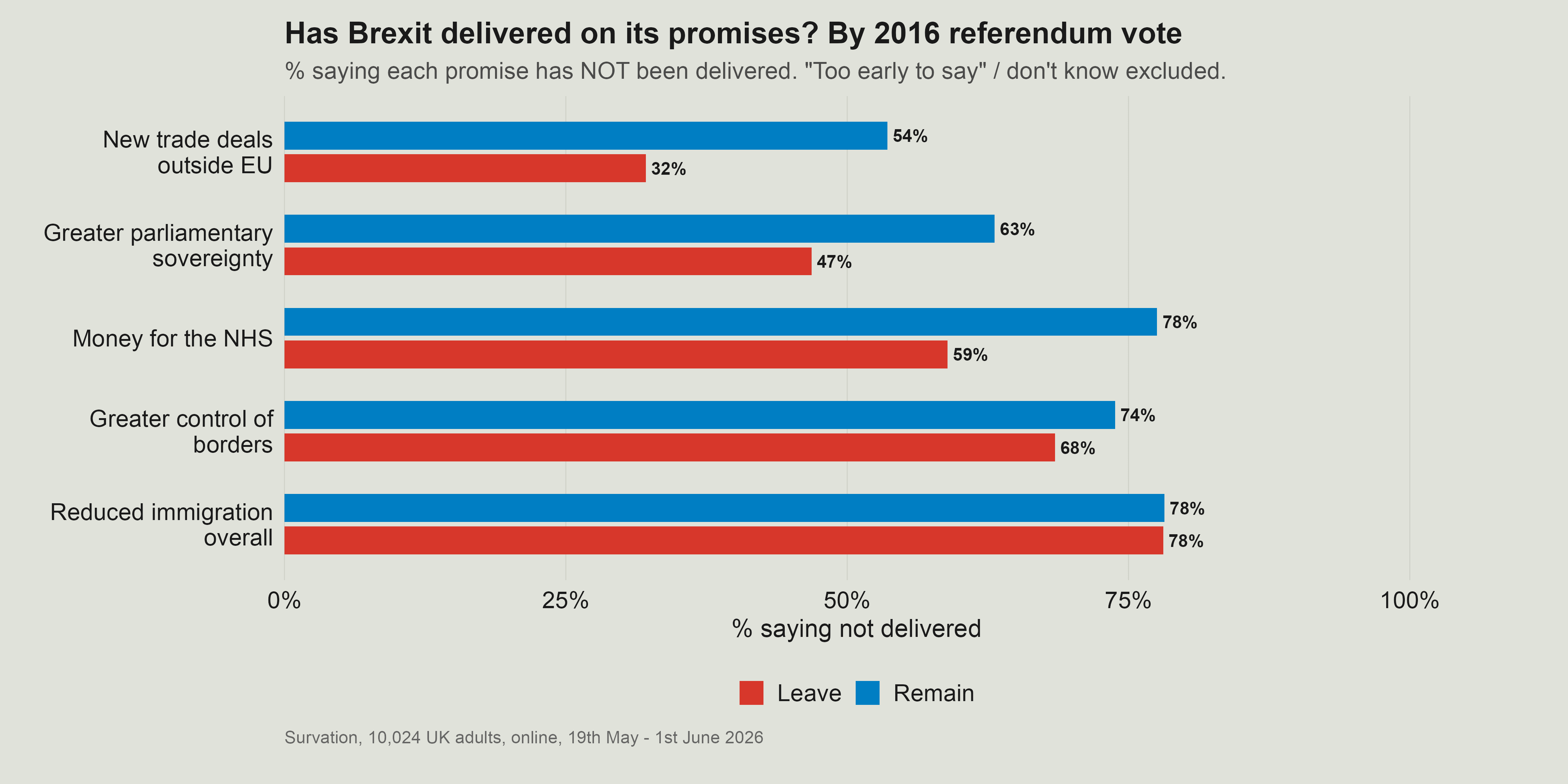
That sense of dissatisfaction extends to the promises Brexit was sold on. Of the five central pledges of the Leave campaign, every single one scored poorly when people rated delivery. The flagship promise of reduced immigration fared worst, with 74% of people saying it has not been delivered. What’s striking is that this isn’t a one-sided verdict: Leavers and Remainers judge delivery just as harshly as each other.
Asked directly whether Brexit had delivered on its promises around the NHS, immigration and sovereignty, a Leave voter from our qualitative panel put it bluntly:
“No, the NHS is worse than ever and immigration is at an all time high – no good for the UK or for the people trying to immigrate here. It has been a mess and failure for both.”
Remain voters in the panel reach the same conclusion from the other side of the divide. One of these respondents, who describes themselves as a remainer wanting their EU citizenship back, was just as unequivocal:
“No, nothing has been delivered. The true believers of Brexit still blame the EU but they had no plan and why should an organisation offer support to a non-member?”
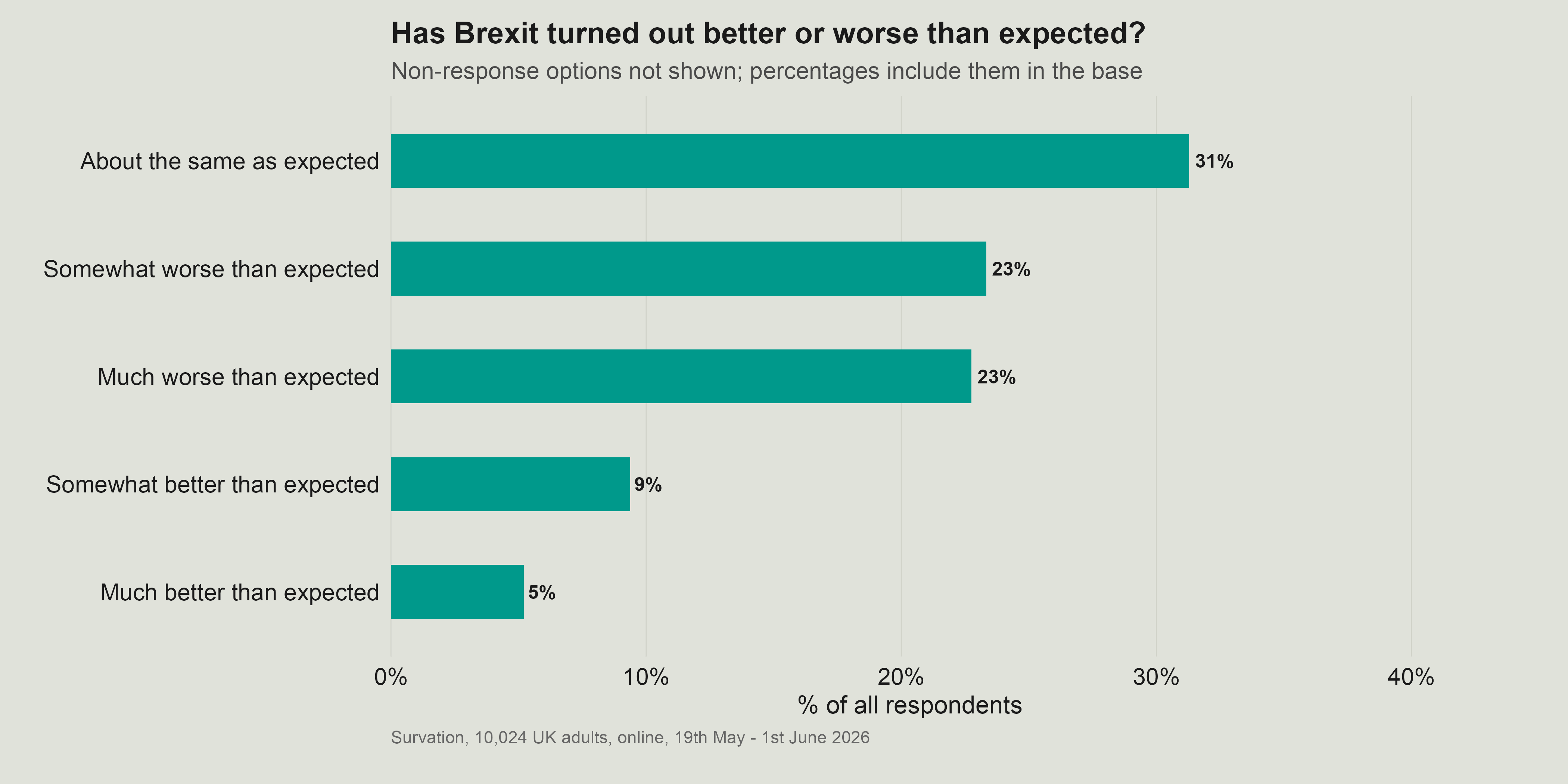
Reflecting on how Brexit turned out a decade after the fact, opinions are split. Overall, a total of 46% think that it turned out much worse or somewhat worse than expected, while 31% think it was about the same as expected. Only 14% believe that it turned out somewhat or much better than expected, signalling disappointment and resignation towards the referendum’s outcomes over the last decade.
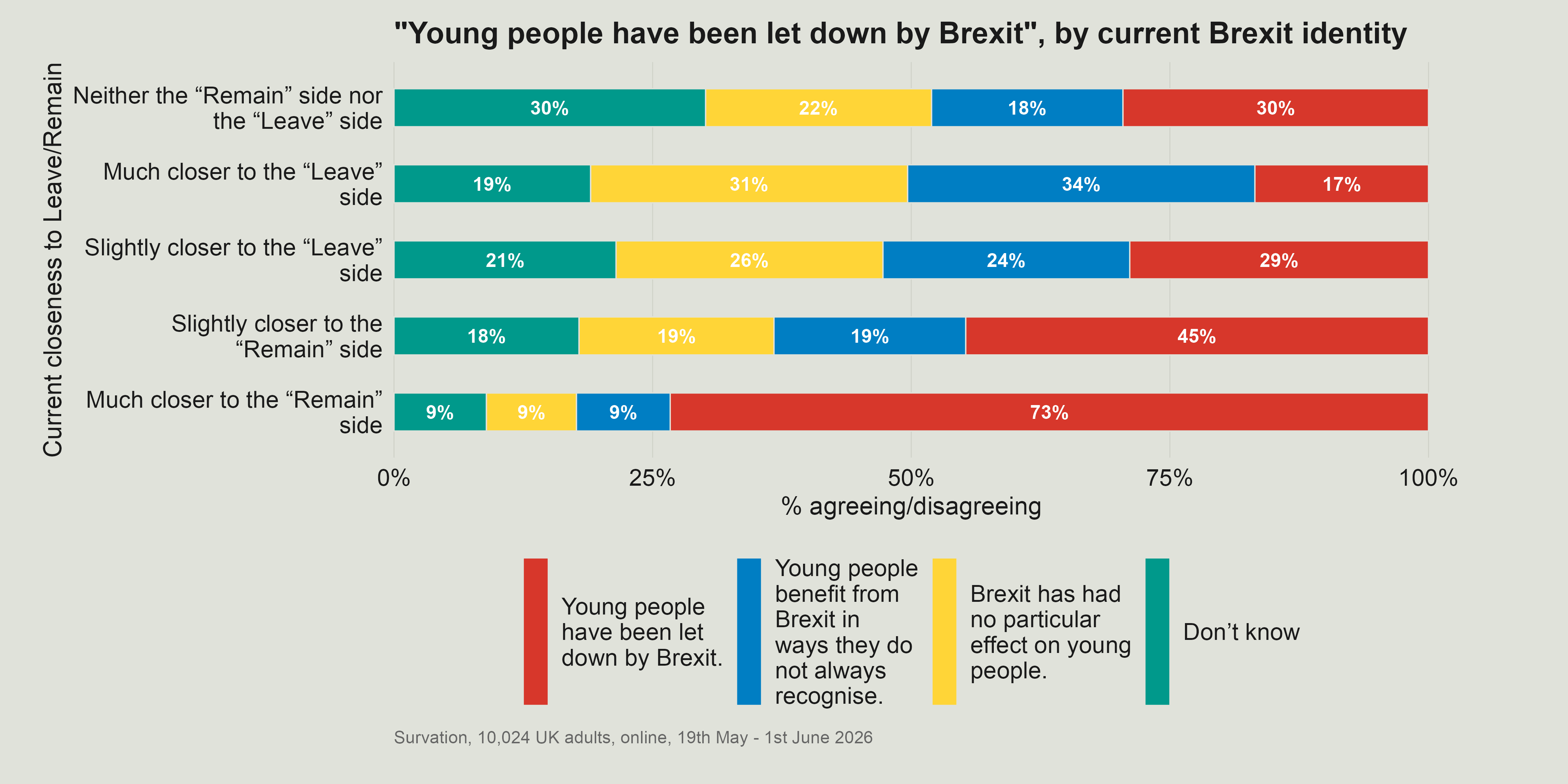
If younger generations feel cooler towards both Brexit identities, older generations are far more certain about who has been failed by the result. Nowhere is the divide sharper than on the question of who’s paid the price. Overall, 44% of people think young people have been let down by Brexit, but that average hides a debate that’s really being fought along identity lines rather than old voting lines. The view is held by 73% of people who feel much closer to Remain today, while everyone else is far more divided.
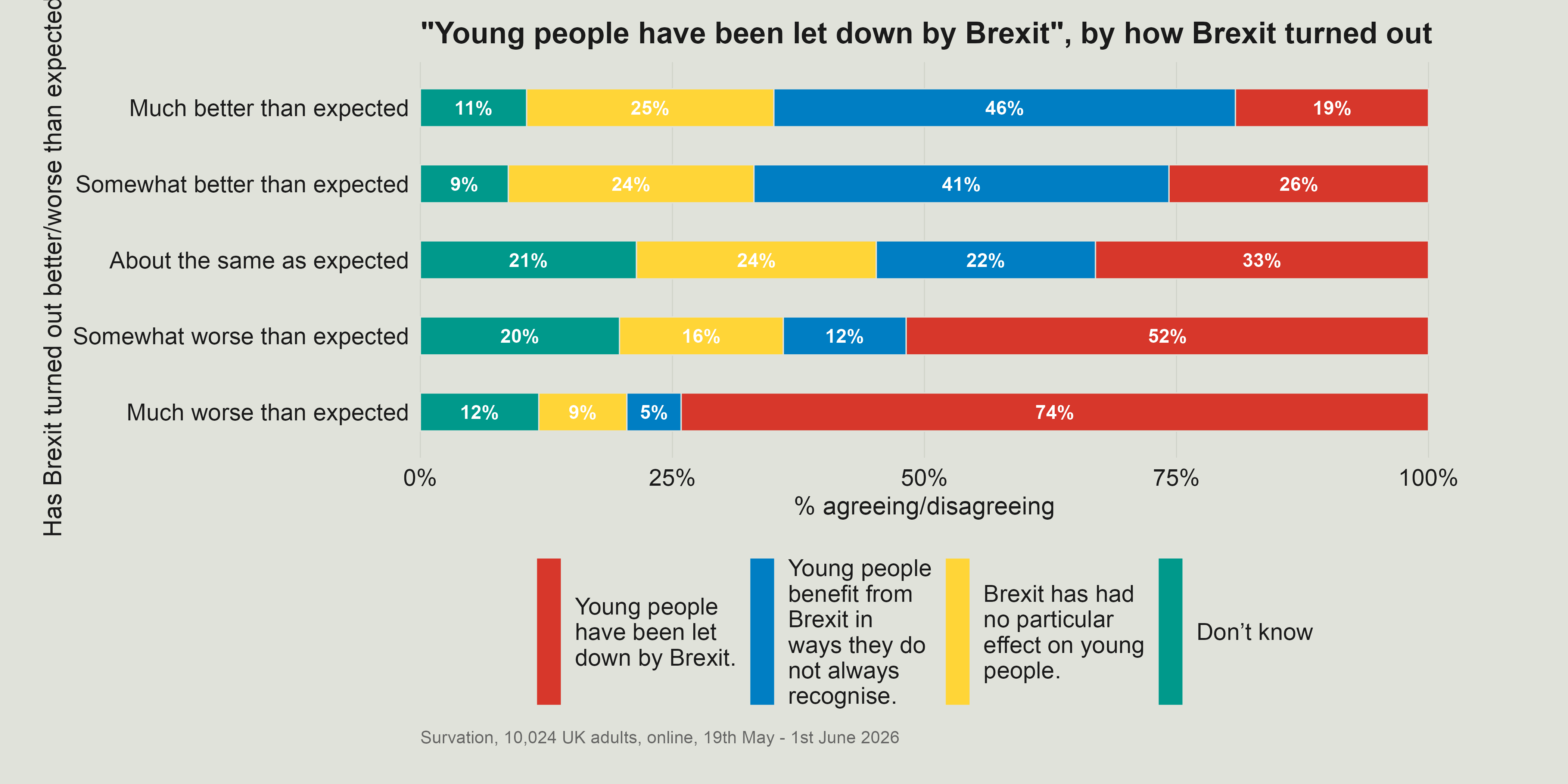
The same divide shows up again when viewed through how people think Brexit has gone overall. Among those who say Brexit turned out much worse than expected, 74% believe young people have been let down by it. Among those who think it turned out much better than expected, that figure collapses to just 19% – and within that more optimistic group, 46% instead believe young people are actually benefiting from Brexit in ways they don’t always recognise.
Asked who deserves the blame for Brexit, three names dominate the answers: Boris Johnson, picked by 38% of respondents, Nigel Farage on 30%, and David Cameron on 29%.
Ten years on, Brexit has stopped being a live argument about whether to leave the EU and has become one about what was lost in the process. The public’s verdict on the decision itself has shifted decisively, but the emotional terrain left behind – the identities, the resentment, the sense that promises were unmet – looks remarkably unchanged. Remain voters have held their ground more firmly than Leave voters, the language people reach for to describe Brexit is overwhelmingly bleak, and there is now rare agreement across the old divide that the country has not got what it was promised.
Coming soon
Want to see our full analysis? In the coming days we will be publishing a full report, drawing on both the survey and our qualitative work. Subscribe to our mailing list here so you don’t miss it.
________________________________________
Survation. is an MRS company partner, a member of the British Polling Council and abides by their rules. To find out more about Survation’s services, and how you can conduct a telephone or online poll for your research needs, please visit our services page.
If you are interested in commissioning research or to learn more about Survation’s research capabilities, please email researchteam@survation.com, or visit our services page.
For press enquiries, please call 0203 818 9661 or email media@survation.com
< Back