Labour policies are not cutting through with the general public – nor Britain’s Progressive Majority
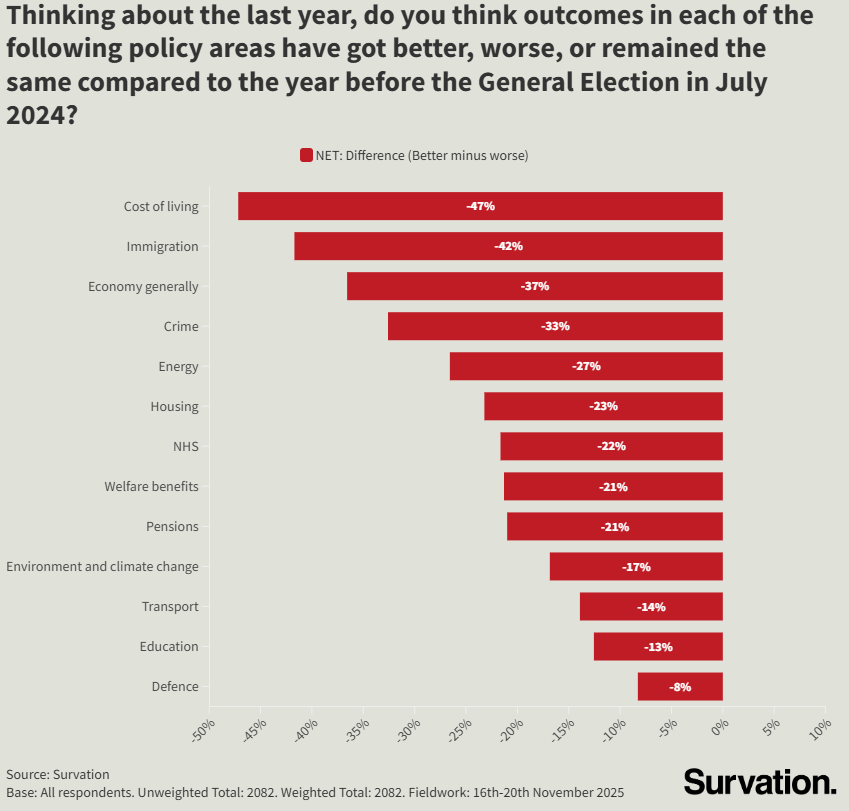
With clear water between Reform UK and Labour in the polls – and two thirds of progressives not backing the governing party – Starmer’s government could hope to turn things around by offering tangible improvements to individuals’ lives and society as a whole. However, the data suggests their policy programme to date has not cut through with the public, with a Labour Party elected on a platform of change perceived as largely upholding the status quo, or even overseeing a decline. With the nation more likely than not to declare that outcomes across all policy areas have got worse rather than better since before the 2024 General Election, we decided to hone in on a few of Labour’s recent policy announcements.
Labour’s perception problem
In four of five areas put to Brits, a majority when combined think these policy areas under the Labour government have either stayed the same since they took office or got worse. Take NHS waiting lists. Despite improvements since coming to power, and their own proclamations, nearly 4 in 10 (38%) think the waiting lists have increased, with an almost equal number believing they have stayed the same (37%). Just 14% believed that waiting lists had decreased under the Labour government. Perceptions were slightly better amongst Britain’s Progressive Majority, but not significantly so – 17% thought the lists had decreased, though a 42% plurality reported that they had stayed the same.
Such a story is replicated elsewhere. When asked if the government’s digital ID scheme would make their daily lives more complicated, less complicated, or neither, 35% of respondents thought the policy would make things more complex, with just 15% believing their lives would become less complicated as a result. The largest proportion (38%) thought it would make no difference. Again, perceptions amongst progressives were improved, but only marginally so. The message that the scheme will “make your life easier” has fallen on deaf ears.
When it comes to social housing, those believing the amount had decreased (23%) were only slightly more than those who felt it had increased (21%), with once again a much larger number reporting that the amount of social housing had stayed the same (37%). In this policy area, progressives diverged most from the general population, with almost 3 in 10 saying that social housing had increased (27%) and 18% perceiving a decrease. However, 41% remained convinced that nothing had changed. Whilst announcing boosts to social and affordable housing investment, this is clearly yet to translate into a shared view amongst the public that more homes are actually being built.
The Miliband effect?
The one area forming something of an exception is Britain’s nuclear energy capacity. Despite a plurality (36%) perceiving no change, in close second were those who thought nuclear energy capacity was expanding (30%), and just 10% perceived a decrease. The numbers are even better amongst Britain’s Progressive Majority, where those who viewed the capacity as expanding matched those who reported no change (both on 37%), and a mere 7% said nuclear energy was on the slide.
On a more cautionary note, this policy area had the highest ‘Don’t know’ score of any that we put to respondents, with a quarter (25%) of the general public and a fifth of progressives (18%) not holding an opinion. So, whilst it’s the area where rosier perceptions are most likely towards government policy, there is a large swathe of the public for whom the message is not getting through to at all.
One can only speculate as to why nuclear energy has managed to attain what other policy areas have not, even if achievements here remain somewhat modest. Perhaps Labour has simply banged the drum loudly enough – and often enough – on Great British Energy since coming to power that the message has seeped into public perceptions. Since our poll, the prime minister’s “strategic steer” towards nuclear will likely reinforce the view that the government intends to expand capacity.
Alternatively, it may be the personal brand of Ed Miliband, currently Secretary of State for Energy and Climate Change. Nuclear energy has seemingly become a personal crusade for the ex-leader, who has declared the government is delivering a “Golden Age” and was able to shout from the rooftops about plans for a new nuclear power plant going through in Wylfa, North Wales.
The Miliband boost may also help to explain the even better perception amongst Britain’s Progressive Majority. Consistently ranked as the member of the cabinet with the highest net favourability score by Labour members, it is not implausible to believe that he achieves much greater cut through with progressive segments of the electorate compared to others.
Communicating, and landing, the message
Whatever the reason(s) behind better perceptions towards Britain’s nuclear energy capacity, it is clearly the case that Labour lacks a general communication strategy that convinces enough of the public or British progressives that their policies are improving lives and national infrastructure. Even if they implement a policy that leads to measurable benefits in a given policy domain, the public appears not to be registering the change. If perception is reality in politics, that’s a damning indictment of a Labour government that promised to turn this country around.
—
GET THE DATA.
Survation conducted an online poll of 2,082 adults aged 18+ in the UK on perceptions to Labour policies. Fieldwork was conducted between 16th–20th November 2025. Tables are available here.
________________________________________
Survation. is an MRS company partner, a member of the British Polling Council and abides by their rules. To find out more about Survation’s services, and how you can conduct a telephone or online poll for your research needs, please visit our services page.
If you are interested in commissioning research or to learn more about Survation’s research capabilities, please contact John Gibb on 020 3818 9661, email researchteam@survation.com, or visit our services page.
For press enquiries, please call 0203 818 9661 or email media@survation.com
< Back