Makerfield by-election: Burnham premium translates to small lead over Reform in first published by-election constituency poll
Following our modelled estimates for the Makerfield by-election, Survation has been tracking the early stages of the campaign, conducting a telephone polling in the constituency on behalf of Election Data Ltd. Fieldwork was conducted by telephone among 504 adults in the constituency between 18 and 22 May 2026.
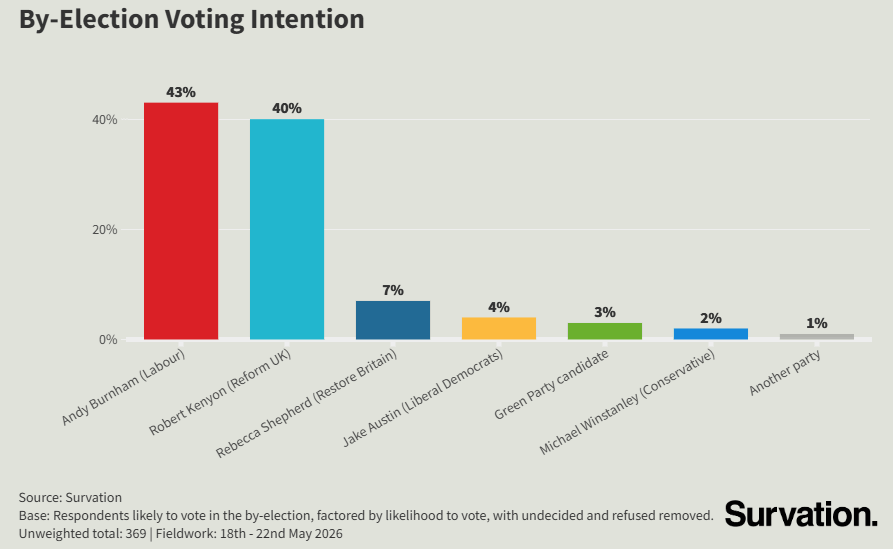
Andy Burnham leads Robert Kenyon by three points in Survation’s first poll of the Makerfield by-election, with the Greater Manchester Mayor’s personal vote pulling Labour into a narrow lead in a seat where Reform UK leads on generic Westminster voting intention by eleven.
At the start of the campaign, Burnham leads on 43% to Kenyon’s 40%. Rebecca Shepherd, standing for Rupert Lowe’s Restore Britain, is on 7% in what is the party’s first parliamentary contest. The Liberal Democrats are on 4%, the Green candidate on 3% (the Greens were in the process of reselecting during fieldwork), and the Conservatives on 2%.
It is important to stress the early nature of this fieldwork. The period covered reflects a volatile candidate picture – the Green candidate entering and withdrawing from the contest – as well as Restore GB’s entry, and was conducted largely prior to Andy Burnham’s campaign launch yesterday (Friday 22nd May).
On a generic Westminster ballot, with no candidate names attached, Reform UK leads Labour by eleven points in Makerfield. The eleven-point Reform lead in a generic ballot, set against a three-point Labour lead in the named-candidate by-election ballot, is the size of the Burnham effect in this poll: enough to put Labour narrowly in front of Reform, not enough to put the seat beyond reach.
Westminster voting intention in Makerfield confirms the competitive environment our model projected, which combined our “What if Andy Burnham Stood” data (collected after the Gorton & Denton by-election) to show the effect the Greater Manchester Mayor could have on the race in Makerfield. Our model estimated that Burnham could win the seat with a narrow margin (before the start of the campaign) with 45 percent of the vote to Reform at 42. Full notes on our initial estimate and methodology are available here, while Reform were likely to take the seat with a large margin in a standard General Election scenario. Compared to the Westminster VI, Labour gains roughly 8 points when the question is framed around the by-election candidates specifically.
Subgroup findings
Three points stand out from subgroup analysis: a wide gender gap, a Burnham effect that is largest among women and over-55s, and a closely fought ward map.
Burnham leads Kenyon by 21 points among women (53% to 32%) while trailing by 15 points among men (33% to 48%). The contest is essentially a contest between two different electorates within the same constituency.
Burnham also leads among the youngest voters (51% to 23% among 18–34s, though on a small base) and is narrowly ahead among the over-55s (46% to 44%). Reform leads by ten points among 35–54s.
Vote switching: Labour’s 2024 voters are sticking with Burnham: 83% are voting Labour again, with 12% defecting to Reform. Reform UK’s 2024 voters are loyal too, with 82% staying with Kenyon, but 13% are switching to Rebecca Shepherd’s Restore Britain. Conservative 2024 voters are the least loyal – the majority of them (62%) are now voting Reform, and only 16% Conservative.
—
Survation will continue to monitor the situation for clients and dig deeper into the issues driving the contest.
Methodology and Data
– Survation conducted the poll by telephone among 504 adults aged 18+ resident in the Makerfield parliamentary constituency between 18 and 22 May 2026, on behalf of Election Data Ltd
– Data were weighted to the profile of all adults in Makerfield aged 18+, by age, sex, ward, and 2024 General Election vote. Targets were derived from Office for National Statistics data and the 2024 UK General Election result.
– Voting intention figures are reported on a base of respondents likely to vote in the by-election, factored by likelihood to vote, with undecided and refused removed.
– At 95% confidence, results from a sample of 504 carry a margin of error of approximately ±5.4 percentage points on the headline. Subgroup figures should be treated with appropriate caution.
– Full data tables, including all crossbreaks, are available to download here.
Contact
– Damian Lyons Lowe, Founder & Chief executive: damian.lyonslowe@survation.com
– Vasil Lazarov, Head of Quant: vasil.lazarov@survation.com
< Back