Public mood on Iran: caution, scepticism, and no appetite for further UK involvement
The ongoing military action in Iran has dominated airwaves. Unsurprisingly, the public have taken notice. A fifth (20%) say they are paying “a lot of attention” and less than 1 in 10 (7%) are paying “no attention at all”. Overall, three-quarters (75%) gave a response of 6 or above, indicating most are following events closely.
With high levels of public interest, what do they actually think about the conflict?
Opposition outweighs support
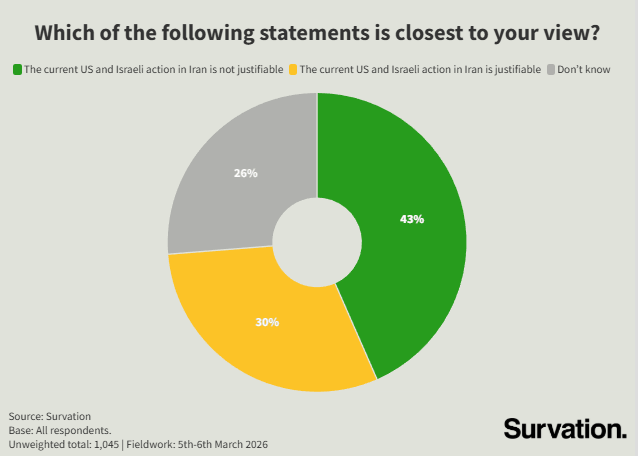
A plurality oppose the conflict. We found that two-fifths (41%) oppose military action by the United States and Israel, with less than 3 in 10 (27%) supporting it. Moreover, over two-fifths (43%) think that US and Israeli action is unjustified, compared to 30% who do.
However, the public did view Iran as being justified in retaliating. Just under half (49%) think that Iranian retaliation is justified – made up of 32% who believe such retaliation is only justified against US and Israeli forces and 17% who say retaliation against wider regional targets is also justified. Just under a quarter (24%) think that retaliation would be unjustified.
UK decisions and domestic implications
The public backed the government’s decision not to allow the US to use British bases for the initial strikes, with 56% saying the decision was right compared to 27% who said it was wrong. Responses to Starmer’s actions following the start of the conflict have generally fallen along party lines: 59% of 2024 Labour voters support his response, compared to just 14% of 2024 Reform UK voters.
Looking ahead, half (49%) think that the UK should adopt a neutral position, whilst only 17% support active UK involvement alongside the US and Israel. A fifth (20%) want the UK to actively oppose the conflict and work towards de-escalation.
On how Britain should navigate the conflict going forward, respondents were more cautious than not. Nearly half (47%) said that British overseas territories should be protected through self-defence measures only, with 33% supporting offensive measures as required. However, any further military action would need the consent of Parliament according to the public. A clear majority (60%) think that Parliament should approve any military action beforehand – just 21% said the government should be able to act without this.
The conflict so far is seen as having notable implications for the UK-US “special relationship”. A plurality (43%) say the relationship has been weakened as a result of the conflict so far, with a further 32% saying it has made little difference. Additionally, very few think that the UK should go along with the US on international conflicts – a mere 9%. The largest proportion (44%) say the UK should only work with the US on a case-by-case basis, depending on what’s best for Britain. A significant group (34%) wanted an entirely independent approach, even if that meant public disagreement with the US.
What the future holds for Iran, and the public’s anxiety
The public were not optimistic for Iran’s future. When asked if the current conflict led to the incumbent government being removed from power, over two-fifths (45%) reported that they anticipated a repeat of Iraq after 2003, with long-term instability. About a quarter (26%) felt that something different would come to pass, with the possibility of stable government.
Summing up their views on a few words, anxiety dominated respondents’ answers. Many described the conflict as “scary”, “dangerous”, and warned of the risk that it may “spiral out of control” or that “ww3 is on the verge of happening”. Perhaps because of these concerns, resistance to further UK involvement, beyond protecting British people and territories, has become the predominant view amongst the public.
—
GET THE DATA.
Survation conducted an online poll of 1,045 adults aged 18+ in the UK on their attitudes towards the conflict in Iran. Fieldwork was conducted between 5th-6th March 2026. Tables are available here.
________________________________________
Survation. is an MRS company partner, a member of the British Polling Council and abides by their rules. To find out more about Survation’s services, and how you can conduct a telephone or online poll for your research needs, please visit our services page.
If you are interested in commissioning research or to learn more about Survation’s research capabilities, please contact John Gibb on 020 3818 9661, email researchteam@survation.com, or visit our services page.
For press enquiries, please call 0203 818 9661 or email media@survation.com
< Back