Safer streets or less privacy? The impact of facial recognition cameras
Live Facial Recognition (LFR) vans are a growing presence on England’s streets as the UK Government seeks a ‘significant modernisation’ of policing and expands the rollout of the technology across England and Wales. The technology compares a watchlist of criminal suspects against faces captured in passing; earlier this year, the Home Secretary pledged funding for 40 new LFR vehicles using emerging technologies in a ‘targeted way’ to identify individuals wanted for serious offences.
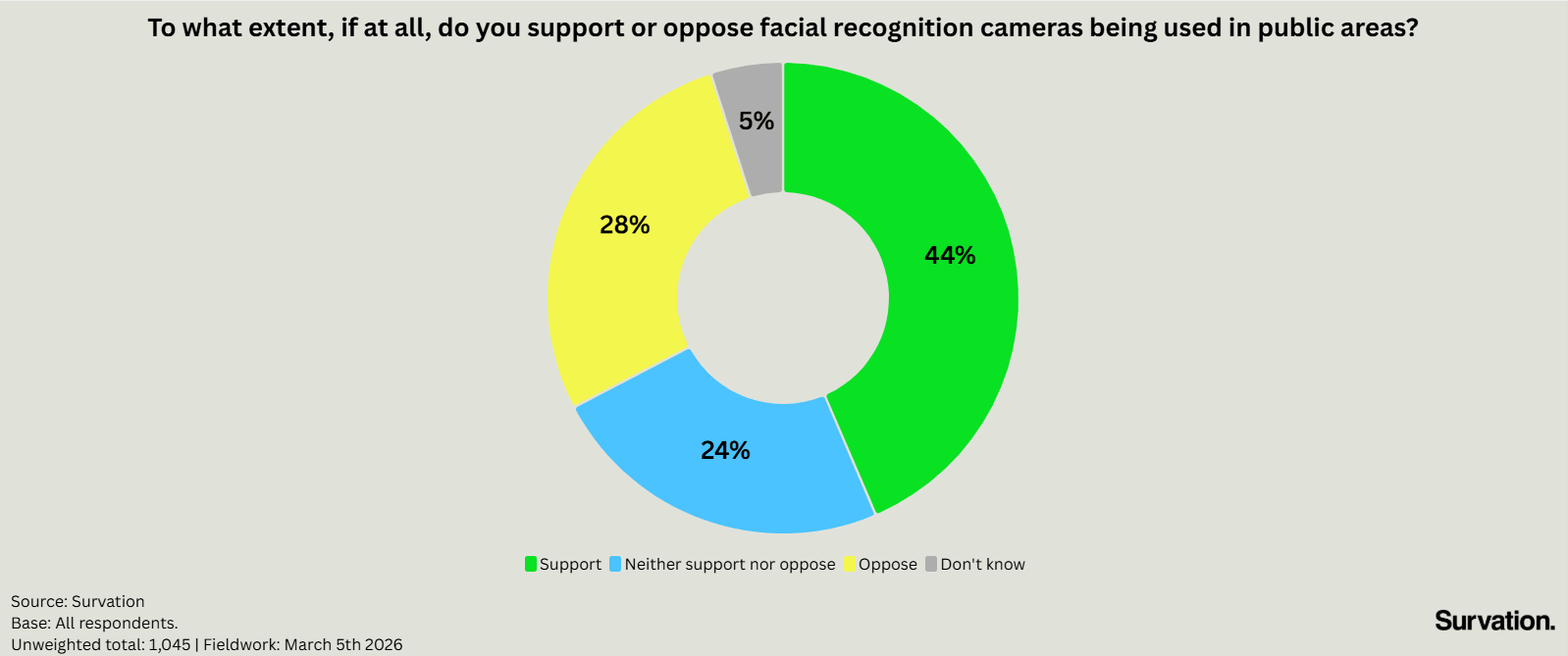
Recent Survation polling shows cautious support (44%) for the use of LFR as a crime prevention tool. Yet, uncertainty remains high (24% neutral, 5% don’t know).
The public are persuadable on the benefits of LFR in policing, but the issue is far from settled and generational divides are clear.
Older generations back LFR in their local area
Older people appear significantly more supportive of the technology than younger age groups. Among those aged 65 and over, 68% support the use of facial recognition technology in their local area, compared to 45% of 18-24 year olds. Therefore, while emerging AI tools might be assumed to provoke concern amongst older generations, the data suggests that perceived benefits around law and order outweigh such reservations.
In the Survation Policy Intelligence Unit’s (SPIU) previous work examining attitudes towards AI in policing, those aged 65+ were slightly less supportive (27%) than 18-24 year olds (33%). It is interesting to see this pattern shift when considering facial recognition technology – with attitudes differing between AI as a general tool and the specific use of facial recognition technology.
Privacy and trust concerns drive opposition
Opposition is strongest among those aged 45 to 54, with approximately two-fifths opposing the use of facial recognition technology in both public areas (40%) and their local area (39%). Amongst LFR’s opponents, over two-thirds (69%) cite concerns related to privacy and trust, with 37% noting possible threats to privacy or civil liberties and a further 32% worried about how the data would be stored or used. This suggests AI tools themselves are not the main concern; scepticism is driven by how they may be used by UK law enforcement.
Of those who oppose LFR, younger audiences were around three times more likely (27%) than over-65s (9%) to cite concerns about discrimination. In contrast, only 11% of 18 to 24 year olds highlighted concerns about the allocation of public funds to technology rather than additional police officers, compared with 40% of older respondents. This suggests that younger generations are not inherently opposed to the modernisation of policing. Instead, their concerns are focused on the potential for AI-driven policing to have disproportionate impacts on vulnerable and minority groups.
Ultimately, while there is measurable public support for police use of facial recognition in the UK, particularly among those aged 65+, a large proportion of the public remain undecided or neutral. Furthermore, despite the significant attention given to issues of bias and misidentification, privacy (37%) and trust (32%) concerns dominate opposition across most age groups.
Building public trust in LFR may depend less on technical performance and more on transparency, safeguards and robust regulation.
SPIU will continue to examine the challenges and public concerns surrounding emerging technologies and the use of AI in UK law enforcement.
If you’re interested in this topic and would like to commission research in this area, please contact Mark Speed, Client Development Director in Survation’s Policy Intelligence Unit, at mark.speed@survation.com.
—
GET THE DATA.
Survation conducted an online poll of 1,045 adults aged 18+ in the UK on their attitudes to the use of facial recognition by UK law enforcement. Fieldwork was conducted 5th March 2026. Tables are available here.
________________________________________
Survation. is an MRS company partner, a member of the British Polling Council and abides by their rules. To find out more about Survation’s services, and how you can conduct a telephone or online poll for your research needs, please visit our services page.
If you are interested in commissioning research or to learn more about Survation’s research capabilities, please contact John Gibb on 020 3818 9661, email researchteam@survation.com, or visit our services page.
For press enquiries, please call 0203 818 9661 or email media@survation.com
< Back