Health Misinformation: Who Is Hit Hardest, and Where
Our research for the London School of Hygiene & Tropical Medicine (LSHTM) highlights how widespread the issue of health misinformation is across the UK. Interviewing 2,110 UK adults (Fieldwork 9th-10th September 2026), we found that false and misleading health claims are shaping people’s decisions and causing real harm. The impact also varies sharply by age and by where people live.
The scale of the harm
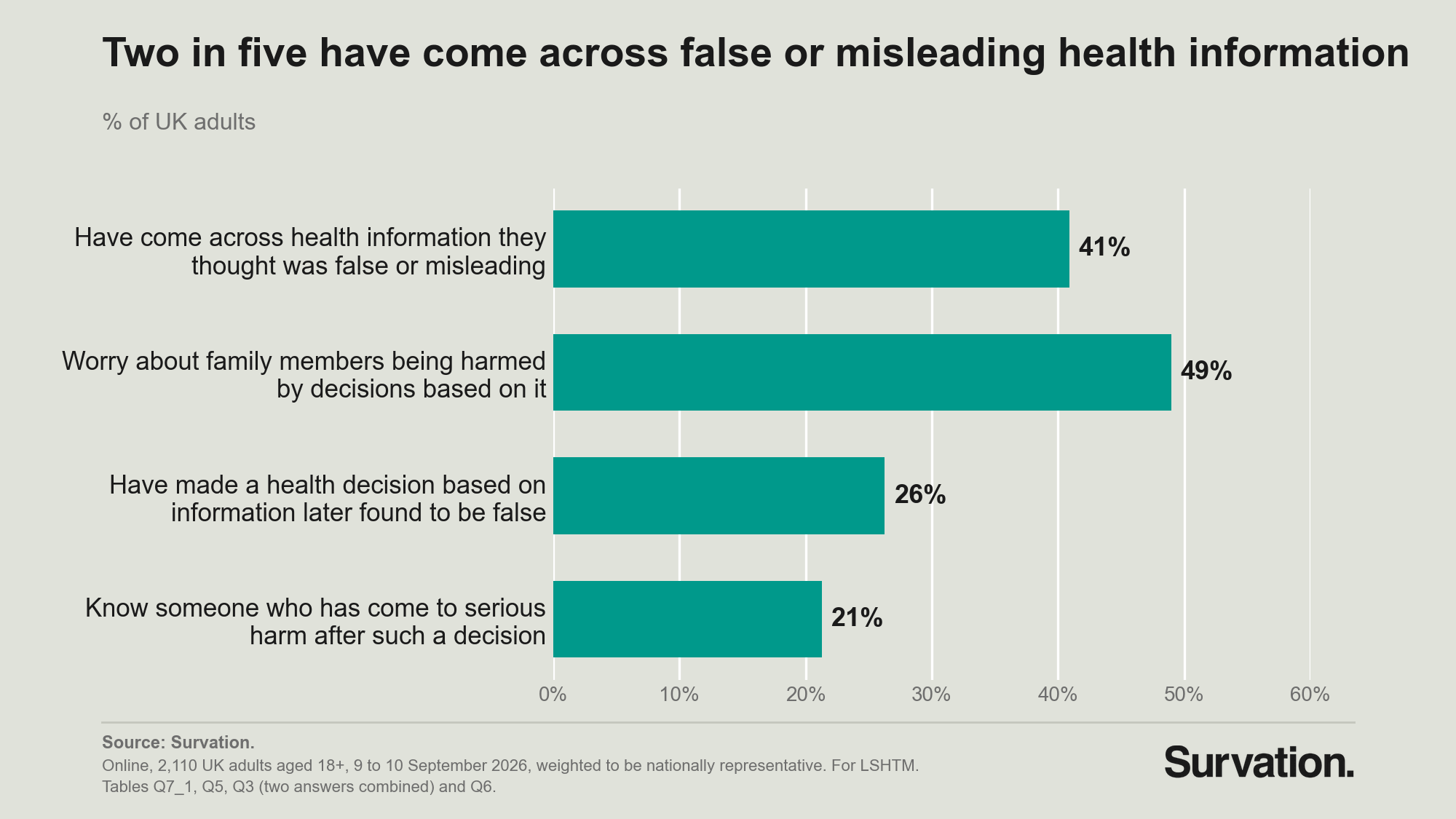
Two in five (41%) respondents say they have come across health information they thought was false or misleading. A quarter (26%) say they have made a health decision based on it, and just over one in five (21%) know someone who has come to serious harm as a result, such as catching a preventable disease or delaying medical treatment.
Beyond those directly affected, many more worry about the damage it could do to their families and to society: 49% worry about health misinformation harming a family member, 62% think it’s likely to cause people to believe in or buy fake cures, and 59% think it will undermine trust in health services.
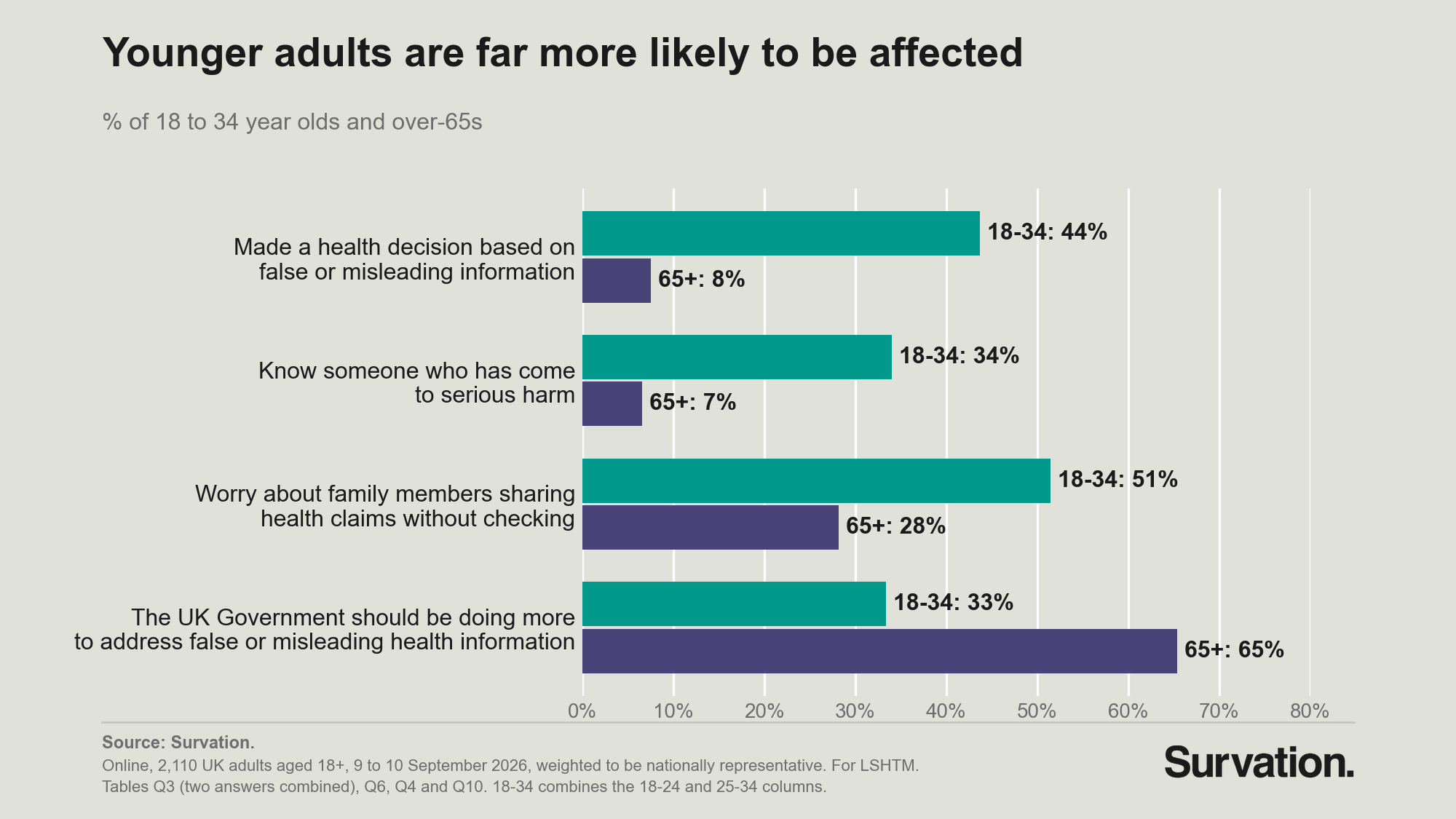
Younger age groups are particularly alert to how misinformation spreads, with half (51%) of 18-34s worried about family members sharing health claims without checking their accuracy, compared with 28% of over-65s.
Where it comes from and what it’s about
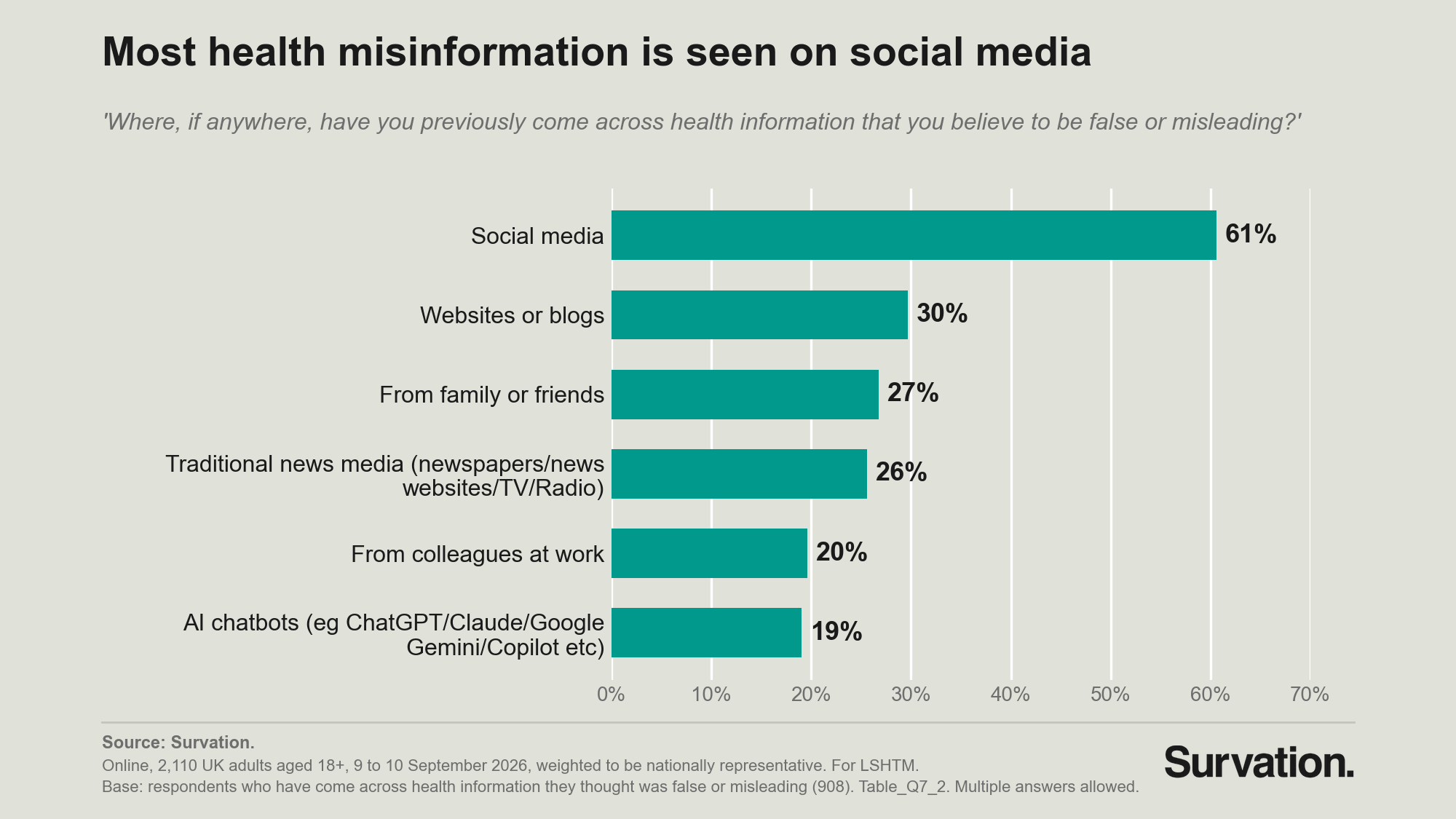
Health misinformation travels through social media feeds and trusted voices alike. Of those who have come across health misinformation, a majority (61%) saw it on social media (61%), but many also came across it on websites or blogs (30%), from family or friends (27%), the traditional news media (26%) and even AI chatbots (19%), rising to almost a third (31%) of 18-34s, against one in ten (10%) over-65s.
Amongst the most common topics were vaccines (24%) and dietary supplements or weight-loss injections (21%), followed by climate change (18%) and mental health (16%). One in eight (12%) had come across misleading claims around women’s reproductive health, including fertility, contraception, abortion and the menopause.
Young people are hit hardest
Not only are younger people more likely to base their own health decisions on this information, they are more likely to know others who have done the same and been harmed by it. Over two in five (44%) 18-34-year-olds have made a health decision based on false or misleading information, compared to 26% of all adults and 8% of over-65s. And a fifth (21%) of 18-34s have made one they later regretted, against 14% of adults overall.
Part of the explanation may lie in where younger people turn for answers. When deciding whether a health claim is accurate, 18-34s are far more likely than over-65s to check social media (28% vs 5%), ask an AI chatbot (25% vs 8%) or ask family and friends (30% vs 12%). They are less likely to rely on the NHS or government websites (41% vs 59%) or their GP or pharmacist (40% vs 58%).
The consequences are clear in their own circles: over a third (34%) of 18-34s know someone who has come to serious harm, against 7% of over-65s.
A regional divide in harm
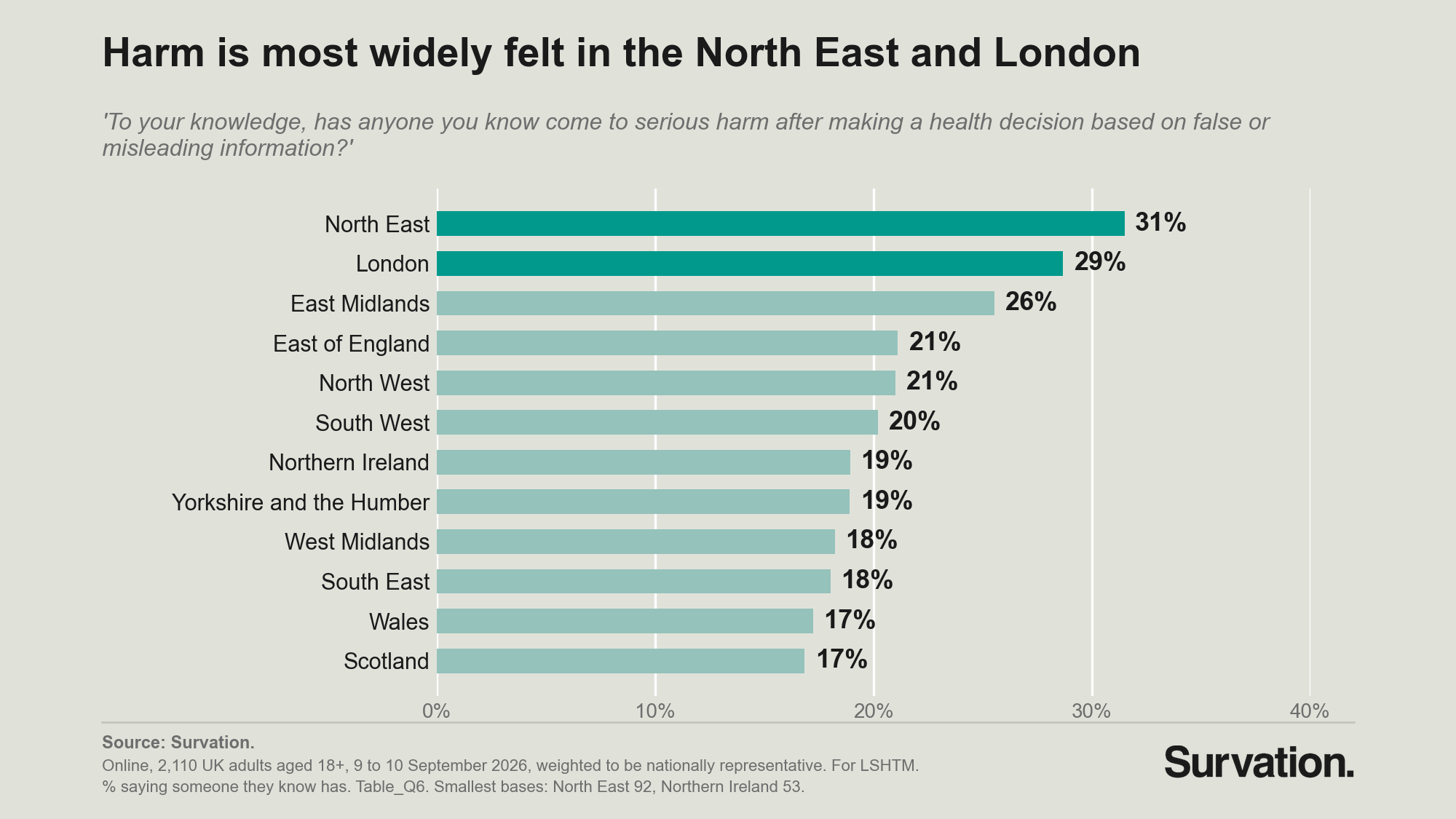
The harm experienced as a result of misinformation is also not felt equally. Three in ten people in the North East (31%) and London (29%) know someone who has come to serious harm, compared with fewer than one in five (18%) in the South East and West Midlands.
The two areas where harm is most widely felt also stand out in how people check health claims: Londoners are among the least likely to check against NHS or government websites (41%) and among the most likely to turn to social media (25%) or AI chatbots (27%), while three in ten (30%) in the North East ask family or friends.
Confidence and skills
People are exposed to more health information than ever, yet many are unsure whether they can trust it. Fewer than half feel very or somewhat confident in their ability to judge if a health claim is accurate (45%), and 19% feel not very or not at all confident. Over-65s are the least confident of any age group at judging whether a health claim is accurate, with just 37% feeling confident, against 48% of 18–34s.
When it comes to finding reliable health information when they need it, slightly more feel confident (57%), but still 13% do not. This varies by region: in Yorkshire & Humber it falls to 44%, whereas in the North West it is 69%.
With people constantly exposed to health information but many unsure how to judge it, it is little surprise that education on how to spot misinformation is among the public’s top priorities.
What the public wants
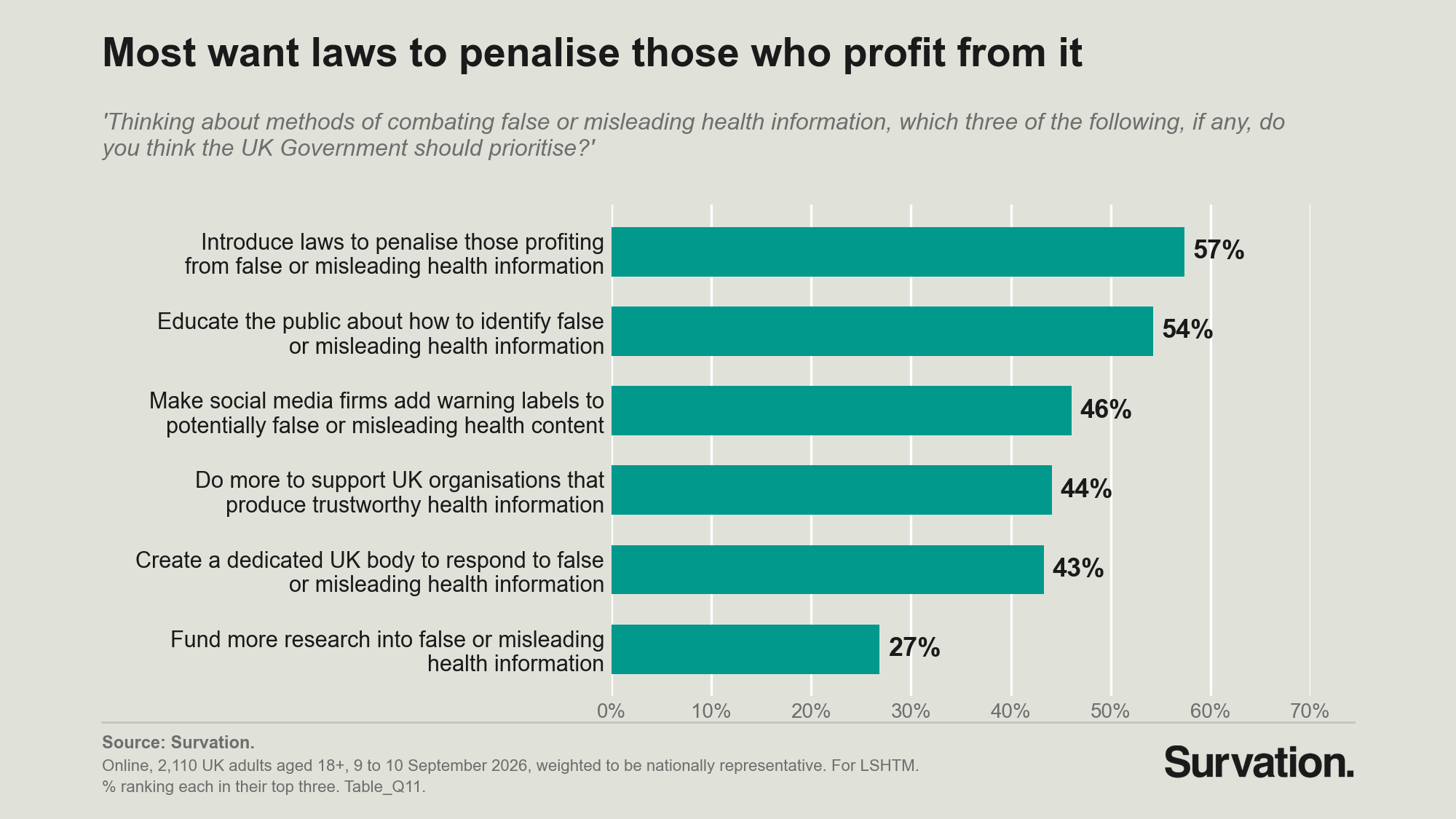
The public wants the Government to take action; nearly half (47%) say the Government should be doing more to tackle health misinformation, and only one in ten (10%) think it shouldn’t be involved at all. Their top priorities are laws to penalise those who profit from it (57%), education on how to spot it (54%) and warning labels on social media content (46%). This is not a partisan issue: more voters of every major party say the Government should be doing more than say it is doing the right amount.
However, the group hit hardest is the least convinced. Only a third (33%) of 18–34s say the Government should be doing more, compared with two-thirds (65%) of over-65s. In fact, one in five (19%) young people think it should be doing less, suggesting some may see this as a problem for people to navigate themselves.
The findings challenge the idea that health misinformation is a fringe problem. The public are worried about its impact, yet fewer than half (45%) feel confident in their ability to spot it. They want more support from the Government, and with harm felt unevenly across age groups and regions, that support will need to be local as well as national. As LSHTM Director Professor Liam Smeeth puts it, this is “a problem that we can no longer ignore”.
Get the data
Survation interviewed 2,110 adults aged 18+ living in the UK online between 9 and 10 September 2026. Data were weighted by age, sex, region, highest level of qualification, socio-economic group, household income, 2024 General Election vote and 2016 EU referendum vote to the profile of all adults in the UK aged 18+.
Full data tables available here.
< Back