
The real Burnham bounce: what Labour members want from his government
Following the first few weeks of Andy Burnham’s premiership, Survation’s poll of Labour members for LabourList uncovered a renewed sense of self-confidence within the party regarding Labour’s chances for re-election and ability to bring defectors back into the Labour fold.
Confidence at the ballot box
Members are markedly more optimistic about Labour’s prospects than they were a few months ago. The large majority (86%) say Labour has a better chance of winning the next general election with Burnham as Prime Minister, against only 4% who say worse.
Furthermore, when asked what they expect the next general election to produce, close to four in five (79%) expect Labour to be part of the next government: 38% a hung parliament with Labour forming a government, 36% a small Labour majority and 4% a large one. Only 9% expect any Reform-led outcome.
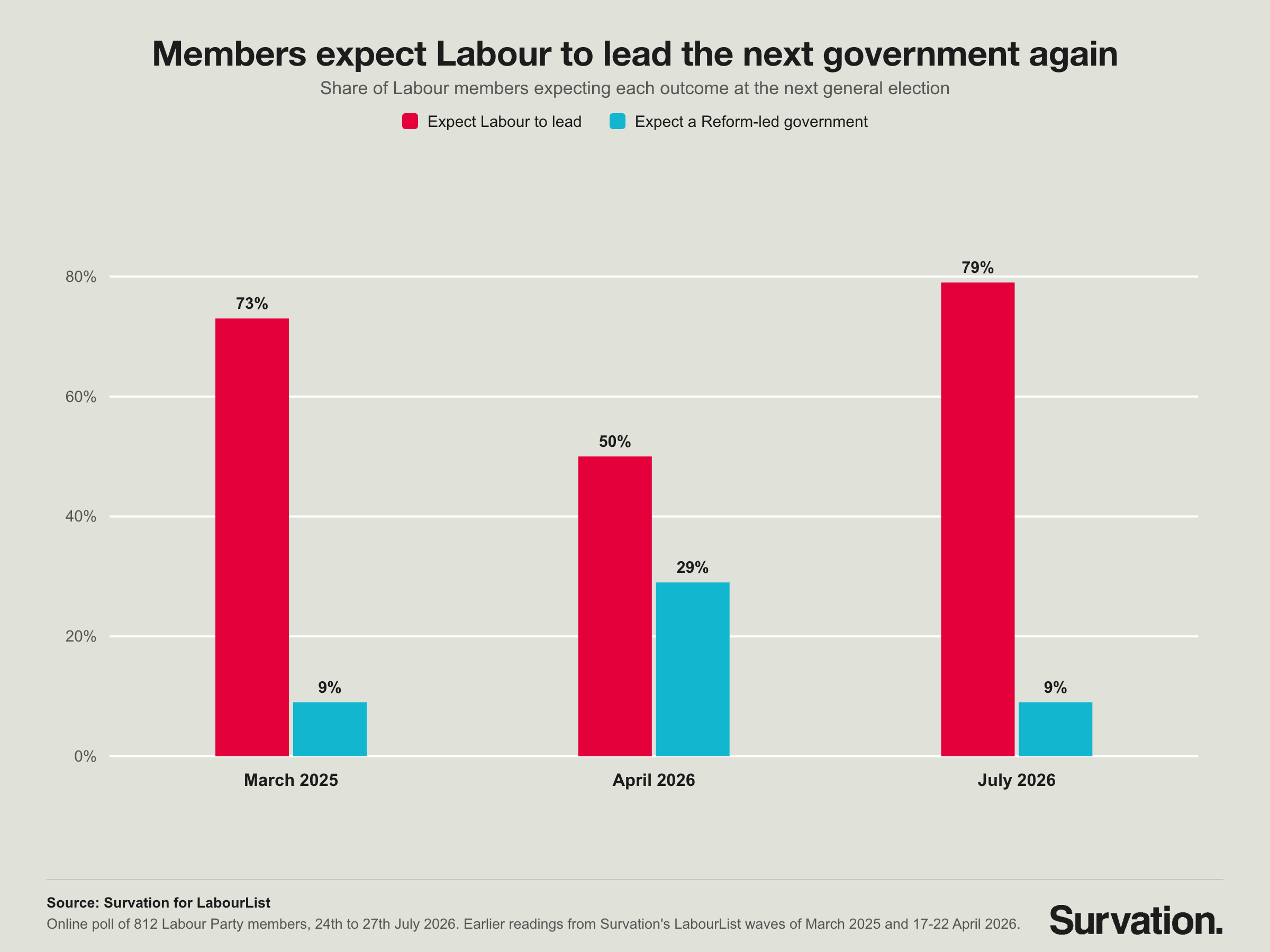
This is a considerable shift in mood. In March 2025, three-quarters of members expected Labour to lead the next government. That expectation then eroded steadily: by our poll of 17-22 April 2026, it had fallen to around half, with almost three in ten expecting a Reform-led government instead. Three months into Burnham’s premiership it stands at 79%, and Reform-led outcomes are back down to 9%. On this measure, the membership’s confidence in its own electoral prospects has been substantially restored.
It would be easy to read all this as a bounce in unity. Labour members are united behind their leader: Burnham’s favourability stands above +71 in every 2020 faction, and 76% say he can unite the party against 10% who say he cannot. However, that unity largely existed before he took office – in our poll of 13 -14 May 2026, 52% of those who backed Starmer for the leadership in 2020 said they would choose Burnham over Starmer in a head-to-head, alongside 88% of Long-Bailey and 65% of Nandy backers. There was no members’ ballot this time, of course: Burnham took over without one, so members were never formally asked to choose him. Favourability is the closest measure available. What has moved is not how united members are, but what they believe that unity can deliver.
Where that confidence points: the voters members want back
What makes this confidence more interesting still is where it points. Three in five members (61%) name Reform UK as Labour’s biggest electoral threat. But when asked who Labour should prioritise winning back, they point in another direction – 41% say former Labour voters who switched to the Green Party, against only 28% of members who argue for winning back voters who went to Reform.
Members therefore identify Reform as the danger but regard Green defectors as the winnable ones, offering a route back to Labour’s 2024 coalition that asks little of the party’s position on key issues such as immigration and asylum – the ground on which Reform defectors would have to be fought.
The confidence to change: members want a break from the Starmer programme
That confidence does not stop at the ballot box; on the programme itself, members are not short of ambition. Just 14% think Burnham should continue with Labour’s original programme for government. 45% would keep existing spending commitments while letting him pursue his own agenda elsewhere, and 38% want a complete break – a combined 83% favouring at least a partial departure from the Starmer programme.
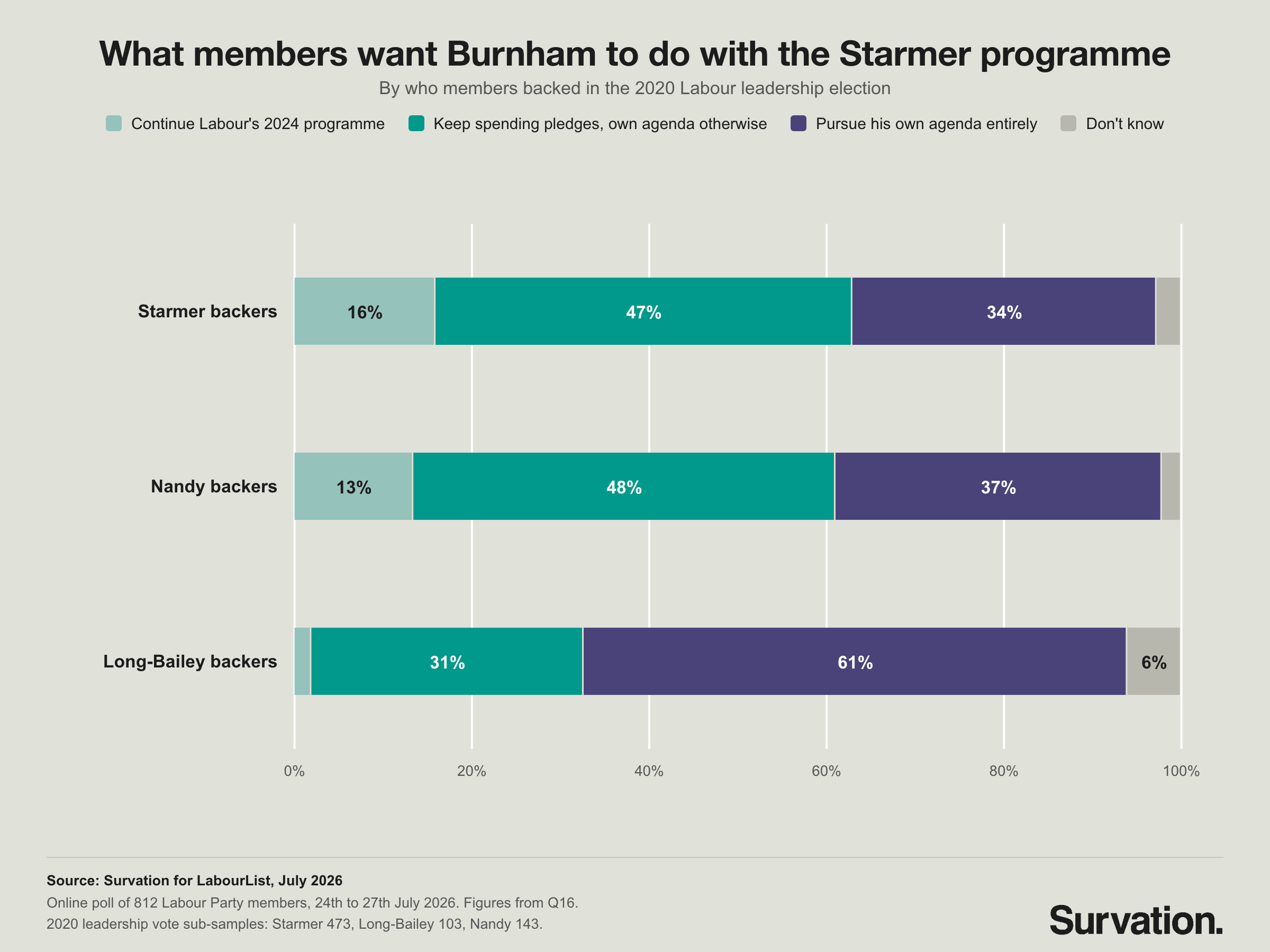
Appetite for tearing up the fiscal framework is therefore limited, but the desire to see the party’s political goals shift is widespread, with some variation across the membership. Among members who backed Starmer in the 2020 leadership election, 47% think Burnham should protect existing spending commitments while pursuing his own agenda elsewhere; Nandy backers say much the same, at 48%.
Members who supported Rebecca Long-Bailey in 2020 want the sharpest break: 61% think Burnham should abandon the Starmer programme altogether. They are also the group most focused on winning back Green defectors rather than Reform ones, which suggests that for this section of the membership at least, the change being asked for is a repositioning leftward.
Confidence in the direction of travel: backing the flagship policies
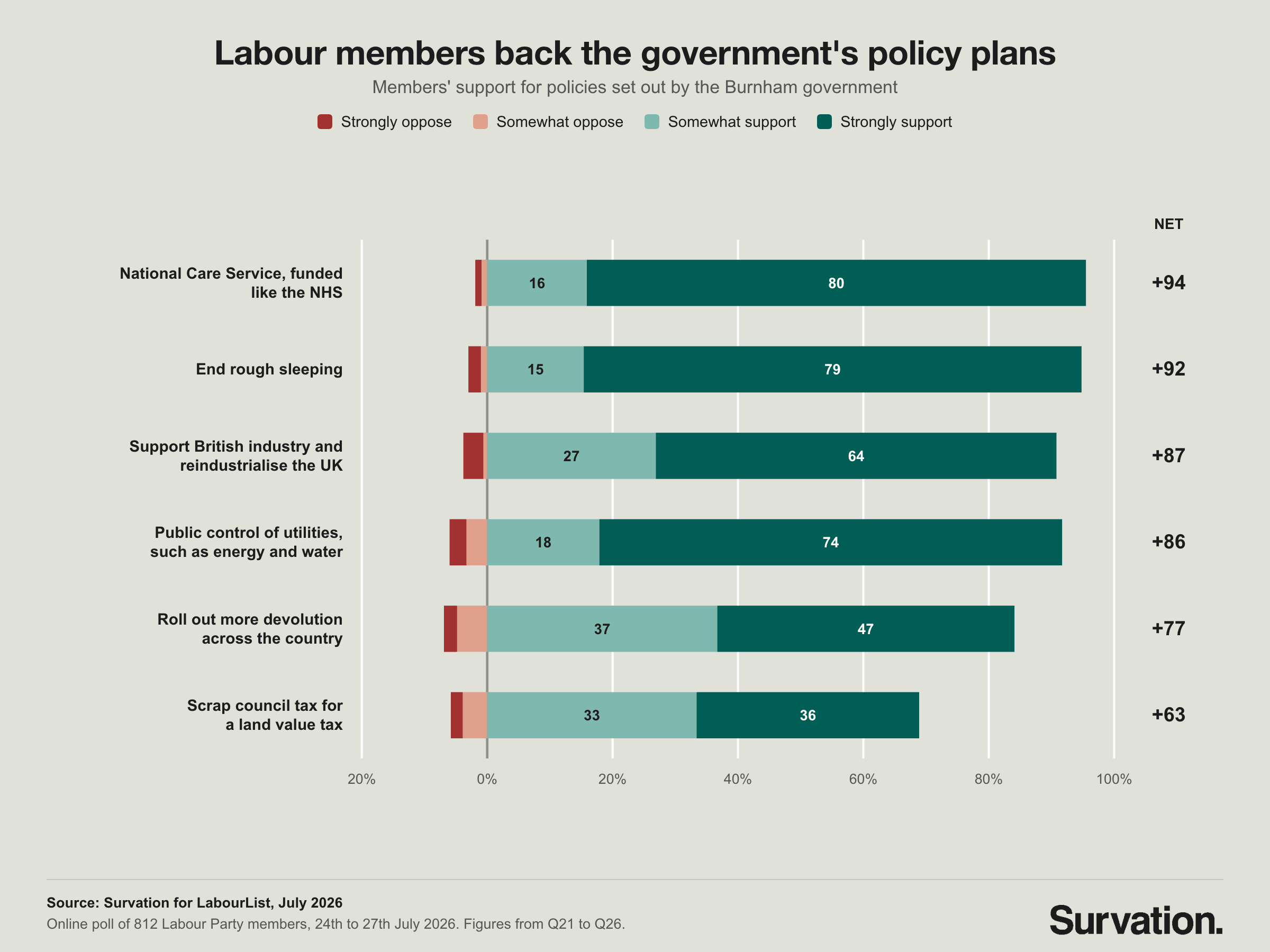
If members are confident enough to ask for a new programme, they are also confident in the one Burnham has begun to set out, with strong backing for the policies announced in Burnham’s first days as PM. 95% of members back his ambition to end rough sleeping, with 79% supporting it strongly. Members are equally enthusiastic about a National Care Service funded similarly to the NHS: 96% support the policy at least to some extent, and 80% back it strongly.
Support also runs high for bringing utility companies under public control, backed overall by 92% of members out of which 74% strongly support it. Plans to support British industry and rebuild the UK’s industrial base find similarly broad backing, with 91% of members in favour and 64% supporting the policy strongly.
Areas members want him to prioritise
Confidence of this kind is a form of political capital, and members are clear about where they want it spent. Two in five (40%) say resolving the cost of living crisis should be Burnham’s single most important priority, with a further 15% ranking it second and 9% third. Combined, 64% of Labour members place the cost of living among the government’s top three priorities.
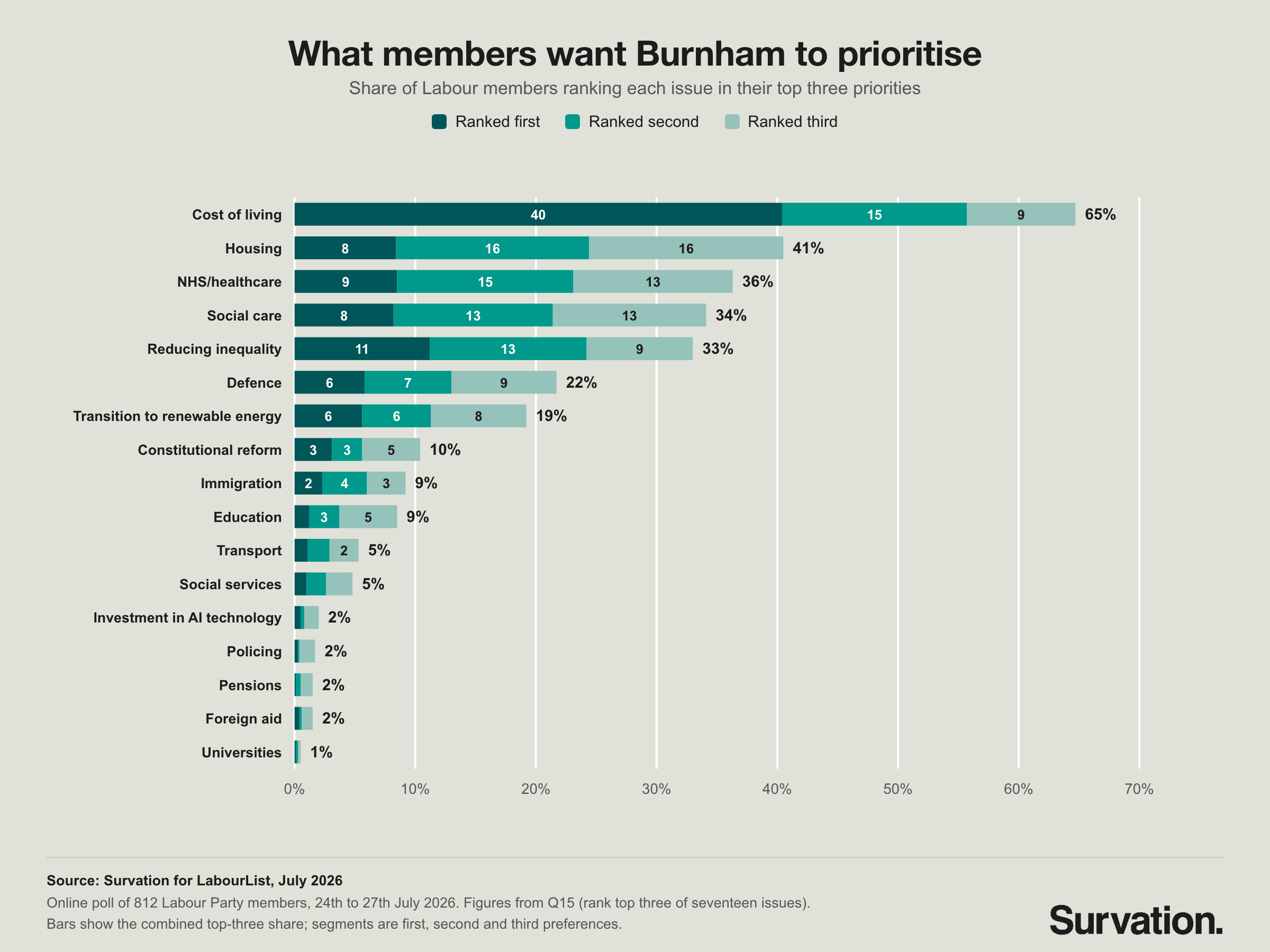
Behind this housing is placed in the top three by 40% of members, the NHS by 36%, social care by 34% and reducing inequality by 33%. At the other end of the list, universities, pensions, foreign aid and policing barely register, each named by under 2% of members across all three preference positions, with universities lowest at half a percent.
A month in, the clearest thing Burnham has given his party may not be a poll lead, but the belief that it can win – and the confidence to say who and what it wants to win with.
—
GET THE DATA.
Survation conducted an online poll of 812 Labour Party members on behalf of LabourList between the 24th – 27th July 2026. Tables are available here.
_____________________________
Survation is an MRS company partner, a member of the British Polling Council and abides by their rules. To find out more about Survation’s services, and how you can conduct a telephone or online poll for your research needs, please visit our services page.
If you are interested in commissioning research or to learn more about Survation’s research capabilities, please contact John Gibb on 020 3818 9661, email researchteam@survation.com, or visit our services page.
For press enquiries, please call 0203 818 9661 or email media@survation.com
< Back