Clacton Unprompted: What effect does the longest ballot ever have on polling?
Last week, Survation published an article on our Clacton constituency poll, the first and only publicly released constituency poll for the by-election.
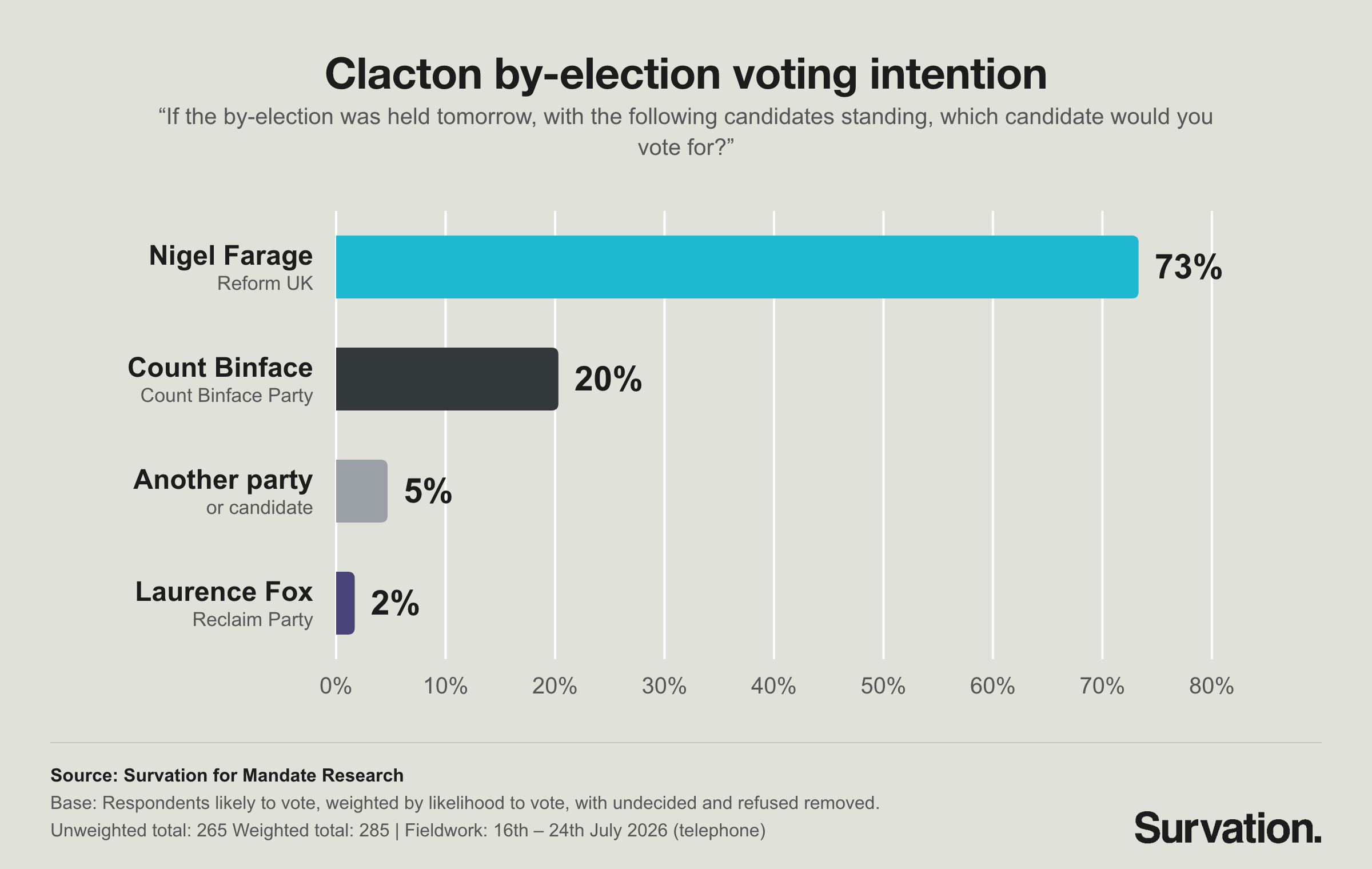
That poll was conducted for Mandate Research between the 16th and 24th of July and sampled 502 people in the Clacton constituency. It put Nigel Farage (Reform UK) on 73% and Count Binface on 20%, with another party on 5% and Laurence Fox (Reclaim Party) on 2%.
On 11th August, Survation conducted a second telephone poll in the constituency of 102 adults, this time with no candidate or party read out at all. This smaller sample would serve as an experiment in prompting, and as a second wave to be combined with the first poll.
Why poll without prompting?
At 34 candidates, the field for this by-election is the largest ever. The physical ballot is almost 1 metre long. Survation’s preferred method is to read respondents the full list of candidates, but with 34 names that wasn’t feasible, so our first poll read out a shortened field.
The uniqueness of this by-election and the shortened candidate list led our chief executive Damian Lyons Lowe to question whether prompting only the “main” candidates would overstate their support, particularly for Farage and Binface.
So we returned to the field, and didn’t prompt at all. Respondents told us, in their own words, who they would vote for. If someone named a party that is not standing, for example Labour or the Conservatives, they were told that party is not contesting the seat, but were not told who is.
The unprompted wave
The result of the second, smaller sample was similar to the first. Farage increased his vote share from 73% to 79%. Count Binface increased slightly to 21%. Gerry Smith was the only other candidate besides Farage or Binface to be named unprompted, and sits at 1% in this sample.
This sample should be considered an exploratory experiment. The small sample size carries a margin of error of ±10%, but allows us to compare results with the existing poll.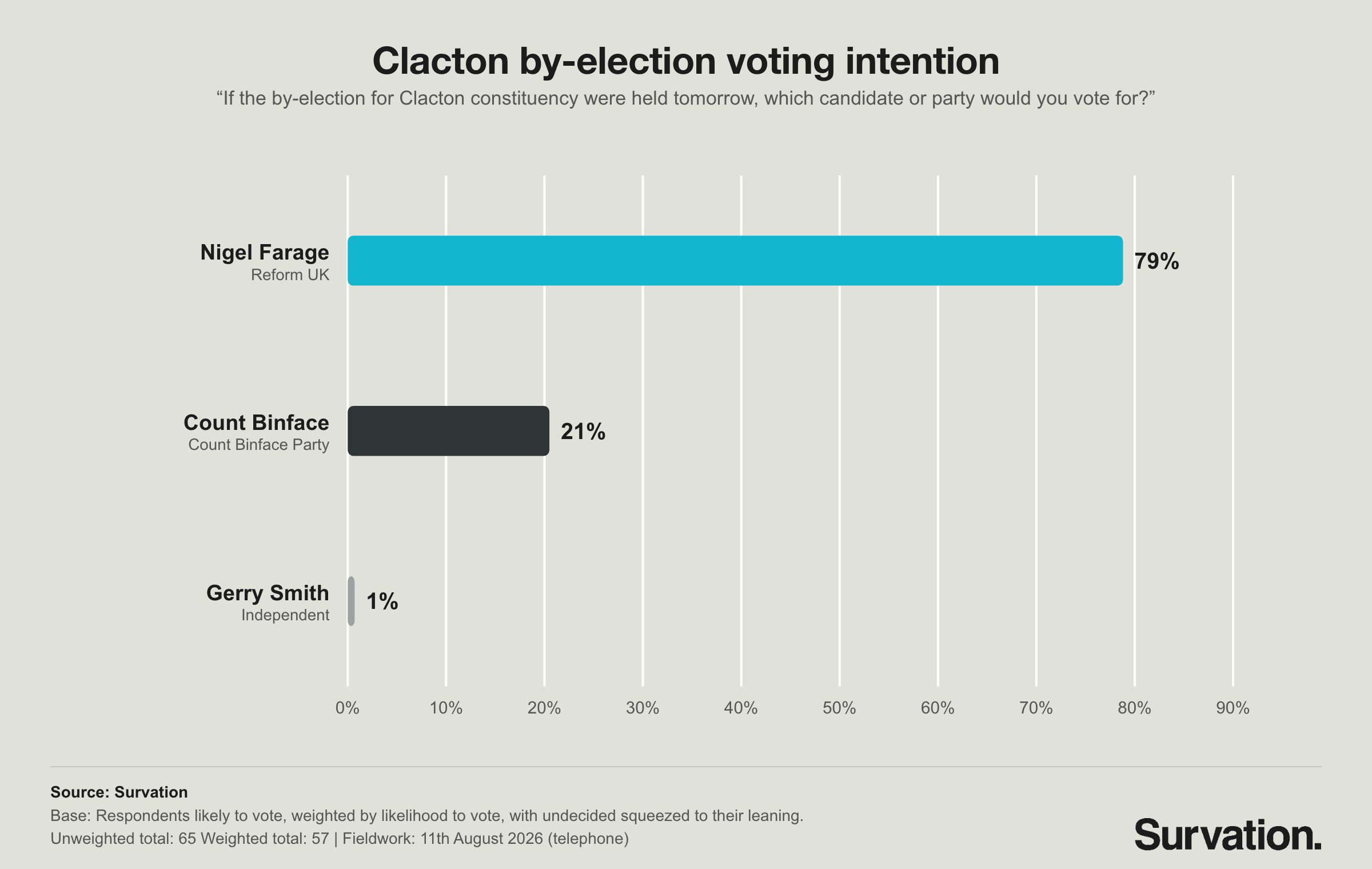
The combined wave
Weighting the two samples together, for a total of 604 interviews, gives Farage 73% and Binface 21%.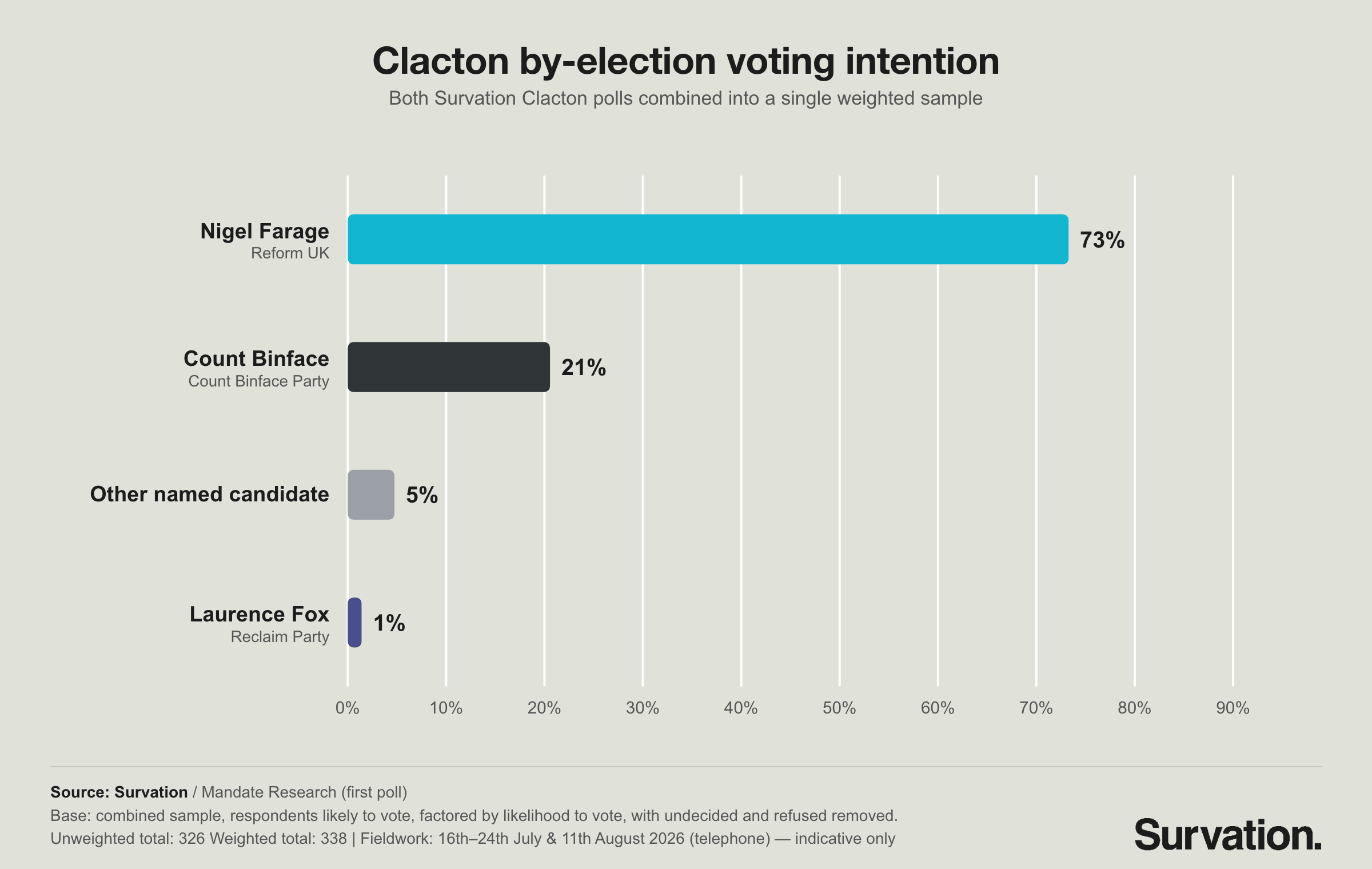
This should be treated as indicative only, as the two polls were three weeks apart and used different prompts, although all responses were standardised across both polls. The combined result provides context only, and when weighted together the samples are broadly similar.
In both polls, Count Binface draws his support from the same groups. He is stronger among younger voters and among 2024 Labour and Remain voters, with almost no support among 2024 Reform voters. He appears to still be seen as the anti-Farage vehicle, and has locked in at least a portion of that vote.
Has a novelty candidate ever polled this high?
As we wrote last week, Count Binface’s previous best by-election result is 0.6% in the 2023 Uxbridge and South Ruislip contest. His highest share anywhere is 1%, on the London-wide mayoral ballot. 20% would be orders of magnitude higher than any previous result.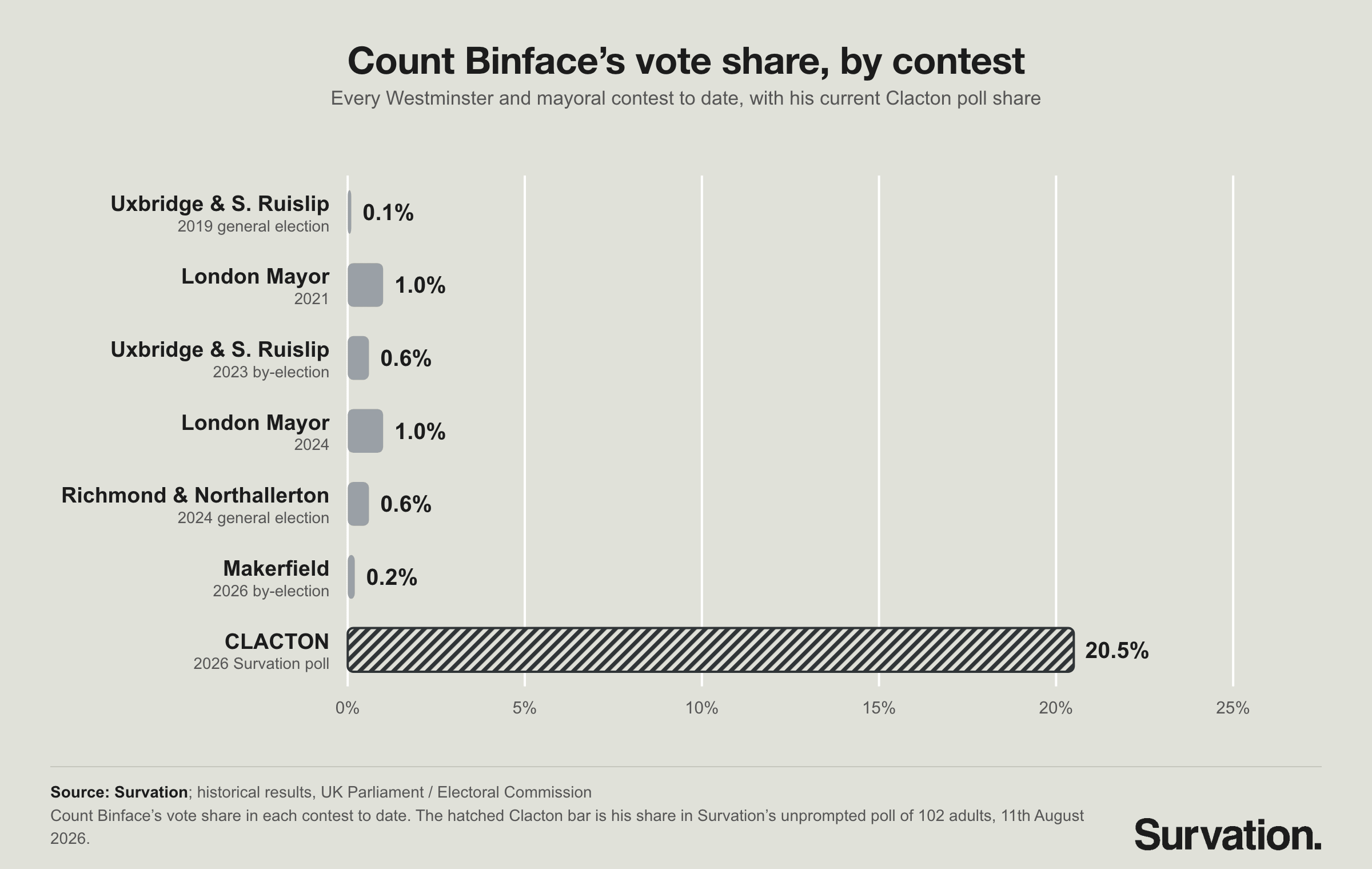
The closest parallel is Haltemprice and Howden in 2008, which held the previous record for the most candidates in a by-election at 26. David Davis resigned his seat to force a debate on civil liberties; Labour and the Liberal Democrats declined to stand.
Davis was returned with 72%. The only major party to stand against him was the Green Party, on 7.4%. The English Democrats took 7.2%, not to be confused with the British Democratic Party who are standing in Clacton.
Among the minor, satirical and novelty candidates, the Miss Great Britain Party achieved 2.2% and the Official Monster Raving Loony Party 1.7%. Even with a fairly open field, these parties didn’t end up anywhere near double digits.
Clacton looks different. Binface is doing something Haltemprice’s fringe never did: acting as the single, recognisable home for the anti-Farage vote in a seat where no major party is mounting a serious challenge.
How accurate will the polling be?
There are caveats, as always. Turnout is expected to be low, and in polling Farage voters have consistently indicated they are more likely to vote. Novelty or satirical candidates often don’t appear in polling at all. The second sample is small at 102 interviews, and unlike a traditional political party, a satirical candidate has no historic record or base of support to weight against. The main takeaway is that across two samples, Count Binface’s support looks credible.
Methodology
Survation conducted an unprompted telephone (CATI) poll of 102 adults in the Clacton constituency on 11th August 2026. Respondents were asked, without any list being read, which candidate or party they would vote for; those naming a party not standing were told it was not contesting the seat, without being prompted on who is. Data were weighted to the profile of the constituency by age, sex, ward, 2024 general election vote, 2016 EU referendum vote, qualification and employment, with targets from ONS data and the 2024 general election result. Voting intention is factored by likelihood to vote and shown with undecideds squeezed to their stated leaning. The comparison poll of 502 adults was conducted between the 16th and 24th of July 2026 on behalf of Mandate Research. Combined figures reweight both samples together and are indicative only, given the interval between the two fieldwork periods and the difference in prompting method.
—
GET THE DATA.
Survation conducted a telephone poll of 102 adults aged 18+ living in the Clacton constituency. Fieldwork was conducted between 11th August 2026. Tables are available here.
_____________________________
Survation is an MRS company partner, a member of the British Polling Council and abides by their rules. To find out more about Survation’s services, and how you can conduct a telephone or online poll for your research needs, please visit our services page.
If you are interested in commissioning research or to learn more about Survation’s research capabilities, please contact John Gibb on 020 3818 9661, email researchteam@survation.com, or visit our services page.
For press enquiries, please call 0203 818 9661 or email media@survation.com
< Back