A majority of the public back Rosebank, but its opponents are the voters Burnham most needs to consolidate
A new Survation poll of 2,011 UK adults for The Green Britain Foundation, conducted online on 3 and 4 November 2026, finds that the public back the UK Government approving the Rosebank oil and gas field by 52% to 19%. However, approval is unlikely to win Labour many votes, as its strongest supporters are mostly Conservative and Reform voters, who rarely vote for the party. Meanwhile, the progressive voters Labour is likely to need behind it to win a majority are the most opposed to Rosebank. Green and Lib Dem voters in particular are the most likely to say approval would make them think the Government takes climate change less seriously.
What is Rosebank?
Rosebank is an oil and gas field located north-west of Shetland. It was approved for development in 2023, but that approval was overturned by Scotland’s highest civil court, the Court of Session. The UK Government is now deciding whether to approve it again.
Supporters argue that developing Rosebank would support jobs and help meet the UK’s energy needs. Opponents argue that it would increase greenhouse gas emissions and most of it will be sold on the international market, rather than domestically.
Rosebank differs from Jackdaw, the North Sea field approved in October. Jackdaw is mainly a gas field tied back to existing infrastructure, whereas Rosebank is primarily an oil field. Its developers estimate Rosebank’s lifetime emissions at up to around 250 million tonnes of CO2 equivalent, compared with up to around 36 million for Jackdaw.
Do the public support Rosebank?
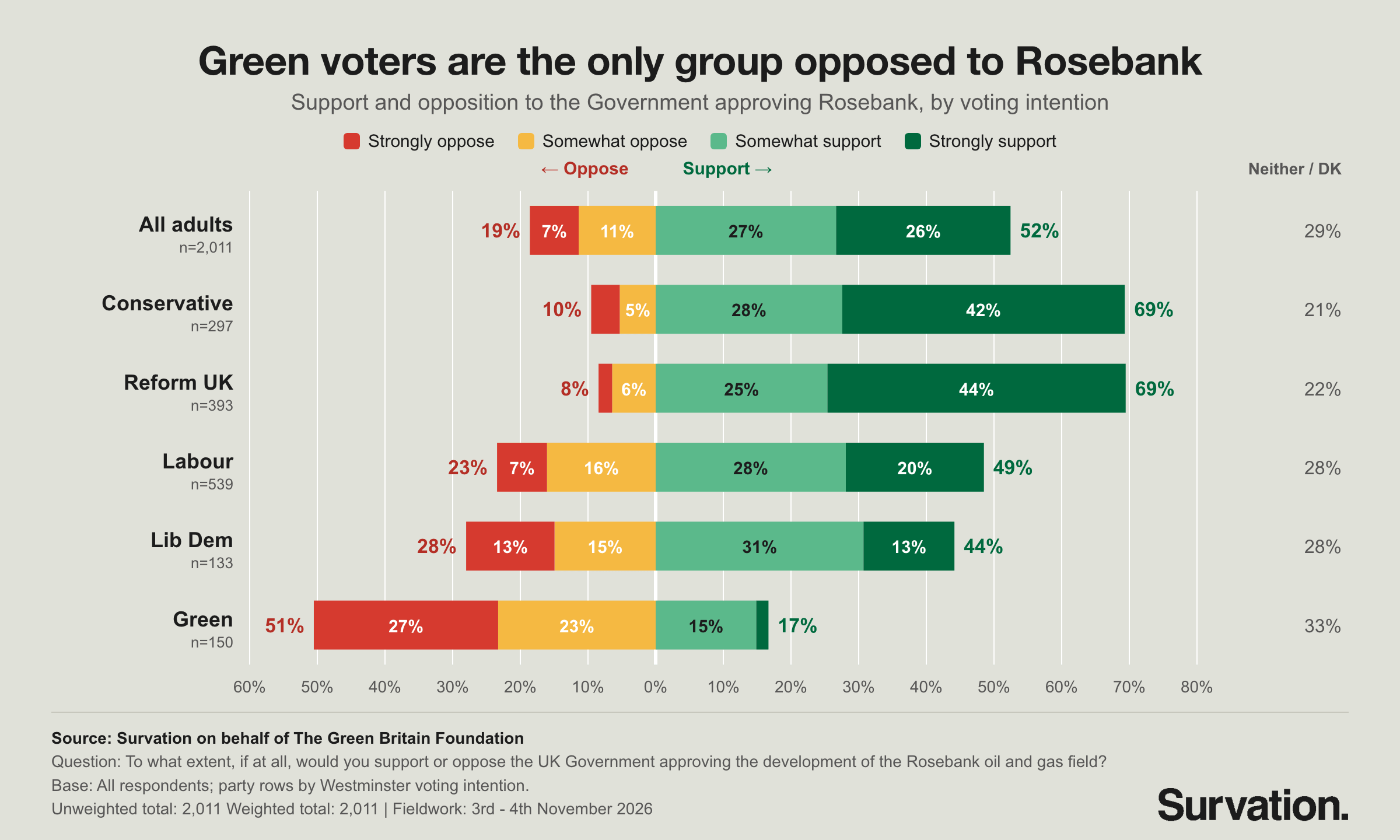
Fewer than half (48%) of the public had heard a great deal or a fair amount about Rosebank before the survey. Even so, just over half of the public (52%) support the Government approving Rosebank, against around one in five (19%) who oppose, with the rest neutral or unsure.
Support is strongest on the right, where seven in ten Conservative and Reform voters are in favour. Among the progressive parties, a plurality of likely Labour and Lib Dem voters back approval (49% to 23% and 44% to 28% respectively), while those intending to vote for the Green Party are opposed by 51% to 17%. Age is another dividing line, with 18-24s evenly split on approval (28% support, 29% oppose, 30% neither) while over-65s overwhelmingly support it 74% to 9%.
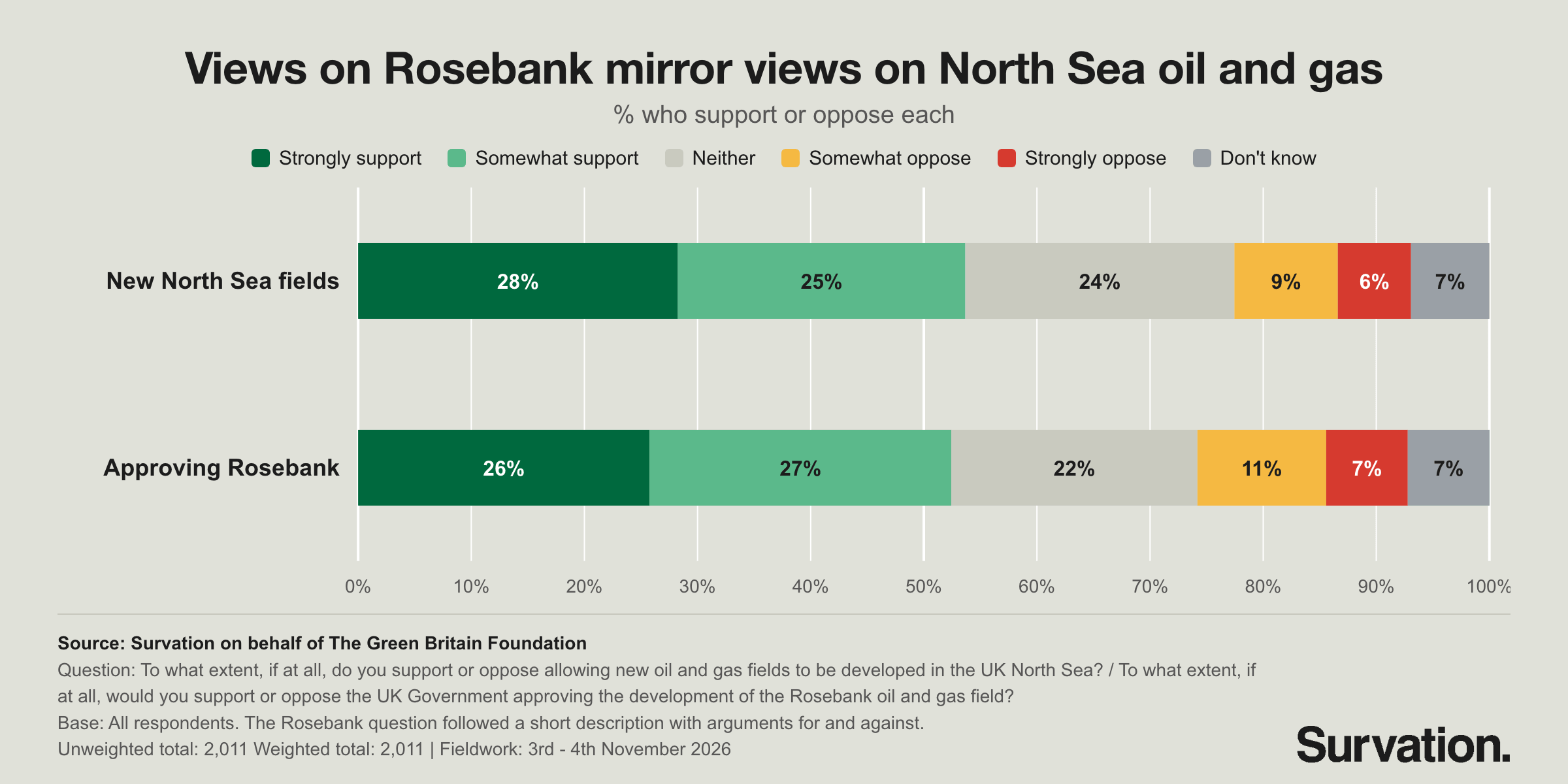
However, the public’s views on Rosebank may say more about attitudes to oil and gas than about the project itself. Respondents were asked about North Sea oil and gas generally before being shown a short description of Rosebank. The results were almost identical (54% support, 16% oppose), suggesting the description did little to shift views.
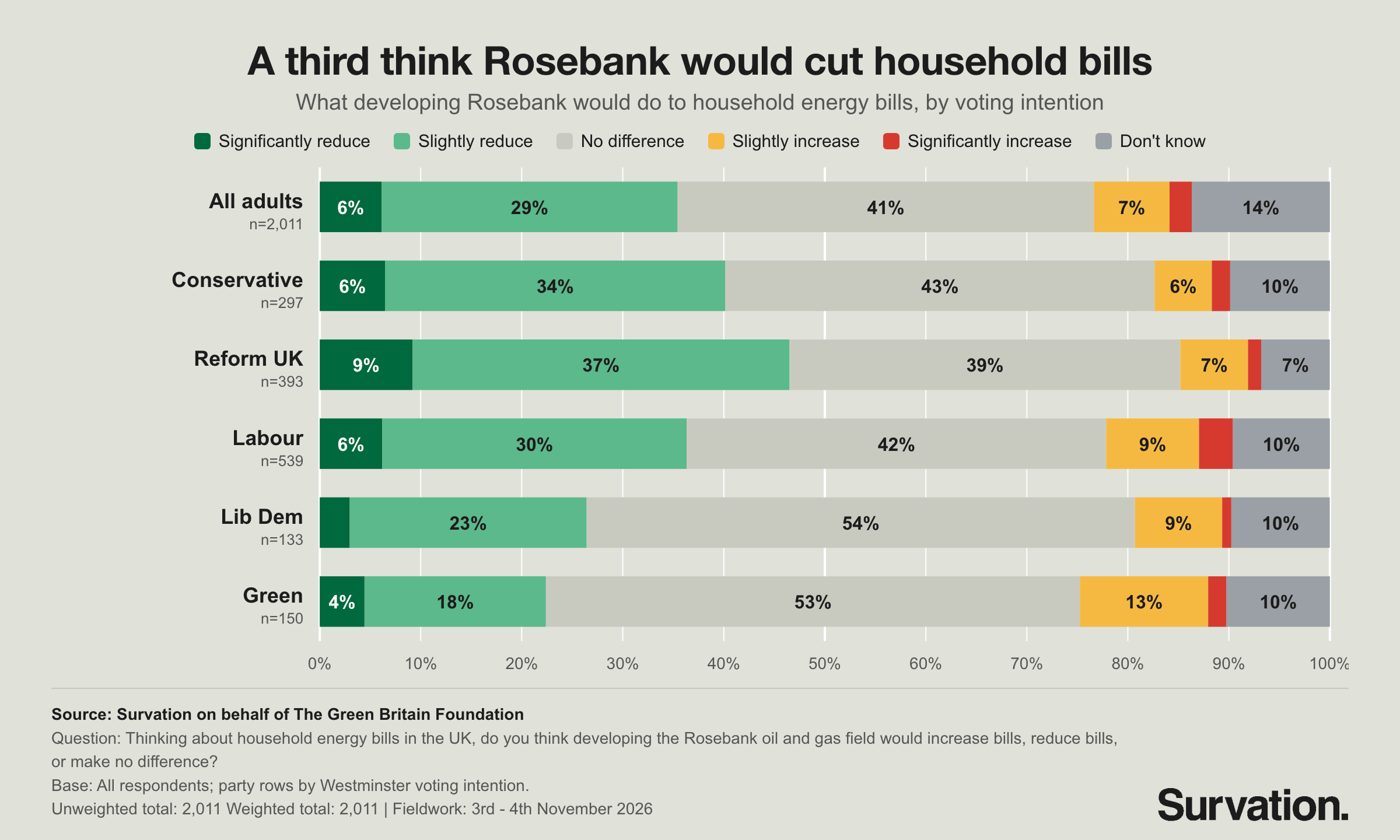
Expectations about bills also split respondents. Asked what Rosebank would mean for household energy bills, around a third (35%) think it would reduce them, 10% that it would increase them and 41% that it would make no difference. Those who expect it to lower bills back approval by more than seven to one (73% to 10%), while everyone else supports it by a much narrower 41% to 23%. Given that independent analysts do not expect new North Sea production to noticeably cut household bills, their support may be softer than it looks.
Rosebank’s opponents are the voters Labour needs
Rosebank may be popular overall, but its political impact depends on who opposes it, rather than how many. Our MRP for 38 Degrees, published in September, found Labour on 272 seats, 54 short of a majority, with 200 seats predicted to be decided by fewer than five points. As our Research and Data Analyst PJ Stock wrote at the time, Labour’s chances of a majority depend heavily on progressive voters, both returning to Labour and voting tactically in seats where Labour is best placed to beat Reform.
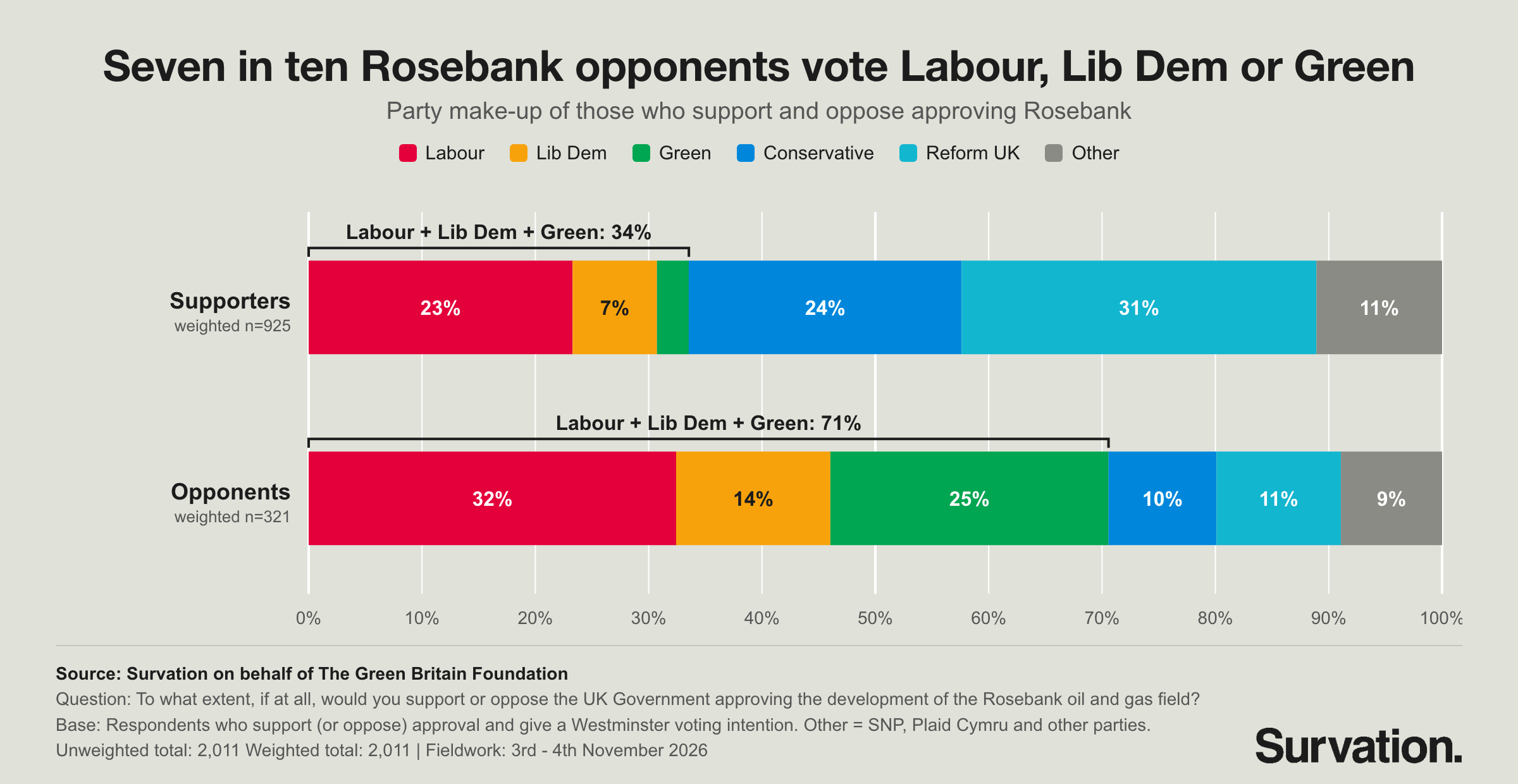
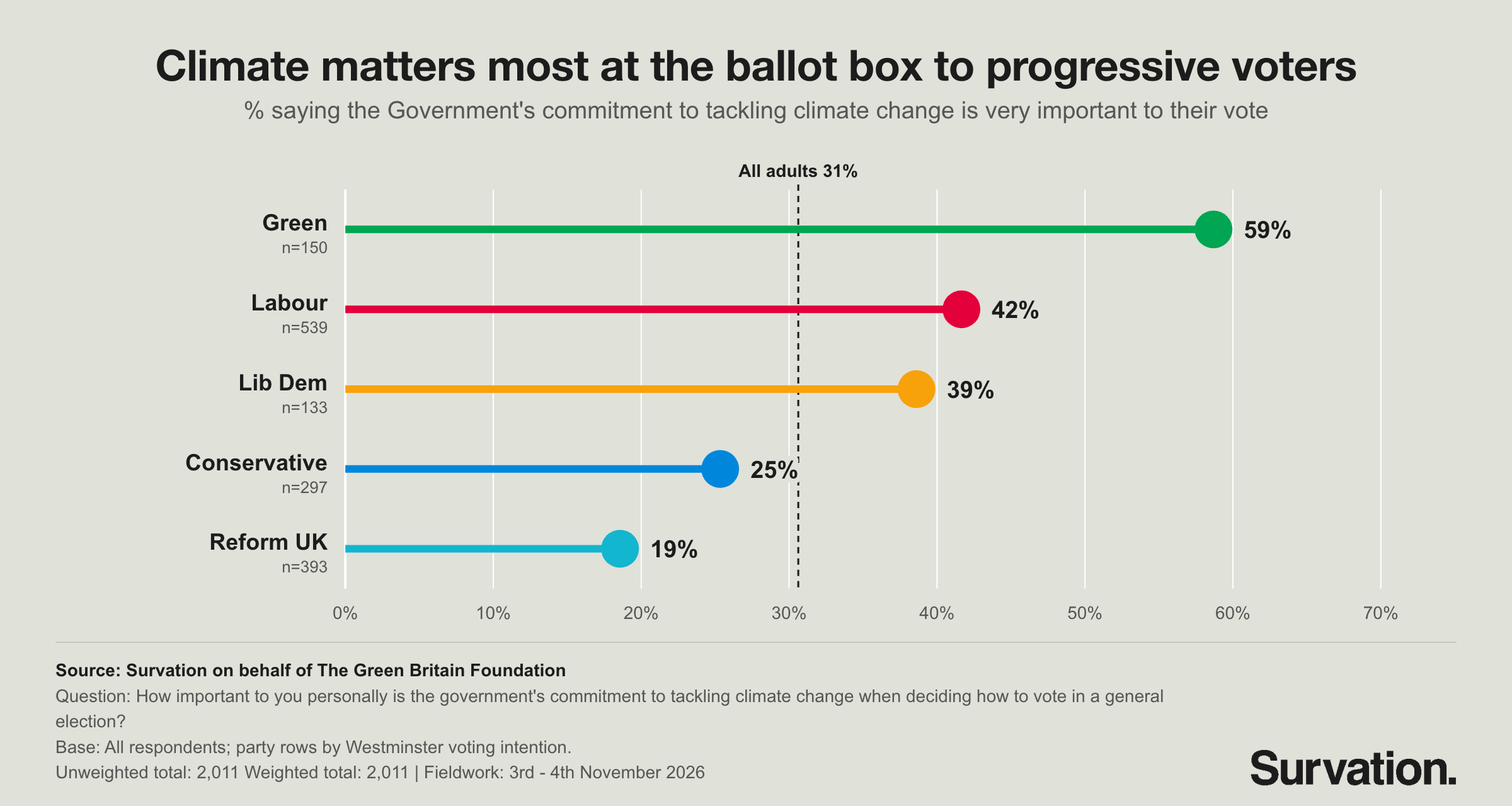
That matters for Rosebank, because its opponents are concentrated among exactly these progressive voters. Of those who gave a vote intention, Labour, Lib Dem and Green voters make up seven in ten (70%) of Rosebank’s opponents and only a third (34%) of its supporters. They are also the voters for whom climate carries the most weight at the ballot box: around two in five Labour (42%) and Lib Dem (39%) voters and three in five Greens (59%) say the Government’s commitment to tackling climate change is very important to their vote, compared with just 25% of Conservative and 19% of Reform voters.
Our work for 38 Degrees also found that tactical voting depends on how strongly people prefer one front-runner over the other. In Labour vs Reform seats, approving Rosebank is unlikely to push progressive voters towards Reform: around eight in ten Labour (77%) and Lib Dem (81%) voters, and almost nine in ten Greens (86%), put their chance of ever voting Reform at 3 out of 10 or lower. However, some may be less willing to lend Labour their vote, sticking with their first choice or staying at home.
If the Government approves Rosebank, it risks alienating the voters it most needs to win back or persuade to vote tactically. The next section tests whether that risk shows up when we ask voters directly.
Would approving Rosebank win Labour votes?
To investigate whether Rosebank’s popularity would help Labour if it approved it, we randomly split respondents into two groups: one was asked how they would react if the Government approved Rosebank, the other if it rejected it, and both were asked how it would affect their vote. Questions like this tend to overstate how many people would actually change their vote, and some groups are small once split, so the results are best read as a guide to the direction and strength of feeling, not as a forecast of vote shares.
At first glance, approval does better. It leaves Labour with a NET score of +9, against -2 if Rosebank is rejected. But almost all of that gap comes from Conservative and Reform voters, who respond well to approval and badly to rejection but are unlikely to vote Labour anyway: 84% of Reform and 73% of Conservative voters put their chance of ever voting Labour at 3 out of 10 or lower. When we ask both groups which party they would vote for, Labour’s share is identical whichever way the Government decides, and neither Reform’s nor the Conservatives’ share moves by more than a point.
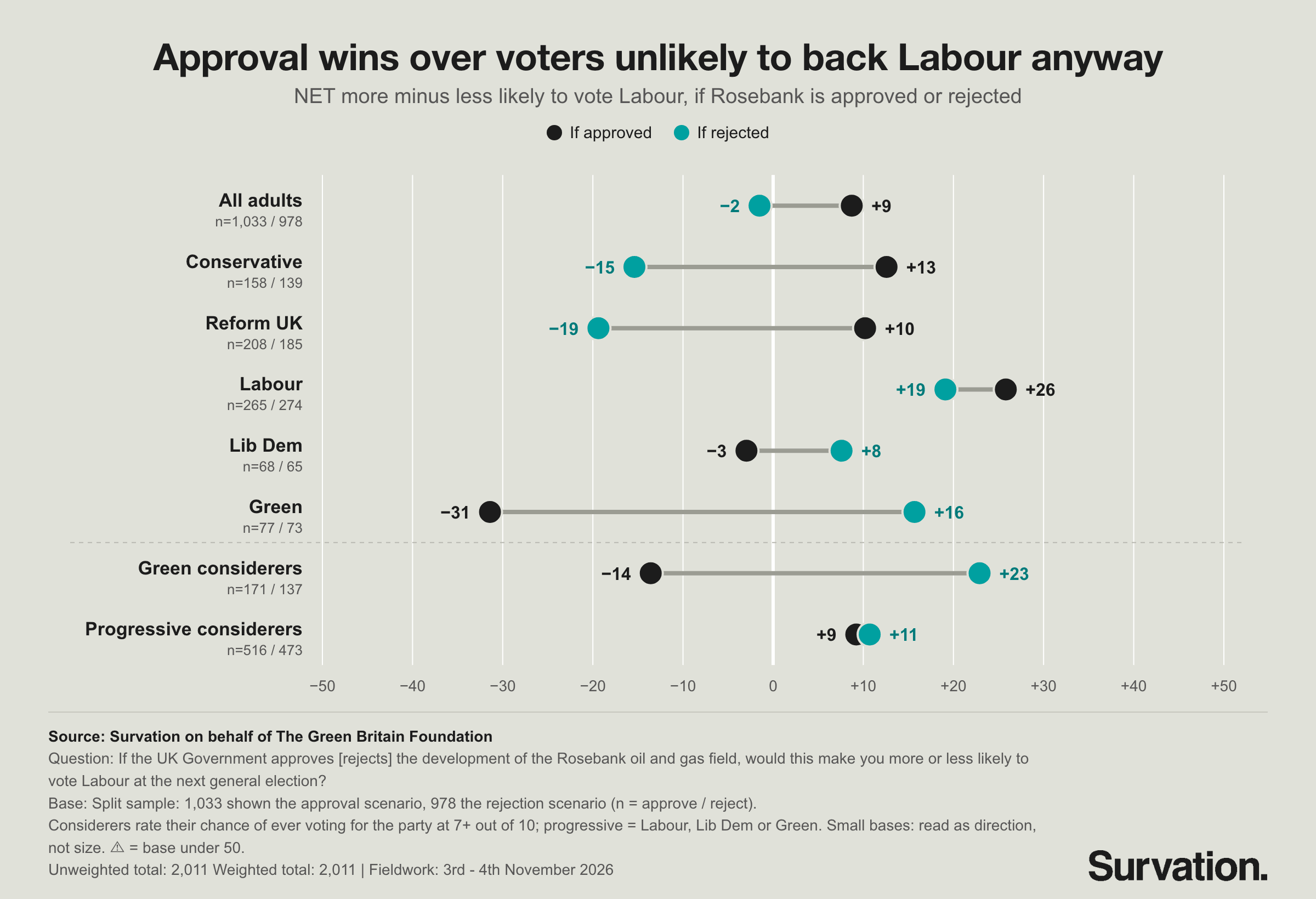
The voters who react against approval are the ones identified in the previous section. If Rosebank is approved, 44% of Green and 35% of Lib Dem voters say they would think the Government takes climate change less seriously. The sharpest split is among Green considerers, those who rate their chance of ever voting Green at 7 or more out of 10. If Rosebank is approved, they say they would be less likely to vote Labour by almost two to one (32% to 19%, NET -14). If it is rejected, that reverses: 37% more likely and 14% less likely (NET +23). Among the three in ten (31%) who say the Government’s commitment to tackling climate change is very important to their vote, rejection does slightly better for Labour than approval (NET +16 against +6), though the difference is within the margin of error.
| Group | Scenario | More likely to vote Labour | Less likely to vote Labour | NET |
|---|---|---|---|---|
| All adults | Rosebank approved | 21% | 12% | +9 |
| All adults | Rosebank rejected | 16% | 18% | -2 |
| Green considerers | Rosebank approved | 19% | 32% | -14 |
| Green considerers | Rosebank rejected | 37% | 14% | +23 |
Those put off would mostly look elsewhere on the left rather than to Reform: among progressive considerers who say approval would make them less likely to vote Labour, almost half would turn to the Greens and three in ten to the Lib Dems, against one in ten to Reform (based on 101 respondents). In other words, the votes approval appears to win are mostly among people unlikely to vote Labour, while the voters it puts off are those Labour needs the most.
So, will Rosebank matter at the ballot box?
Rosebank and the transition away from fossil fuels are likely to be one issue among many at the next election, with the cost of living continuing to dominate the public’s concerns. With fewer than half (48%) having heard a great deal or a fair amount about Rosebank, and almost a quarter (24%) having heard nothing at all, it may weigh less on how people vote than these figures imply.
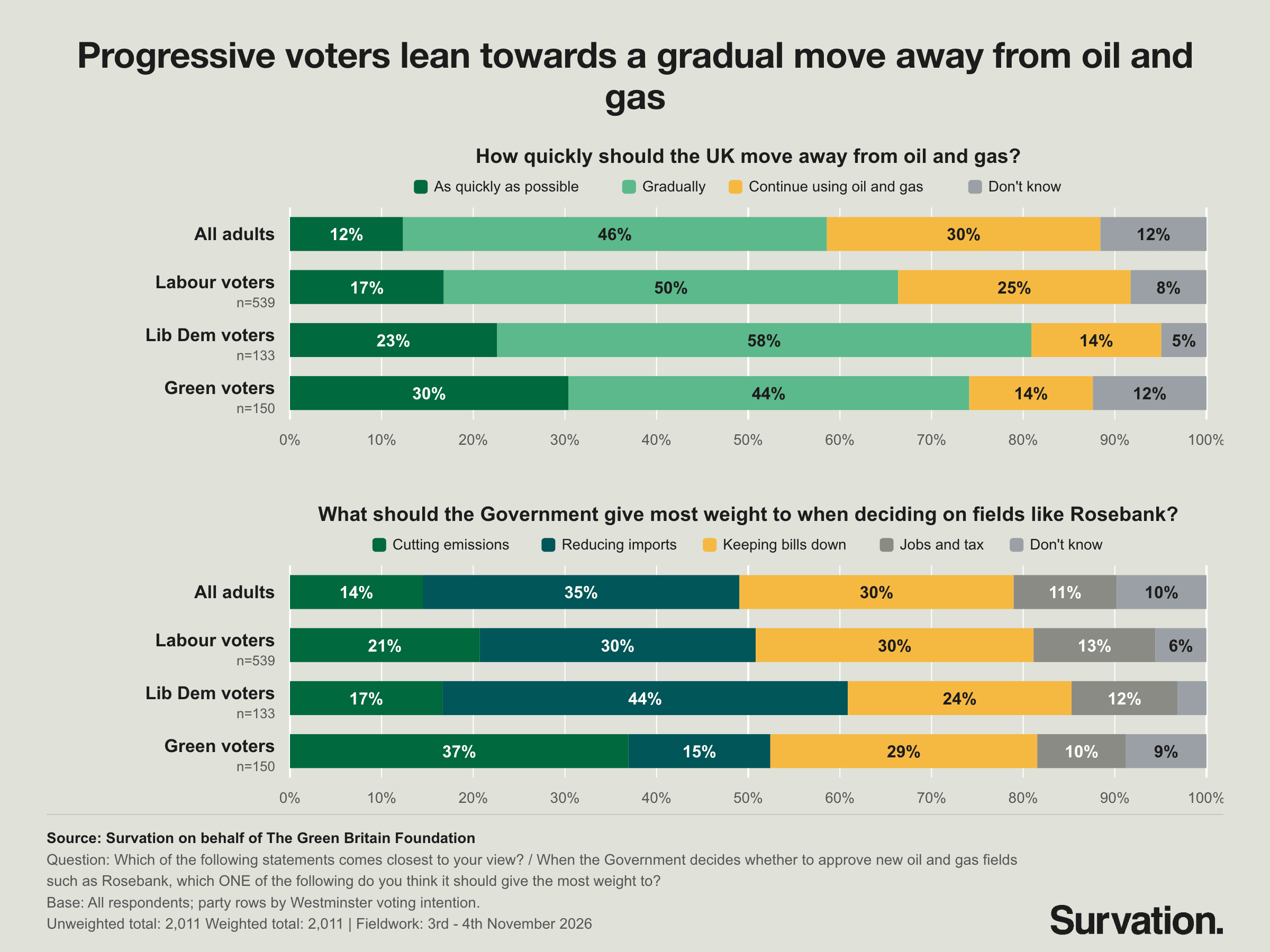
A gradual move away from oil and gas, rather than an immediate one, is also the most common view among progressive voters: half of Labour voters, almost six in ten Lib Dems and more than four in ten Greens favour it, against fewer than a third in each group who want to move away as quickly as possible. And asked what the Government should give most weight to when deciding on fields like Rosebank, only around one in five Labour voters (21%) chose cutting emissions, behind reducing reliance on imports and keeping bills down (three in ten each). Rosebank may therefore sit within the bounds of what many progressive voters are willing to tolerate.
Taken together, Rosebank looks unlikely to be a decisive issue for most voters. A majority support approval, and neither decision moves headline voting intention in our data. But Labour’s route to a majority doesn’t depend on most voters. It depends on narrow margins in seats where progressive voters must decide whether to back Labour to stop Reform. The voters most opposed to Rosebank, and most likely to think less of Labour’s climate commitment if it goes ahead, are concentrated in that group. The risk for Burnham, then, is less that approval costs him votes outright, and more that it makes the progressive consolidation he needs a little harder to achieve.
Get the data
Survation interviewed 2,011 adults aged 18+ living in the UK online on behalf of The Green Britain Foundation between 3 and 4 November 2026. Respondents were first asked about new North Sea oil and gas fields and their awareness of Rosebank, then shown a short description of Rosebank before being asked whether they supported approval. They were then randomly assigned to one of two scenarios: 1,033 were asked about the Government approving Rosebank and 978 about it rejecting it. Data were weighted by age, sex, region, nation, highest level of qualification, social grade, annual equivalised household income, 2024 General Election vote and 2016 EU Referendum vote to the profile of all adults in the UK aged 18+.
Full data tables can be downloaded here.
————————————————
If you are interested in commissioning research or to learn more about Survation’s research capabilities, please email researchteam@survation.com, visit our online surveys and polling page or call John Gibb on 020 3818 9661
For press enquiries, please call 0203 818 9664 or email media@survation.com
Survation is an MRS Company Partner and a member of the British Polling Council.
< Back