30 Days of Burnham: Has the ‘bounce’ continued?
In Survation’s latest Westminster voting intention poll, conducted on 18 August 2026, the race between Labour and Reform UK is again tied at 26% each.
This fieldwork marks the end of Burnham’s first month as Labour leader (17 July) and Prime Minister (20 July). Whilst the polling has moved since he took office, we are still very early in his premiership, and the trend will become clearer over the coming months.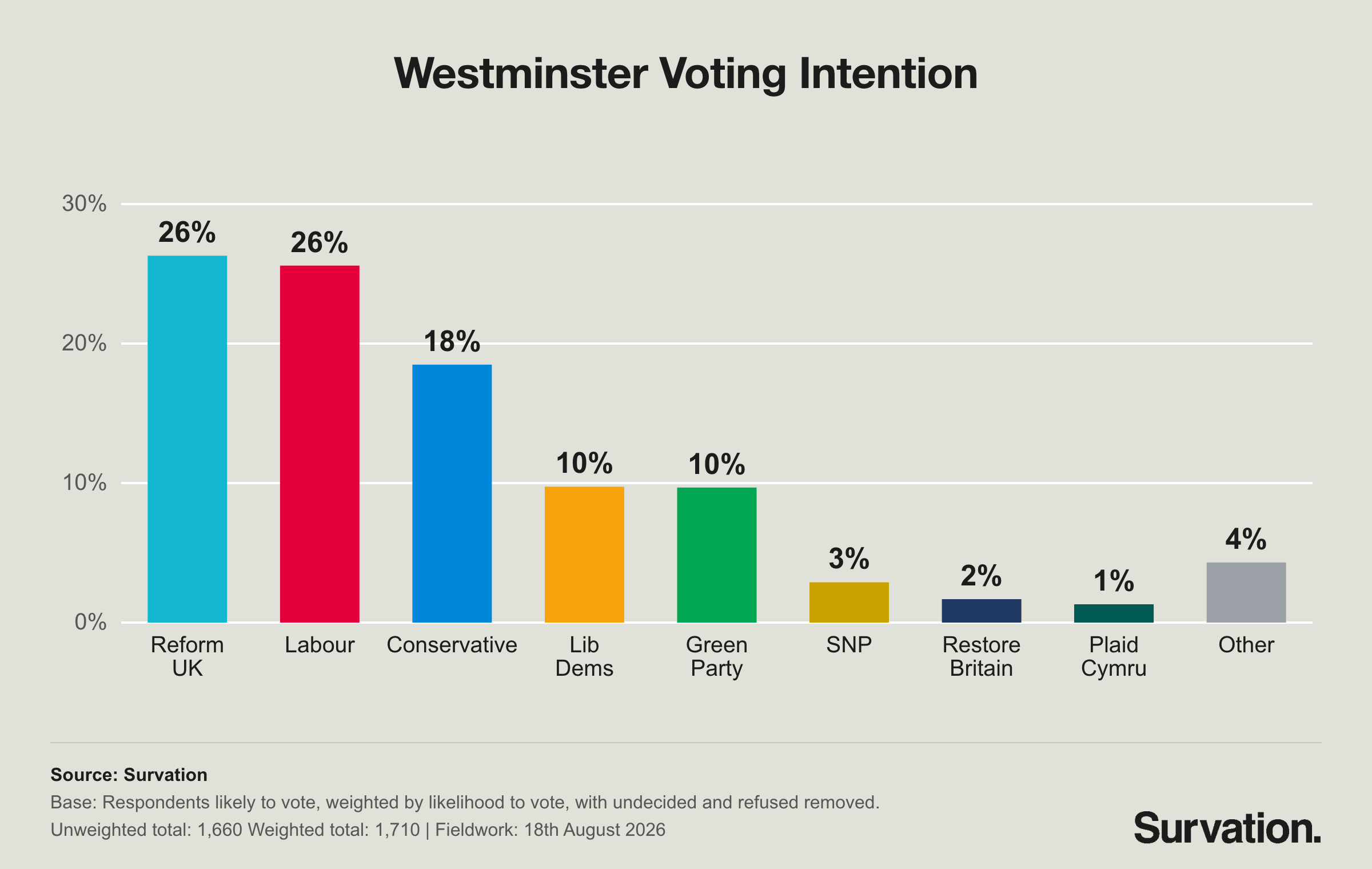
The trajectory since Burnham took office
Looking across consecutive Survation polls around the time of the leadership change gives a sense of the early “Burnham effect”: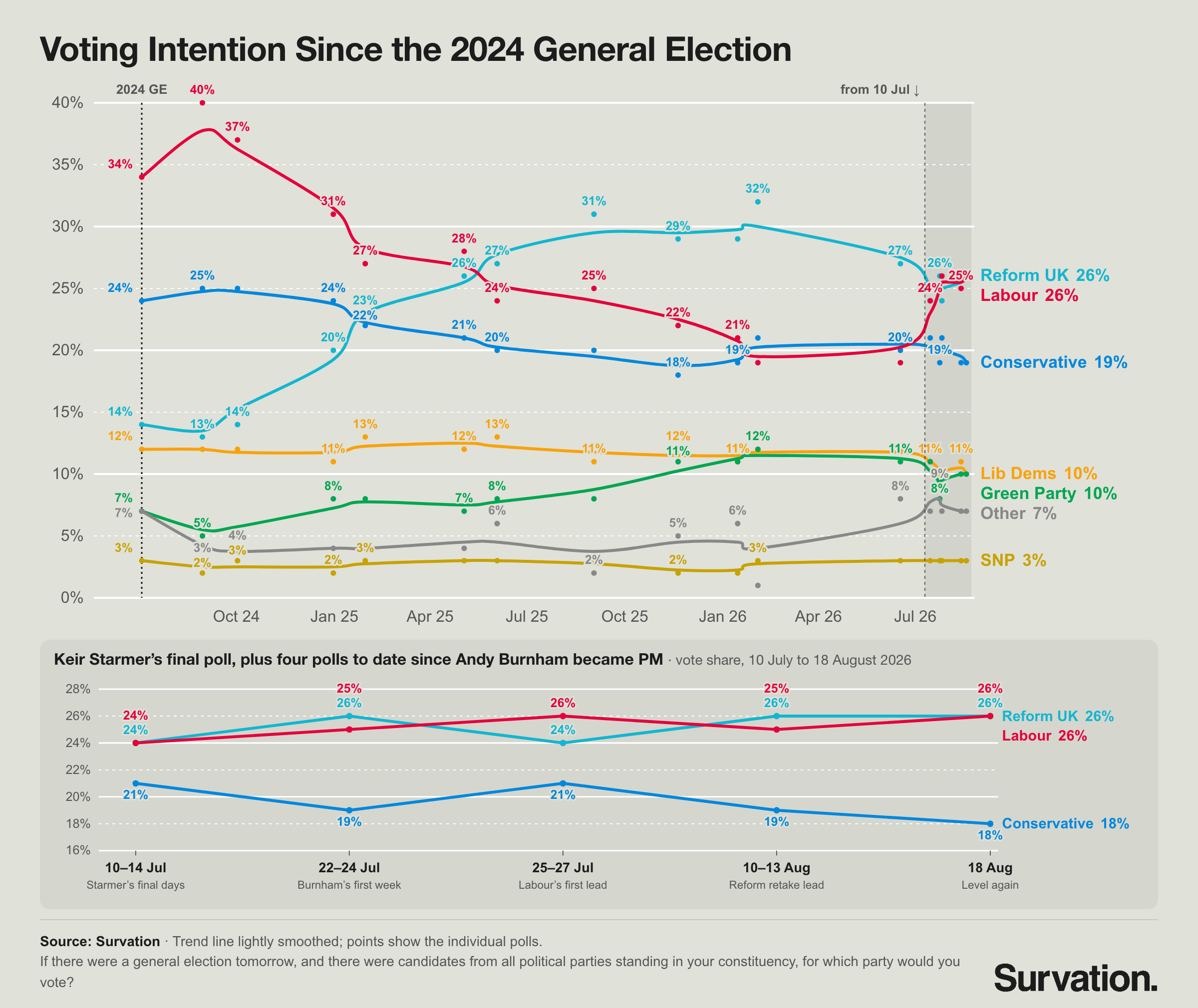
In Starmer’s final poll (10–14 July), Labour and Reform were tied on 24%, with the Conservatives on 21%.
In the first weeks after Burnham became Prime Minister, Labour rose and briefly took a narrow lead, reaching 26% in late July, their highest share with Survation for more than a year and the first time they had headed the series since May 2025.
Since then the most recent two polls show Labour and Reform essentially level, both sitting on 25–26%, while the Conservatives have remained stuck in the high teens to low twenties.
Whilst the leadership change halted the long decline in voting intention for Labour under Starmer, it has not yet produced a decisive breakthrough, and so far all movements are within the margin of error.
Confidence in the Government’s ability to address the issues
Public confidence in the government’s ability to address key national issues decreased steadily under Starmer. By the time he left office, NET confidence was negative across the board, with immigration, refugees and asylum seekers, and the economy all sitting between –41 and –36.
Below are the net confidence scores across the four Survation polls conducted since Burnham came to office. A positive NET means more people are confident than not; a negative NET means more people are not confident than confident.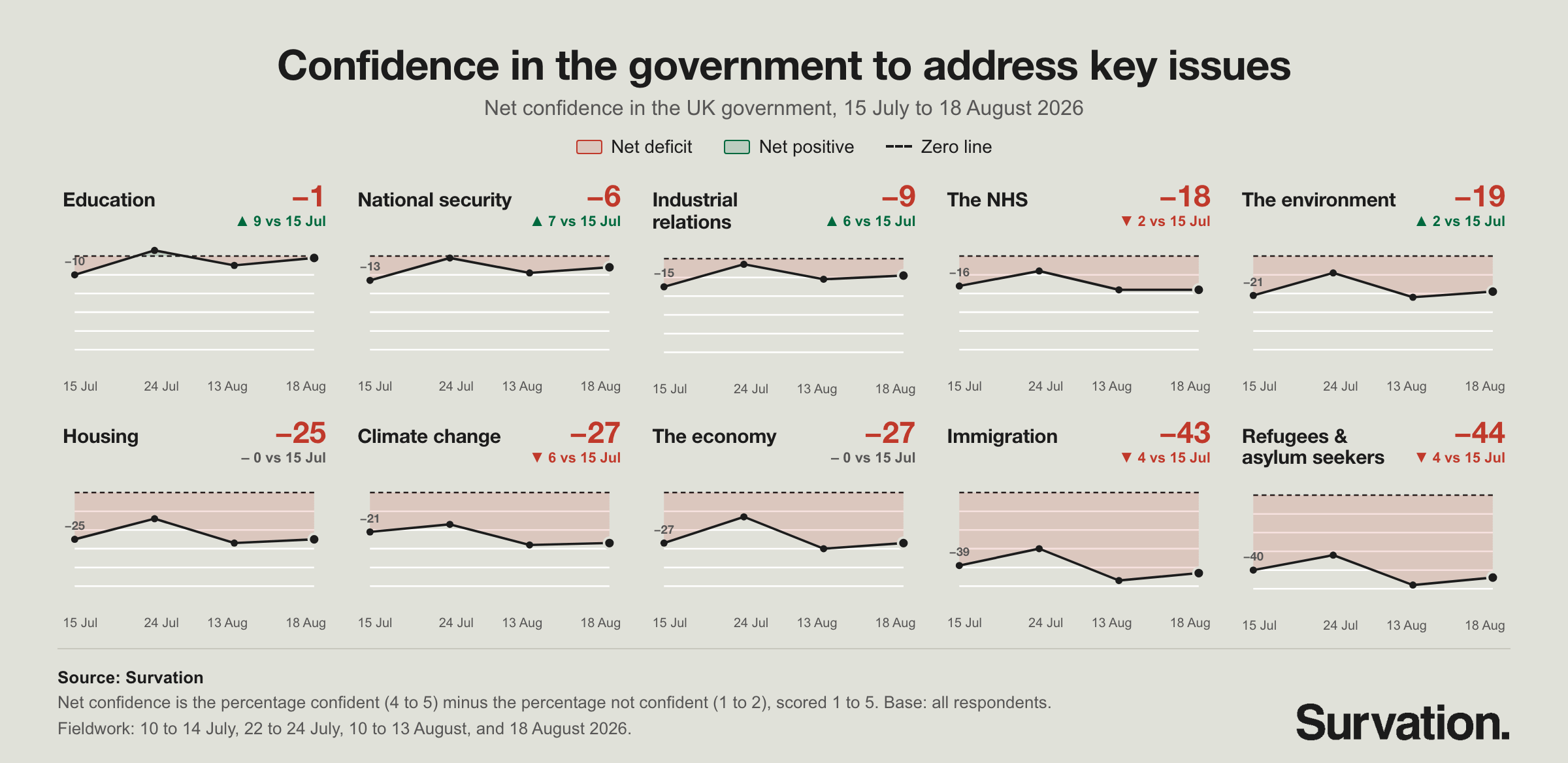
Right after the leadership change, confidence improved across most issues – in some cases sharply. The economy moved from –36 to –13 and immigration from –43 to –30, while education even flipped into positive territory figures (+3) in the previous Survation poll. That lift coincided with the period in which Labour briefly took the lead (25–27 July).
However, the poll conducted three weeks into his premiership marked a return to negativity across the board, with refugees reaching -48 and immigration -47. That negativity persisted into the latest figures – immigration at -43, refugees and asylum seekers at -44, the economy at -27, education at -1 and national security at -6 – and even with a modest recovery on some measures, all remain well below the early-Burnham peak (25-27 July).
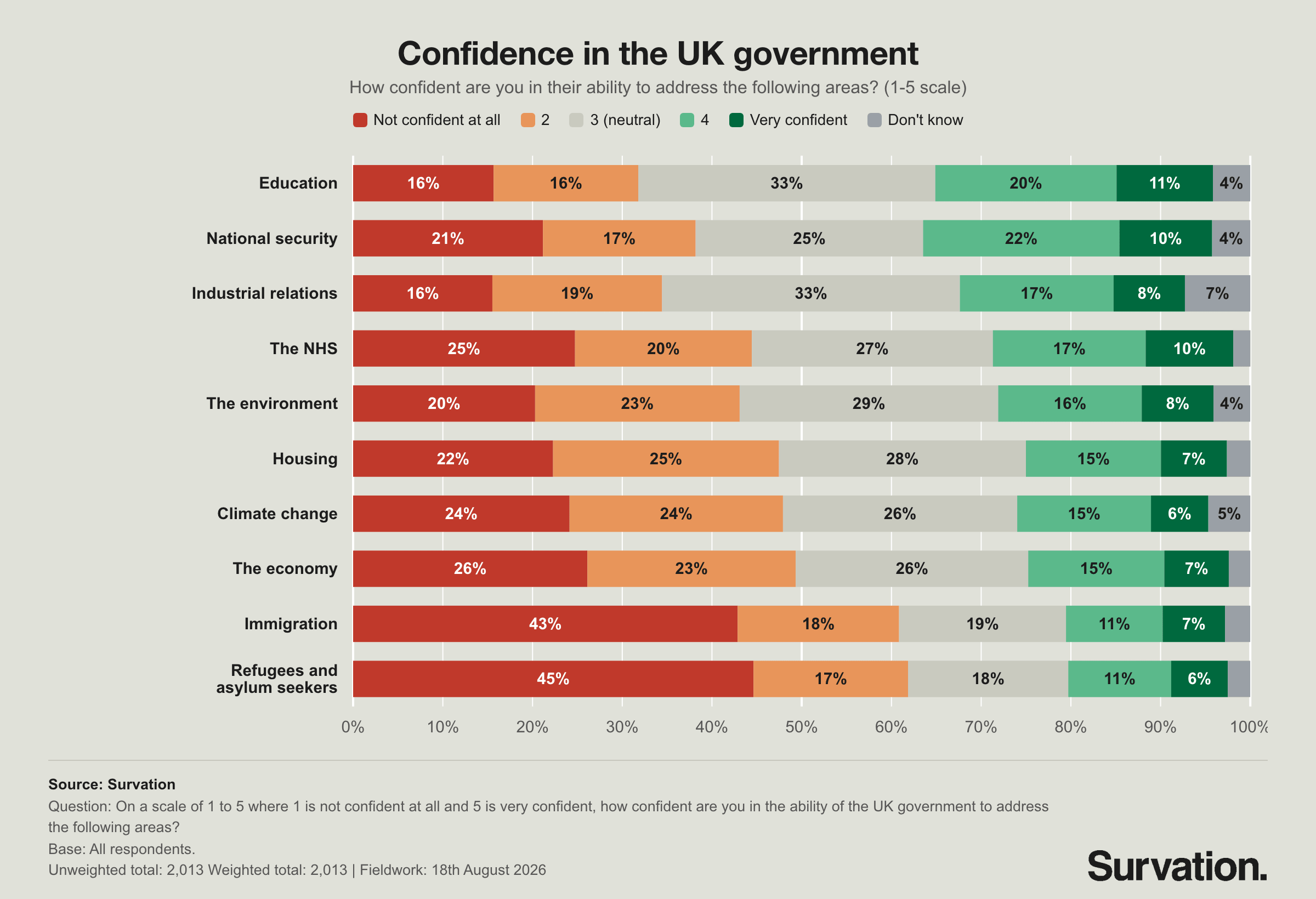
Again, this is across four polls conducted over the course of a month, so a longer-term trend is yet to be established. It is notable, though, that immigration has already slipped back to the kind of numbers Starmer saw, while confidence on refugees and asylum seekers (–44) is now lower than it was in Starmer’s final days (–41). The economy, meanwhile, remains meaningfully better than his final range at –27.
This fluctuation on refugees and asylum seekers came in the context of comments Burnham made on dispersal. On 11 August the Prime Minister told GB News that it could not be the case that only the poorest communities received all of the dispersal of refugees and asylum seekers, arguing that “all parts of the country need to work, to play their part.” The remarks were widely reported the following day (BBC News).
Education (-1) and national security (-6) remain the least negative areas, but even these have slipped from their early-Burnham highs. The initial honeymoon improvement in public faith in the government’s ability to deliver does not appear to be holding.
Leader ratings: Burnham maintains pole position
Where the positivity is clearest is in Burnham’s edge over his rivals on leadership approval. The most recent poll puts him at +14 NET approval, down slightly from previous highs of +19 and +17. For contrast, Keir Starmer was at –55 in the last poll to ask this question of him, on 30 June 2026.
Kemi Badenoch has the second highest approval at +7. Ed Davey is at –2, while Nigel Farage is at –17 and Zack Polanski at –20.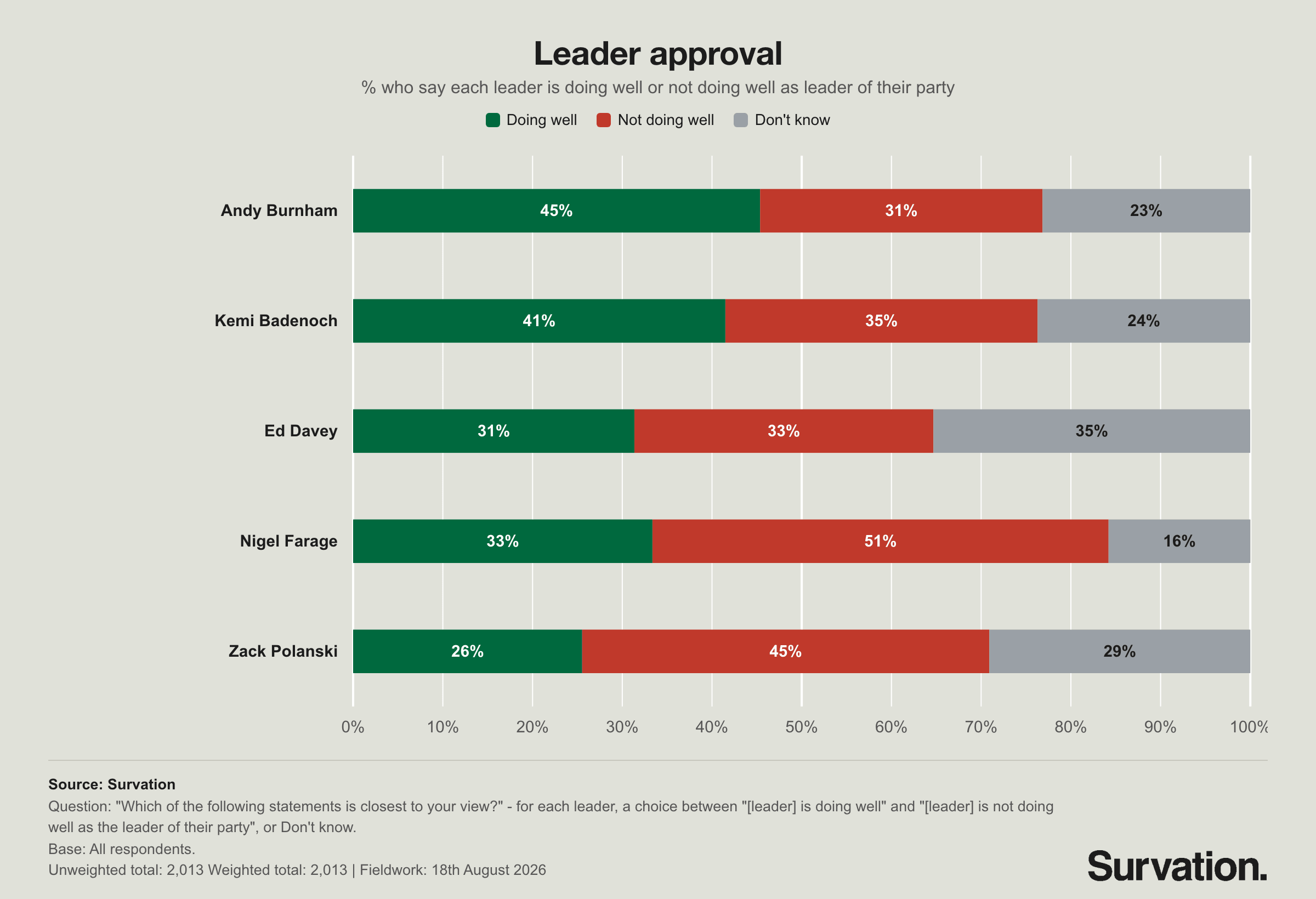
Where things stand now
Labour are in a stronger position than at any point in the previous year. Burnham’s personal standing is a clear improvement on the final Starmer period, and there was an early lift in public confidence.
One month in, however, Labour are yet to maintain a definite lead, and confidence in those key issues appears to already be slipping.
The coming months will show whether the early ‘bounce’ can be turned into a consistent lead, or whether the public’s continuing lack of confidence, especially on asylum and immigration, will drag Labour back.
—
GET THE DATA.
Survation conducted an online poll of 2,013 adults aged 18+ in the UK on their voting intentions. Fieldwork was conducted on 18th August 2026. Changes are versus our poll of 10-13 August 2026. Tables are available here.
_____________________________
Survation is an MRS company partner, a member of the British Polling Council and abides by their rules. To find out more about Survation’s services, and how you can conduct a telephone or online poll for your research needs, please visit our services page.
If you are interested in commissioning research or to learn more about Survation’s research capabilities, please contact John Gibb on 020 3818 9661, email researchteam@survation.com, or visit our services page.
For press enquiries, please call 0203 818 9661 or email media@survation.com
< Back