Britain voted for change. Two years on, Labour is being judged on it
New polling and MRP for 38 Degrees shows a public that agrees on what it wants and is waiting to see whether Burnham’s government can deliver.
Two years into a Labour government and two months into Andy Burnham’s premiership, our annual poll and MRP analysis of 8,124 people on behalf of 38 Degrees, as featured in The Guardian, finds a country that has stopped feeling better off and largely agrees on what should be done about it. On that agenda, Labour is (narrowly) more trusted to deliver it than any other party.
Alongside this, we delve into the issues and policies among the Progressive Majority which we initially developed with 38 Degrees a year ago. These are the 54% of voters who would seriously consider voting Labour, Lib Dem, Green, SNP or Plaid. They now make up nine in ten Labour voters, up from eight in ten in 2024, but they are not one bloc. All five segments agree the cost of living comes first, but they disagree on social issues and on whether politics can change anything. That gap between what unites people and what divides them is where Labour’s narrow path to a second term lies.
A country down in the dumps..
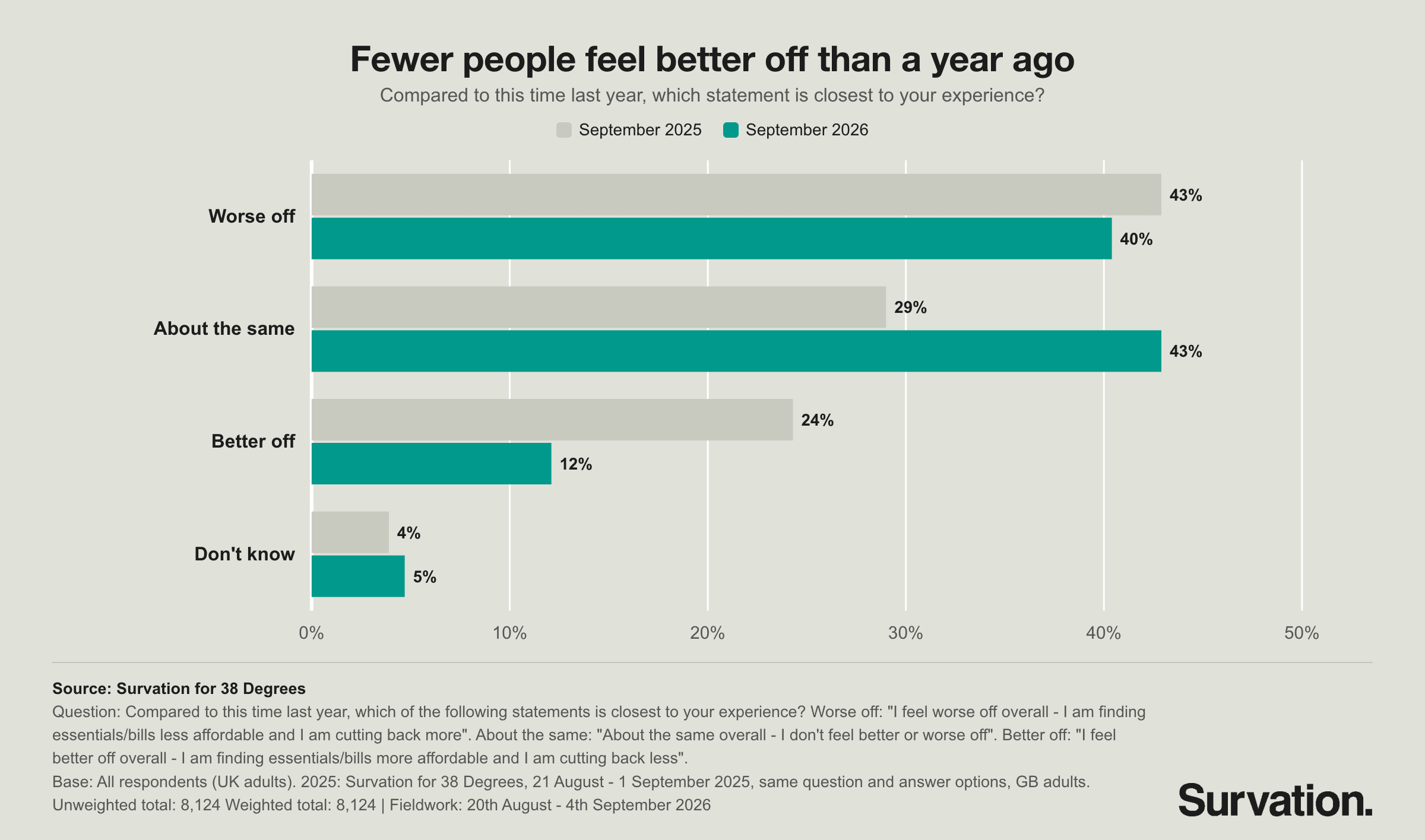
The number of people who feel worse off than a year ago has barely moved, and 40% say so now, against 43% last September. The change is at the other end. Last year, close to a quarter (24%) felt better off than twelve months before. This year, it is down to one in eight (12%), with almost all of the difference moving into people feeling no better or worse off.
The geographic distribution of this issue is even more telling. We applied MRP analysis on the data to map out how people feel about their finances across constituencies in Great Britain. When we did this a year ago, feeling better-off was the modal answer in 46 constituencies, with 35 of them in London. This year, the same number is zero.
What is more, people expect this to get even worse. When we ask people about their expectations for how their household finances will look a year from now, a third expect them to get worse, and fewer than one in five (19%) expect them to get better, while quarter of the public (25%) already feel worse off than a year ago and expect next year to be worse again.
Change delayed?
Feeling “about the same” is a fair assessment of how the public has judged the last two years, after electing a Labour government which campaigned on a platform of change and national renewal without seeing much measurable change. A year before the election, in our June 2023 poll for 38 Degrees, cheaper energy bills topped the list of changes people most wanted from the next government (41%).
A week after the general election, a plurality of the public felt more positive about the future, but they were hedging their bets: there was no policy area in which a majority expected things to improve over the following five years. By October 2024, voters were already becoming more pessimistic than optimistic, with one respondent to our qualitative panel for Labour’s 100 days in office describing it as “a very poor start when people have been longing for change in attitude.”
A year in, 44% rated the government’s performance as good and 49% as poor, which presented a sense of disappointment in a government with four years left in power. By last November, 63% said the cost of living had got worse compared with the year before the election, against 15% who said it had got better.
Keir Starmer left office liked by 22% of the public and disliked by 55%. In our July poll for 38 Degrees and Good Morning Britain, with fieldwork conducted in the days before Andy Burnham took over, seven in ten (71%) said the next Prime Minister should clean up British politics to restore public trust, and 79% said Britain needs leaders prepared to shake up the system.
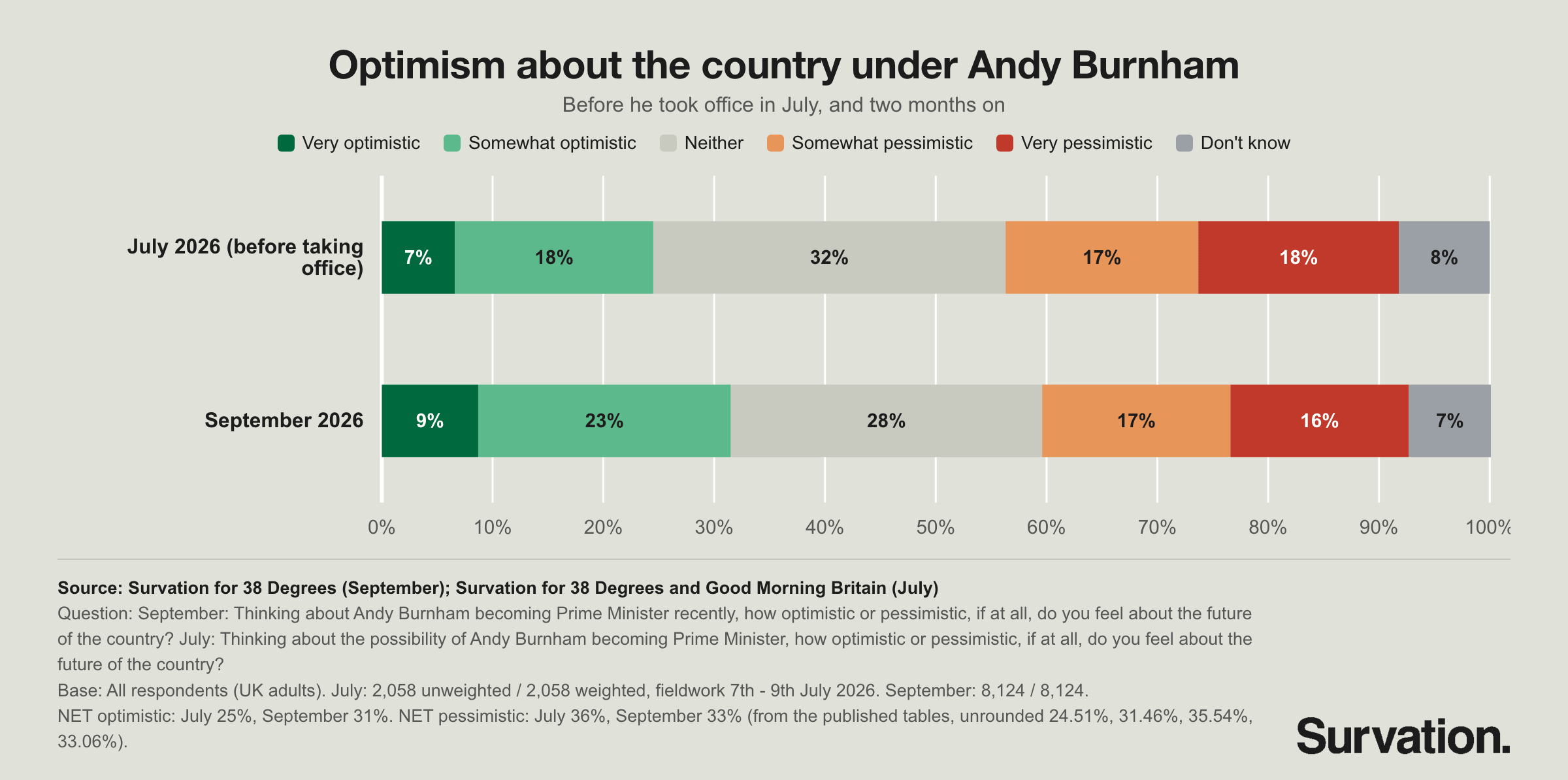
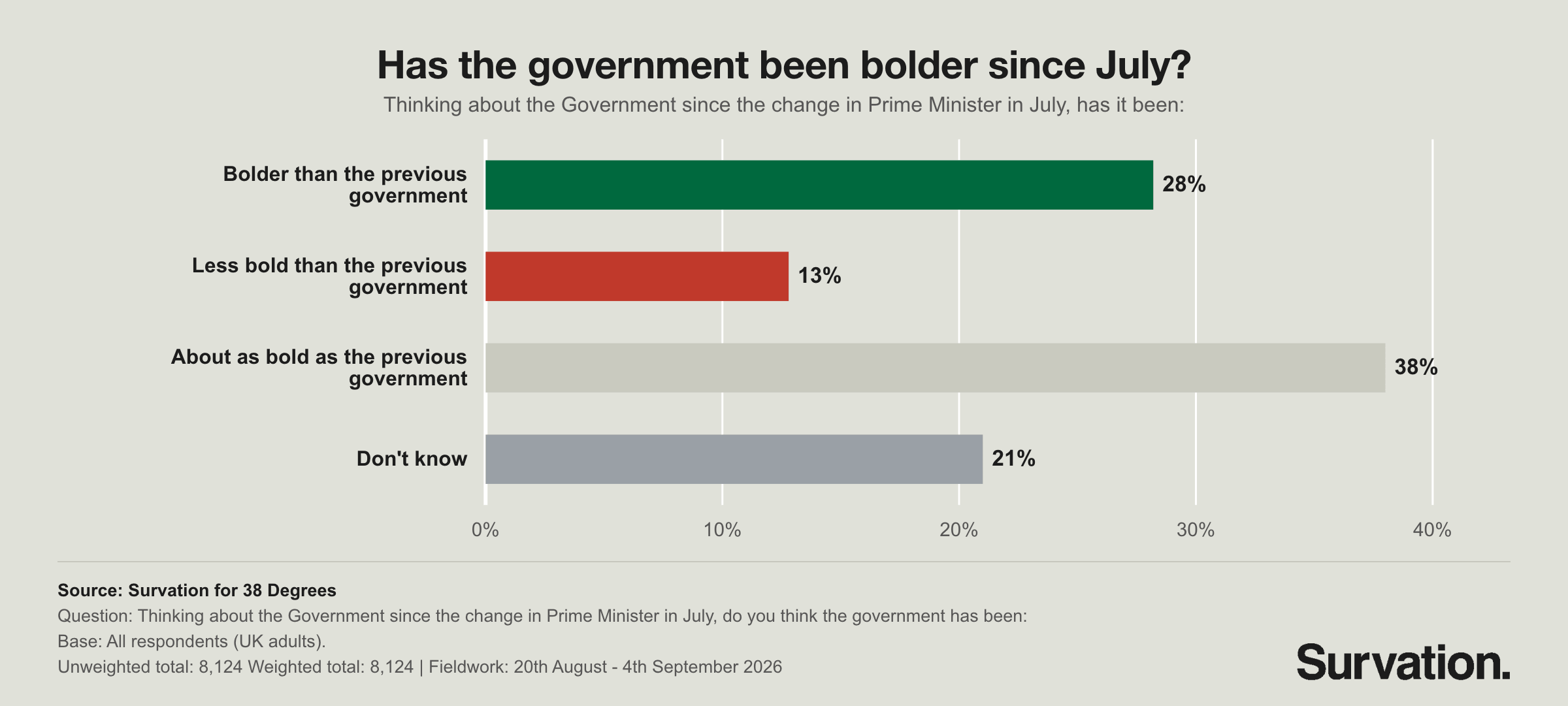
Two months on, the new Prime Minister has a hearing but not yet a verdict. The public has warmed to him a little: in July, pessimism about the country’s future under Burnham outweighed optimism by 36% to 25%, and it is now level, at 33% to 32%. More people think he is committed to cleaning up politics (43%) than think he is not (30%). But while seven in ten (70%) say it is important for a government to be bold and willing to take radical action, just 28% think that the new Burnham government has been bolder than its predecessor.
What actually matters? – position vs valence issues
Political scientists have long distinguished between two kinds of issues. On position issues, voters want different things and parties compete for them by taking different sides on the issue. On what Donald Stokes called valence issues, the public largely agree on the desired outcome, and parties compete on who is more credible at delivering it. Those judgements of credibility are formed largely by comparing what a government promised with what people have felt.
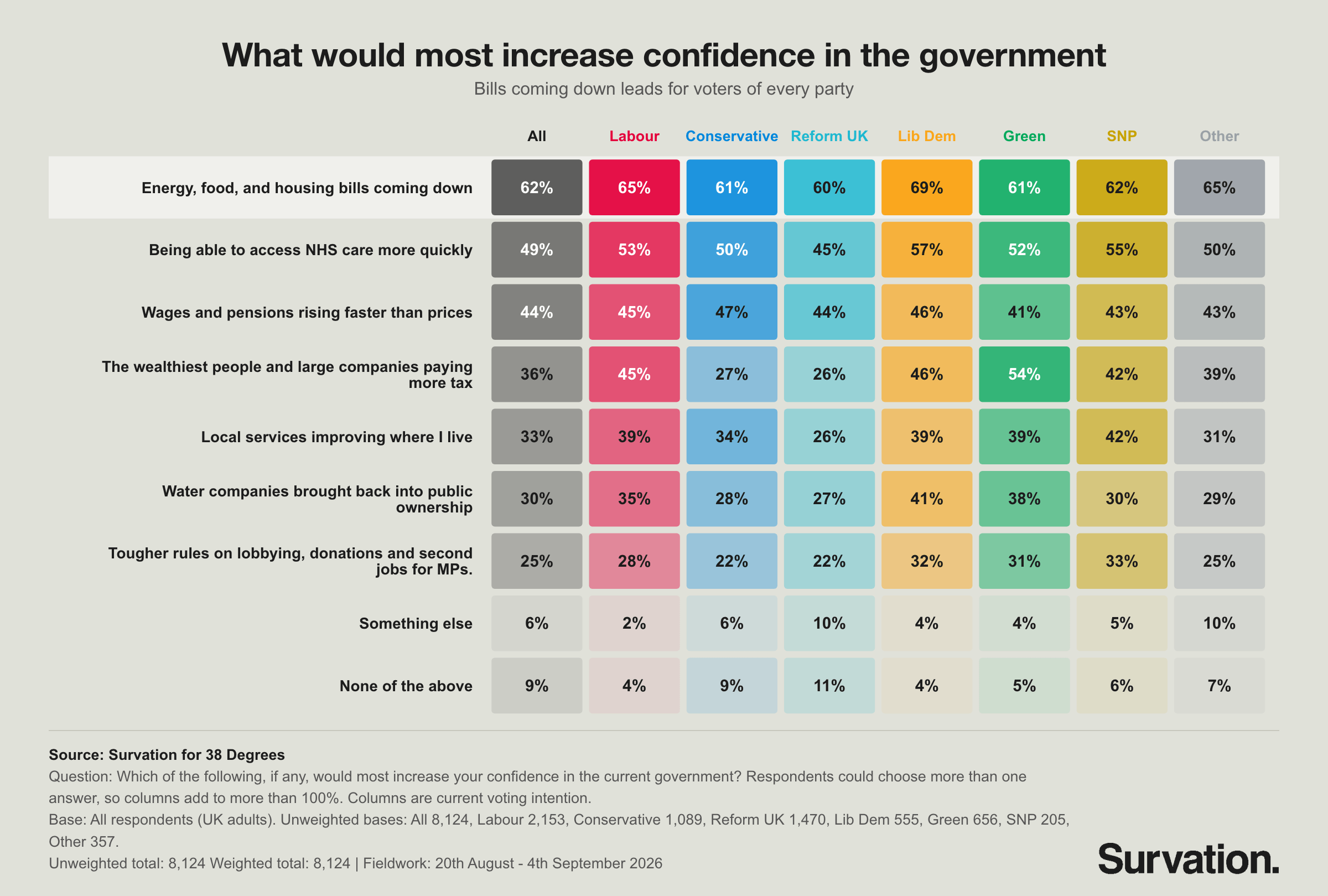
The cost of living is about as clear a valence issue as there can be. It is by far the top issue when we ask people about the issues which have the largest personal impact to them (66%) as well as the issues which are important for deciding their vote (63%). Moreover, when we ask people what would most increase their confidence in the government, 65% of Labour voters, 61% of Conservative voters and 60% of Reform voters choose energy, food and housing bills coming down.
Labour, competence, and the Progressive Majority
Asked which party they trust most across a range of 16 policy areas, voters put Labour ahead of Reform on 15 of them, including the cost of living (+6 points), the NHS (+12), housing and jobs. Taken across all 16 policy areas, a quarter of the public (25%) name Labour, more than those who name no party (23%) and also more than those who name Reform (19%).
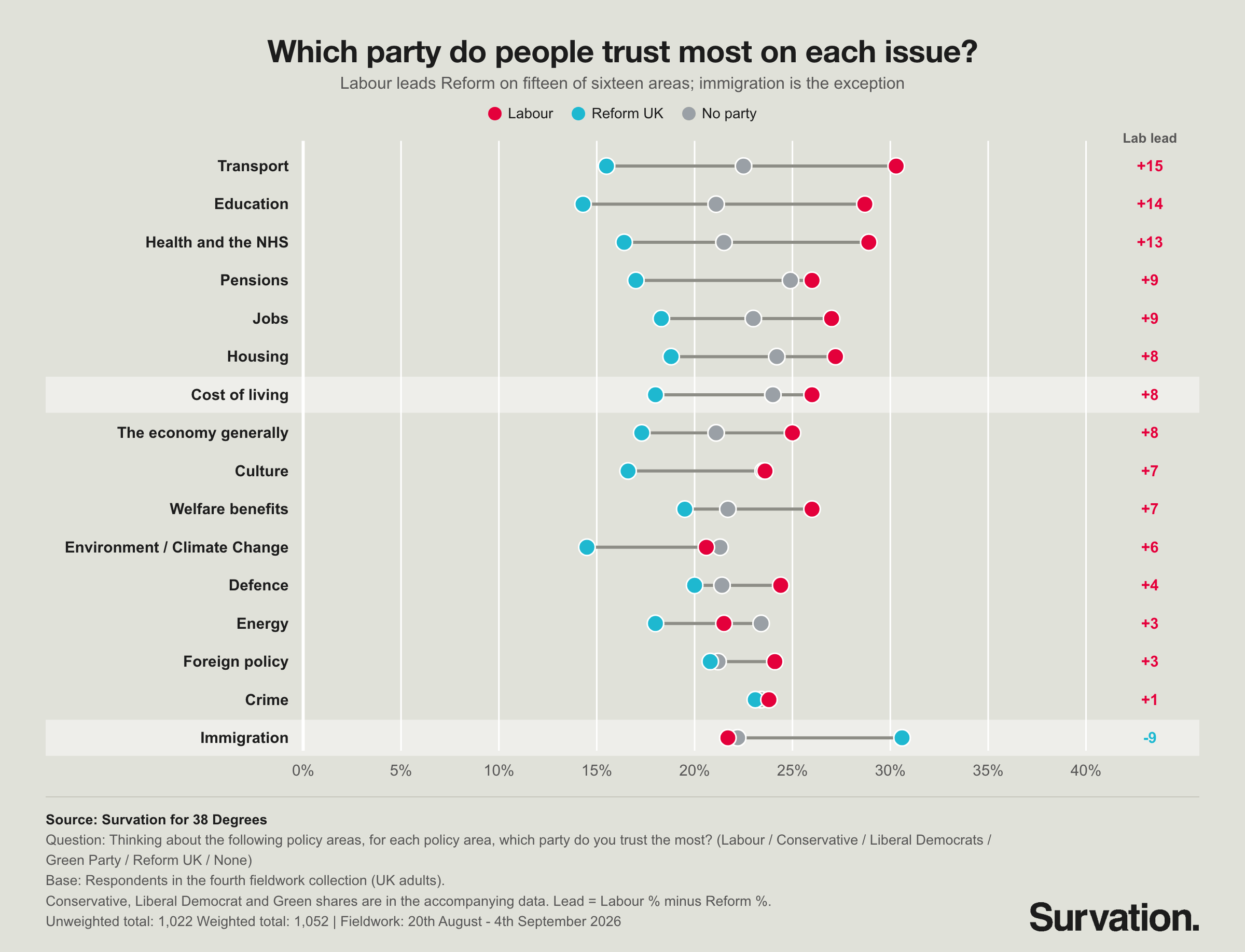
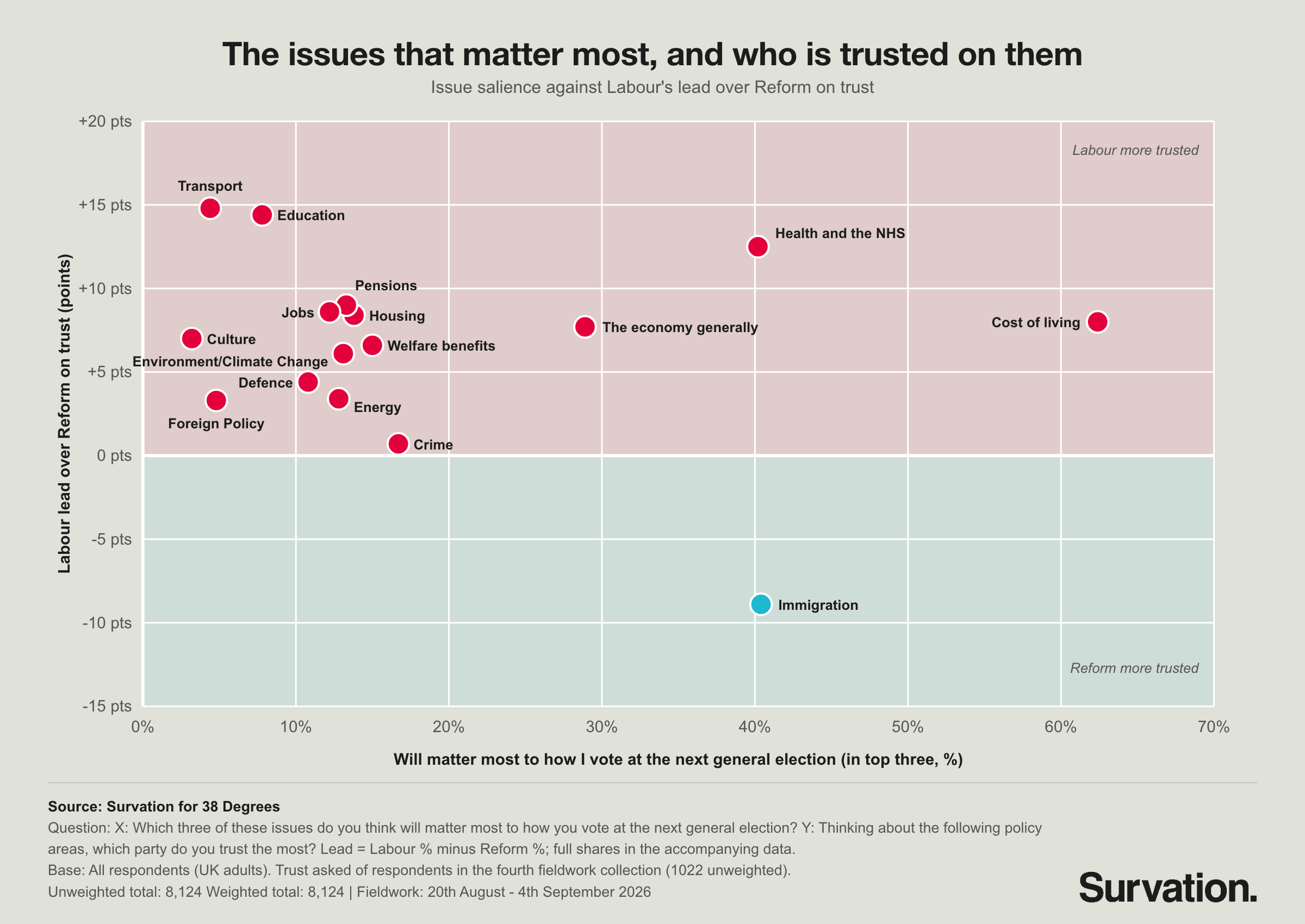
This lead is narrow, though. Labour’s score on any single area is around a third of voters, and between a fifth and a quarter of people name no party at all on every issue. That is less a verdict against Labour than a share of the public still waiting to be convinced, and it is large enough to decide where the advantage ends up. Despite the small lead, the public on average trust Labour more than Reform to deliver on the issues that matter the most to them, and their expectations lie with Labour to make a meaningful change to how they feel:
In our segmentation of the Progressive Majority, created in partnership with 38 Degrees, the 54% of adults who would be more likely than not to vote for one of the progressive parties, tells a similar story. In four of the five Progressive Majority segments, the factor that best separates those open to voting Labour from those who are not is trust in politicians, ahead of all other policy offers we tested.
On a valence issue this is precisely what we would expect. People already agree on what they want, so what separates them is whether they believe it will be delivered, and making Labour be seen as the party most competent on the issues that matter is one of the biggest challenges facing Andy Burnham.
Hope, not grievance is in short supply
It is tempting to conclude that disengaged voters need to be made angrier about a system that has let them down. One of the five Progressive Majority segments, the Struggling Sceptics, suggests otherwise. They make up 17% of the progressive majority and are the worst off of the five, with two thirds of them (67%) feeling worse off than a year ago. On economic questions, they are as far to the left as any group in the country, but they are also the most detached from politics. They rate their trust in politicians at 2.2 out of 10, they don’t tend to vote in elections as much as other segments, and they are the only segment in which “no party” is chosen on more policy areas than Labour.
What sets them apart is lack of hope rather than grievance. Majorities in every segment agree that politicians act in the interests of companies and the super-rich, and close to half of Conservative voters say the same. The difference is whether that grievance becomes a belief that voting achieves anything. More than nine in ten (94%) of the most confident segment say their vote matters in general elections, against just over a quarter (27%) of Struggling Sceptics, which is the widest gap between segments on any topic.
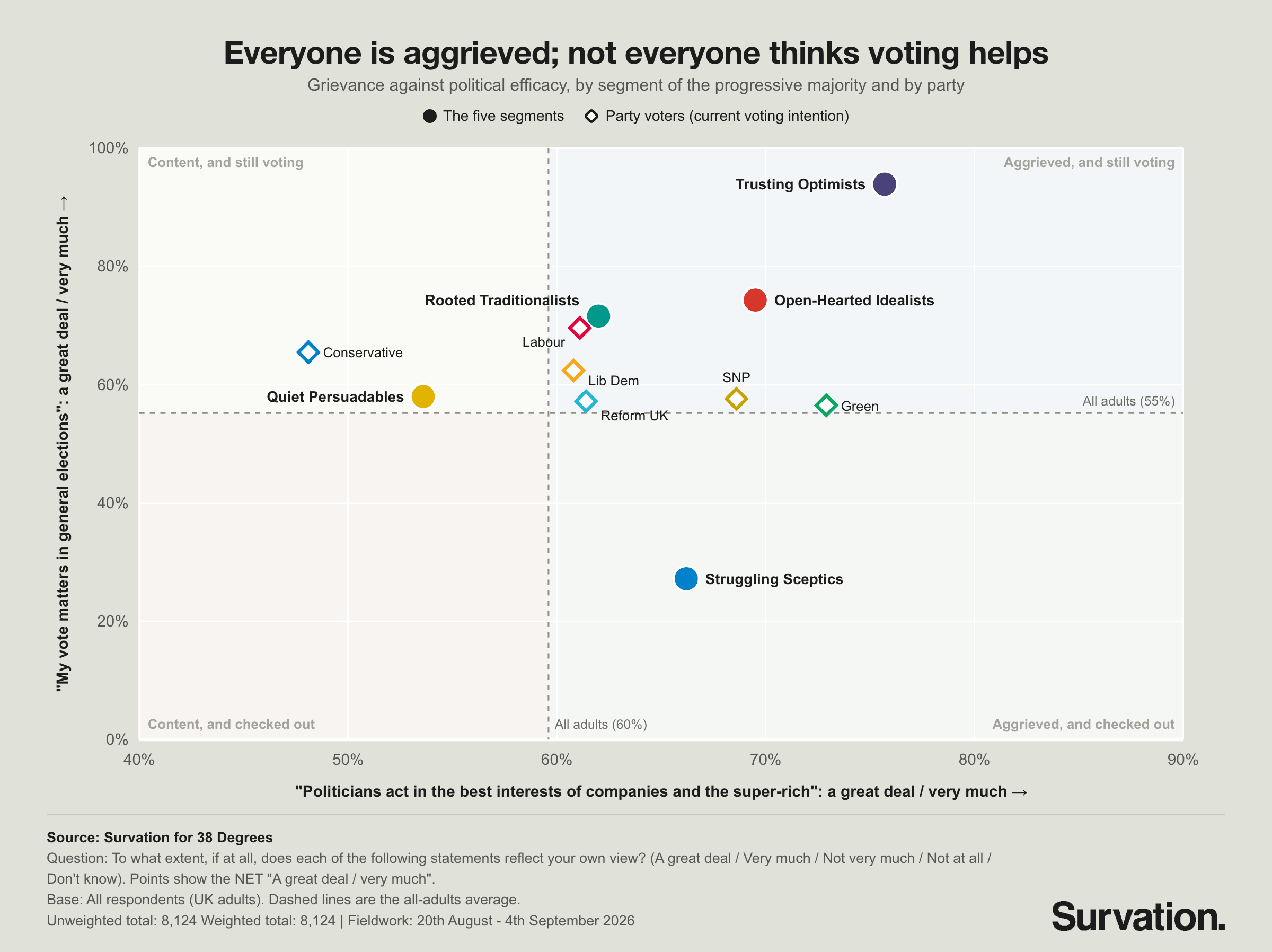
Political scientists call this political efficacy, and it is a different thing from discontent. A voter who trusts another party can be persuaded, while a voter who trusts no party is telling us they do not expect delivery from anyone, and two years of feeling like their finances are not getting any better have given them little reason to change their mind.
Immigration is the biggest source of disunity
Whilst the cost of living is a valence issue, immigration is a clear example of a position issue. It is also the only issue for which the public trusts Labour less than Reform to address.
For most issues, more people say they are personally affected than say it will decide their vote, but immigration runs the other way. Around a third (32%) say it has a major personal impact on them, while four in ten (40%) say it will be among the issues that decide how they vote. That 8-point gap is the largest of all issues, as we can see below:
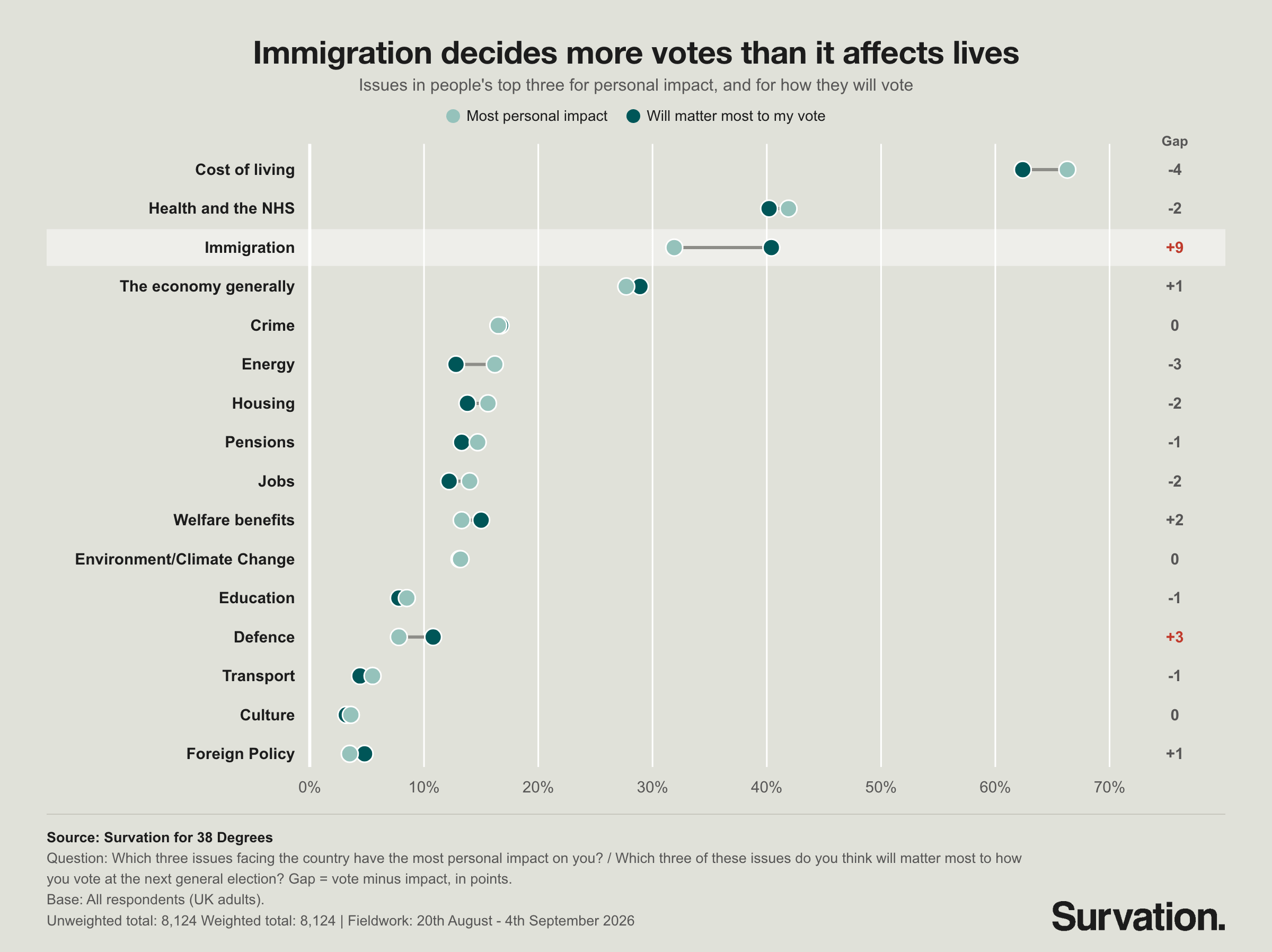
What this means is that immigration is working mainly as a judgement about the state of the country rather than about people’s own lives. It is clear that economic issues are those which unify voters across the whole country, while social issues are the key divider.
It is also where those who fall in the Progressive Majority are most divided. On the cost of living, the five segments differ only in how strongly they feel. On immigration, they take opposite sides, and they care about it to very different degrees. The most liberal segment takes the pro-immigration position on 95% of the statements we asked, but only 11% name immigration as a vote-deciding issue. The most restrictive segment within the coalition answers that immigration is good across four measures 12% of the time but 48% of them name it as an important issue to them. For contrast, Reform voters are only slightly more restrictive (15% positivity towards immigration across the four measures), but it forms a top voting issue for 75% of them.
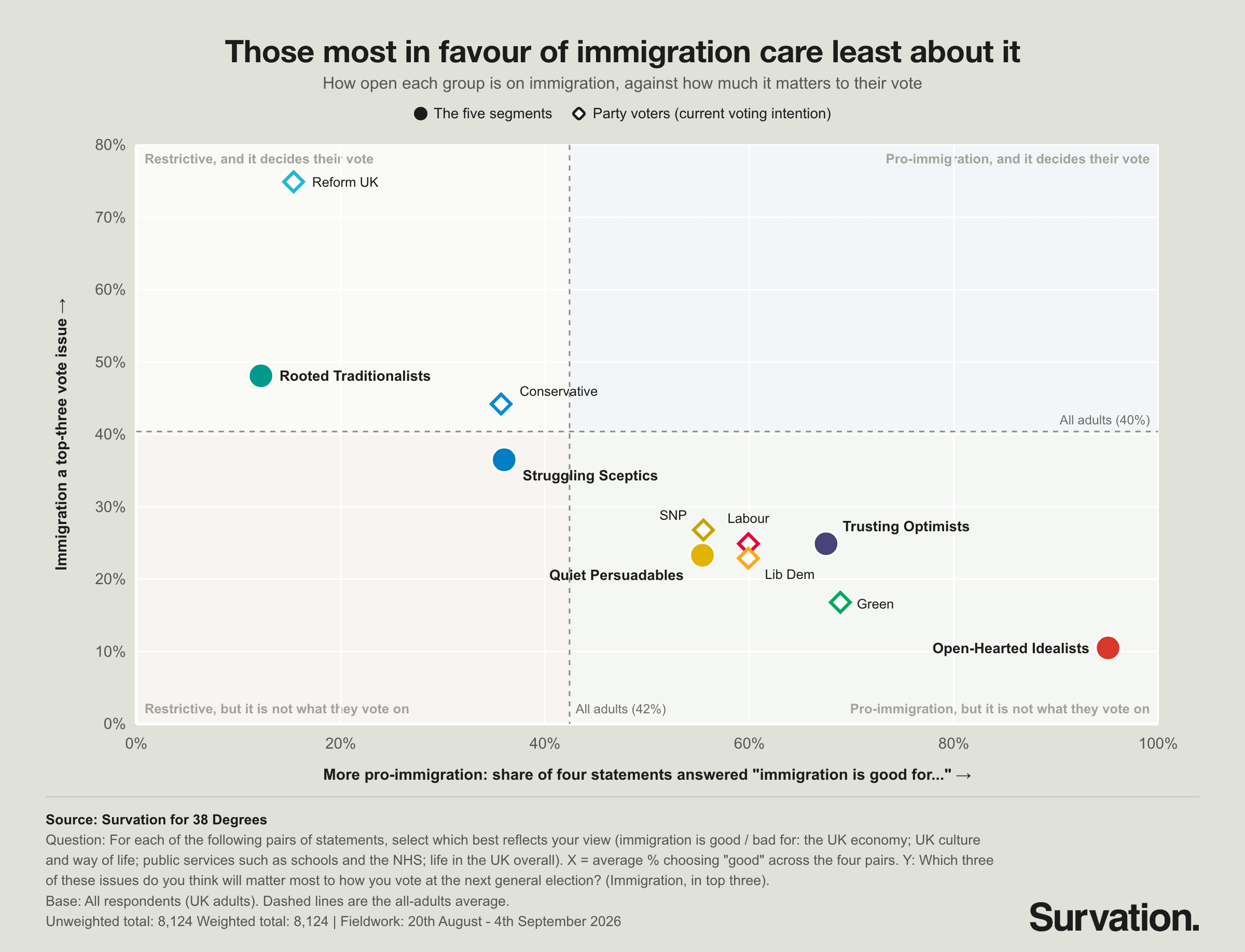
This leads to a clear dichotomy between voters: there are two camps which sit on opposite sides of the issue, but the extent to which it matters to them is vastly different, and there is no simple way to appeal to voters on this issue given that they want different things, and that the party in government is not, and never has been, trusted enough to deliver on it. This, however, doesn’t mean that the issue should be ignored as a whole, but instead, that the expectations from the government are pointed in a different direction.
Labour’s narrow path to a second term
In 2024 the public voted for change while telling Survation they doubted it would come, and for most of the two years since, its doubts have largely been proven right. Andy Burnham came to power on a platform of restoring hope, while promising change at a lightning speed. As it currently stands, Labour, albeit narrowly, holds the advantage on the issue that unites the country, and Reform holds it on the issue that divides it. Which of the two the next election is fought on matters more than any single policy, and the way to keep the contest on the cost of living and delivery people can feel.
________________________________________
Get the data
Survation conducted a multilevel regression and post-stratification (MRP) model of Westminster voting intention on behalf of 38 Degrees, based on a poll of 8,124 adults living in the UK. Fieldwork was conducted between 20th August 2026 – 4th September 2026. Data tables can be downloaded here and MRP estimates for voting intention can be downloaded here.
________________________________________
If you are interested in commissioning a poll or MRP or to learn more about Survation’s research capabilities, please contact John Gibb on 020 3818 9661, email researchteam@survation.com or visit our services page.
For press enquiries, please call 0203 818 9661 or email media@survation.com
Survation. is an MRS company partner, a member of the British Polling Council and abides by their rules. To find out more about Survation’s services, and how you can conduct a telephone or online poll for your research needs, please visit our services page.
< Back